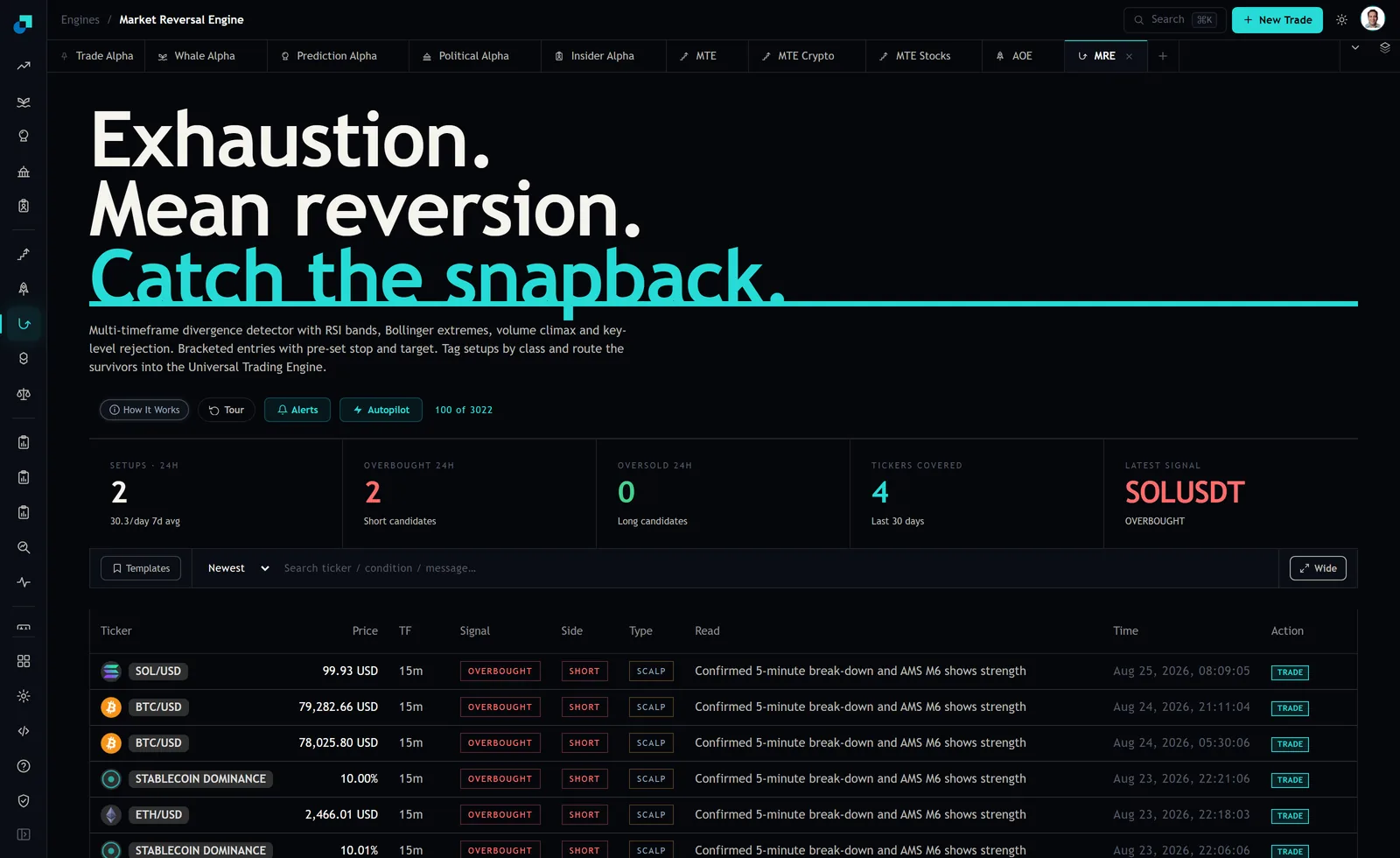
Read the Read column on any row in the MRE feed and the reason the signal feels late is written out for you. Every visible row in the capture says the same thing: the break-down was confirmed on the five minute chart before the fifteen minute setup printed. The engine is not slow. It is waiting on purpose, and it is telling you exactly what it waited for.
The complaint that follows is always the same. By the time the row appears, the move has already started, and you could have been in earlier. Both halves of that are true. The question is whether being in earlier would have made you money, and that question has an answer you can work out on the back of an envelope.
Where the lag actually comes from
There are three possible sources of delay and only one of them is real here.
The first is platform latency. MRE scoring updates on every supported timeframe close and new signals are surfaced in the live feed within seconds of computation, then pushed out by email and to Discord and Telegram. Seconds is not what you are feeling when a setup looks late.
The second is your own. The top row in the capture is stamped Aug 24 2026 at 21:11:04. If you sit down and open the dashboard the next morning, the delay is twelve hours and it belongs to you, not the engine. That is a real problem and it is a scheduling problem, not a signal problem.
The third is the confirmation itself, and this is the structural one. The engine will not call a fifteen minute reversal until a five minute break has confirmed. That is a full lower-timeframe bar of price movement, which happens before the row exists and cannot be recovered by any amount of sitting at your desk. It is the cost of the method, and it is paid on every single signal you take.
Pricing the bar you give up
Put numbers on it with the prices from the capture. BTC/USD was quoted at 79,282.66 when the top setup fired. Suppose a five minute bar in a fast tape travels three tenths of a percent, which on that price is about 238 dollars a coin. On a 2,000 dollar position, three tenths of a percent is 6 dollars. That is the toll, and you pay it whether the trade works or not.
Now price the thing it buys. A false start is a setup that triggers and immediately fails, so on a bracketed entry it costs you the stop. Say the stop sits six tenths of a percent away, which on the same 2,000 dollar position is 12 dollars, plus your fees on both sides.
The comparison is straightforward. You pay 6 dollars on every trade you take. You save 12 dollars plus fees on every false start you never enter. So the confirmation pays for itself if it removes more than roughly one false start in two. Below that it is overpriced, above that it is cheap.
Notice what happens when you change the inputs. If the stop on a class is much wider than the confirmation bar, the toll shrinks relative to what it saves and confirmation looks better. If the stop is very tight, the toll is a large fraction of the risk and confirmation looks worse. So the answer legitimately differs between a scalp-class setup and a wider one, and anyone telling you confirmation is always good or always bad has not done this division.
The number I cannot hand you
Here is the honest part. I do not know what fraction of false starts the confirmation removes on your instruments at your venue, and nobody else does either, because it is not observable from the outside.
The reason is structural. The archive of setups contains signals that confirmed. The ones that triggered on the five minute chart and then failed to confirm never became rows, so they are not in the record you can see. That means the entire comparison group is missing from the data the dashboard shows you, which is exactly why this argument goes round in circles on forums and never resolves.
What that leaves you with is your own account. It is a smaller sample than you would like and it is the only sample that is actually about your fills, your fees and your instruments.
The chart illusion that makes it feel worse
One more thing worth naming, because it drives more bad decisions than the arithmetic does.
On a completed chart, the reversal bar is obvious. It sits there with a long wick and a clean rejection and it is impossible not to see. In real time that bar is a bar that has not closed yet, and it looks identical to the dozens of bars that went on to do nothing. The confidence you feel looking backwards at the signal you could have taken early is manufactured by knowing how it ended.
The practical form of this illusion is a habit: you start taking the unconfirmed break yourself, on your own read, and comparing it to the confirmed signal you would have got. It feels like an edge because you remember the times it worked. If you are going to do it, do it with a record, which is the next section, because memory is a terrible instrument for this specific measurement.
A two week test that settles it for your account
This is small enough to actually finish and it produces a number you can act on.
- Every time you spot the unconfirmed condition yourself, write down the instrument, the time, the side, and the price right then. That is your early entry. Do not trade it. The record is the point.
- When and if the confirmed row appears, write down the price at that moment. The gap between those two prices is your toll, in dollars per unit, for that instrument.
- Keep the ones that never confirmed. Those are the whole reason for the exercise, and they are the rows the dashboard will never show you.
- After two weeks, take the average toll across everything that confirmed, and count what fraction of your early entries would have hit the stop before a confirmed signal ever arrived.
- Compare that fraction against the break-even from the second section. If your early entries fail more often than roughly one in two, take the confirmed signal and stop arguing with it.
Ten to twenty observations will not be statistically decisive and I am not going to pretend otherwise. What it will do is replace a feeling with a rough number, and rough numbers beat feelings by a wide margin in this specific decision. Most people who run it discover their early entries fail far more often than they remember, because the failures are the ones that resolve in three minutes and never make it into the story you tell yourself about the day.
If you finish the two weeks and the toll turns out to be small relative to your stops, there is a legitimate conclusion available: the confirmation is cheap on your setup and you should take every confirmed row as shipped rather than trying to anticipate it. That is a boring answer and it is the one that leaves the most money in the account.