The diversification pitch for crypto is usually delivered as a single number. Correlation to equities is near zero, therefore a small allocation improves the efficient frontier, therefore approve the sleeve. Every allocator has heard it and most have approved something on the strength of it. The number is generally accurate. The argument built on it is not, because it answers a question nobody is exposed to.
What a portfolio is exposed to is contribution to loss when the rest of the book is losing. Correlation is an unconditional, unscaled, single horizon statistic. It says nothing about magnitude, nothing about the state that matters, and nothing about the holding period the mandate actually runs on. A due diligence pack that clears those three gaps is a different document from a slide with a correlation on it, and this is what belongs in it.
What the correlations panel contributes
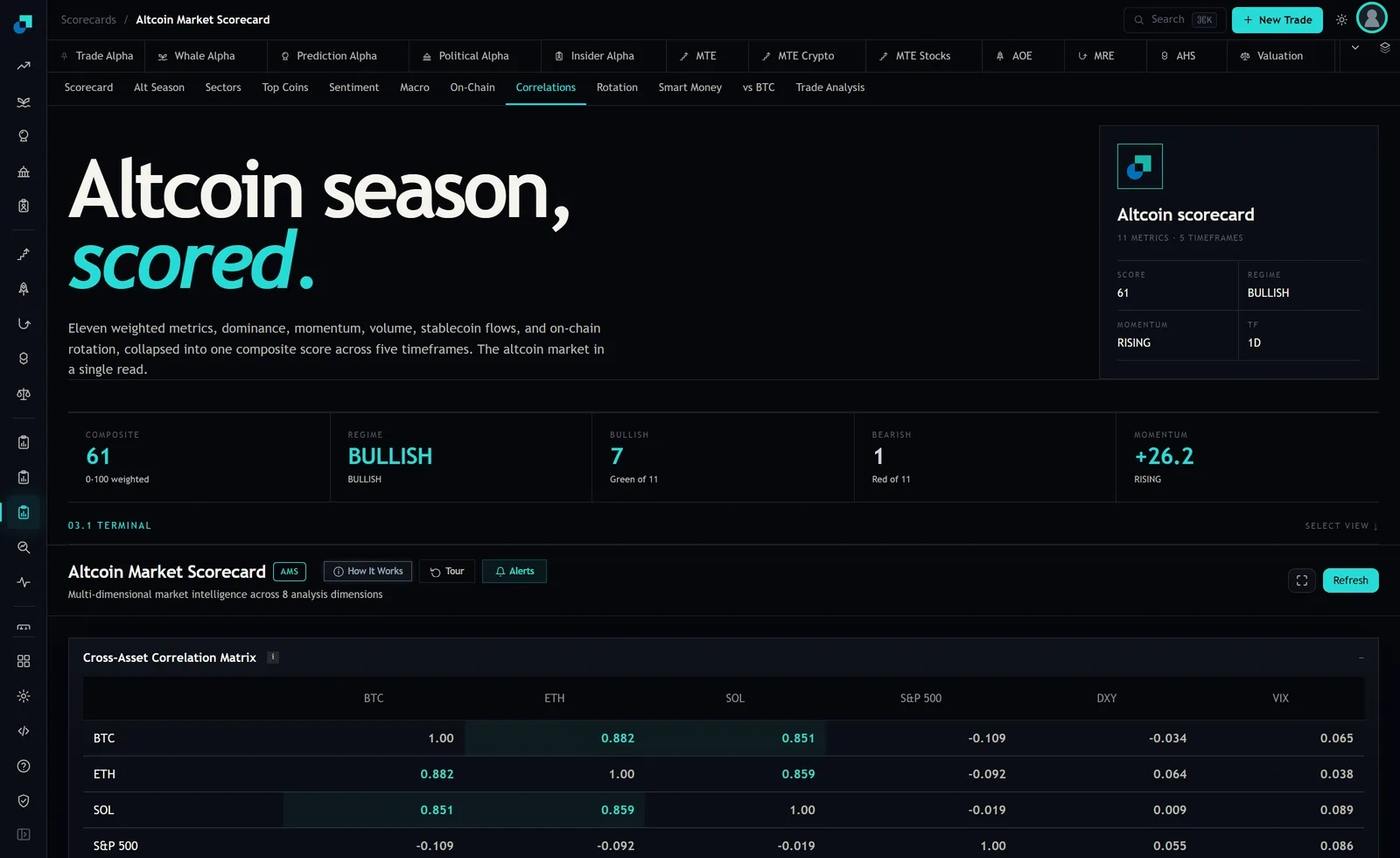
The Correlations tab of the altcoin scorecard prints a Cross-Asset Correlation Matrix over BTC, ETH, SOL, S&P 500, DXY and VIX. The crypto to equity cells read minus 0.109 for BTC, minus 0.092 for ETH and minus 0.019 for SOL. Against DXY they read minus 0.034, 0.064 and 0.009. Against VIX, 0.065, 0.038 and 0.089.
That is a useful screen and a legitimate starting point. It is also everything the panel can contribute to this question. The window is not stated on the surface, there is no conditional or stress basis visible, no beta, no horizon variation, and no history of the series. I am not going to imply otherwise. What follows is the work that turns a screen into evidence, and it happens on your side.
One reading is worth flagging while you are on the panel. S&P 500 against VIX prints at 0.086. Over most windows that pair is strongly negative, so a near-zero reading is a prompt to establish the lookback and frequency before treating any cell here as characteristic rather than episodic.
Item one, beta through pre-registered stress windows
Replace correlation with beta and the conversation changes immediately, because beta carries the volatility ratio that correlation strips out.
The arithmetic is worth spelling out for the committee. An asset with a correlation of 0.2 to equities but four times the equity volatility has a beta of 0.8. A five percent allocation to it therefore behaves, in variance contribution terms, more like a twenty percent allocation to something equity-like. The correlation slide implied a rounding error. The beta says the sleeve is a material equity position in disguise. Both statements come from the same data.
Then compute that beta inside stress windows rather than across the full sample. The critical discipline is how the windows get chosen. Selecting them by hand invites hindsight, and an allocator will say so. Define them by rule, in advance, from an external series. The worst five percent of monthly returns in the policy benchmark is a defensible rule. So is any published drawdown threshold applied mechanically. Write the rule in the pack, apply it without exception, and report the count of windows it produced.
Report three betas on one line. Full sample, stress windows, and the difference. If the stress beta is materially higher than the full-sample beta, the diversification claim is conditional on nothing going wrong, which is the opposite of what diversification is for.
Item two, the periods where the claim visibly failed
Any pack that presents only supporting evidence gets discounted to zero by a serious allocator, and correctly so. Include the failures, and include them before you are asked.
The rule-based window selection above does most of this work for you, because it will surface the episodes regardless of whether they flatter the thesis. For each window, report the crypto sleeve's return, the benchmark's return, and one sentence on the mechanism. Mechanism matters more than magnitude here. Crypto falling alongside equities because both are risk assets repricing on the same macro news is a different failure from crypto falling because leverage inside the crypto system unwound. The first says the diversification claim is weak in that state. The second says the sleeve carries a funding and infrastructure exposure the equity book does not have, which is a separate line item in the risk register.
The second category deserves particular attention because it is invisible in a correlation matrix. Venue failures, custodian failures, stablecoin dislocations and forced deleveraging in crypto lending are exposures with no equity analogue. They can produce losses uncorrelated with equities, which technically supports the diversification claim while being a poor reason to feel good.
Item three, the horizon the claim holds over
Correlation is horizon dependent, and the horizon on the slide is almost always daily while the horizon in the mandate is almost never daily.
Compute the same relationship at daily, weekly, monthly and quarterly frequency and report all four. If the near-zero reading is a daily phenomenon that strengthens as you lengthen the horizon, the sleeve is a diversifier for a trading book and not for a pension. That single table has ended more allocation discussions in my experience than any amount of argument about the asset class.
Two mechanical points to get right. Non-synchronous pricing biases short-horizon cross-asset correlations toward zero, since crypto trades through the equity close, so use a common daily cut and say which one. And the number of independent observations falls fast as the horizon extends, so a quarterly estimate over a short history is a wide band rather than a point. Report the observation counts alongside the estimates so nobody mistakes precision for evidence.
Item four, what the allocation actually costs to hold
The last section of the pack is the one most likely to be missing and the one that decides implementation.
State capacity in dollars, derived from realistic participation in observed volume, for both entry and exit. State the round trip cost at the size contemplated, in basis points, including the spread you would actually cross rather than the mid. State the custody arrangement and the counterparty concentration it creates. State the operational tail explicitly, because an asset whose worst case includes a custodian failure is not comparable to one whose worst case is a price move, and the committee is entitled to see those risks named rather than folded into a volatility figure.
Then close the loop back to sizing. The honest form of the diversification claim is not that crypto diversifies. It is that at weight w, computed at horizon h, with stress beta b, the sleeve reduces portfolio risk per unit of expected return, and here are the states in which that fails. A claim in that form can be tested next year against what happened. A correlation on a slide cannot, which is why it keeps getting approved and keeps getting relitigated after every drawdown.