Three definitions of alt season circulate, people argue about which is correct, and the argument misses the more useful observation. Two of the three are constructed so that they can only confirm alt season after the outperformance they are testing for has already happened. They are not wrong. They are reports, not forecasts, and using a report to decide whether to enter is how you end up buying the last third of a move.
Here are the three, what each one actually measures, and the one family of measures that is not circular along with the price you pay for using it.
Definition one, the breadth test
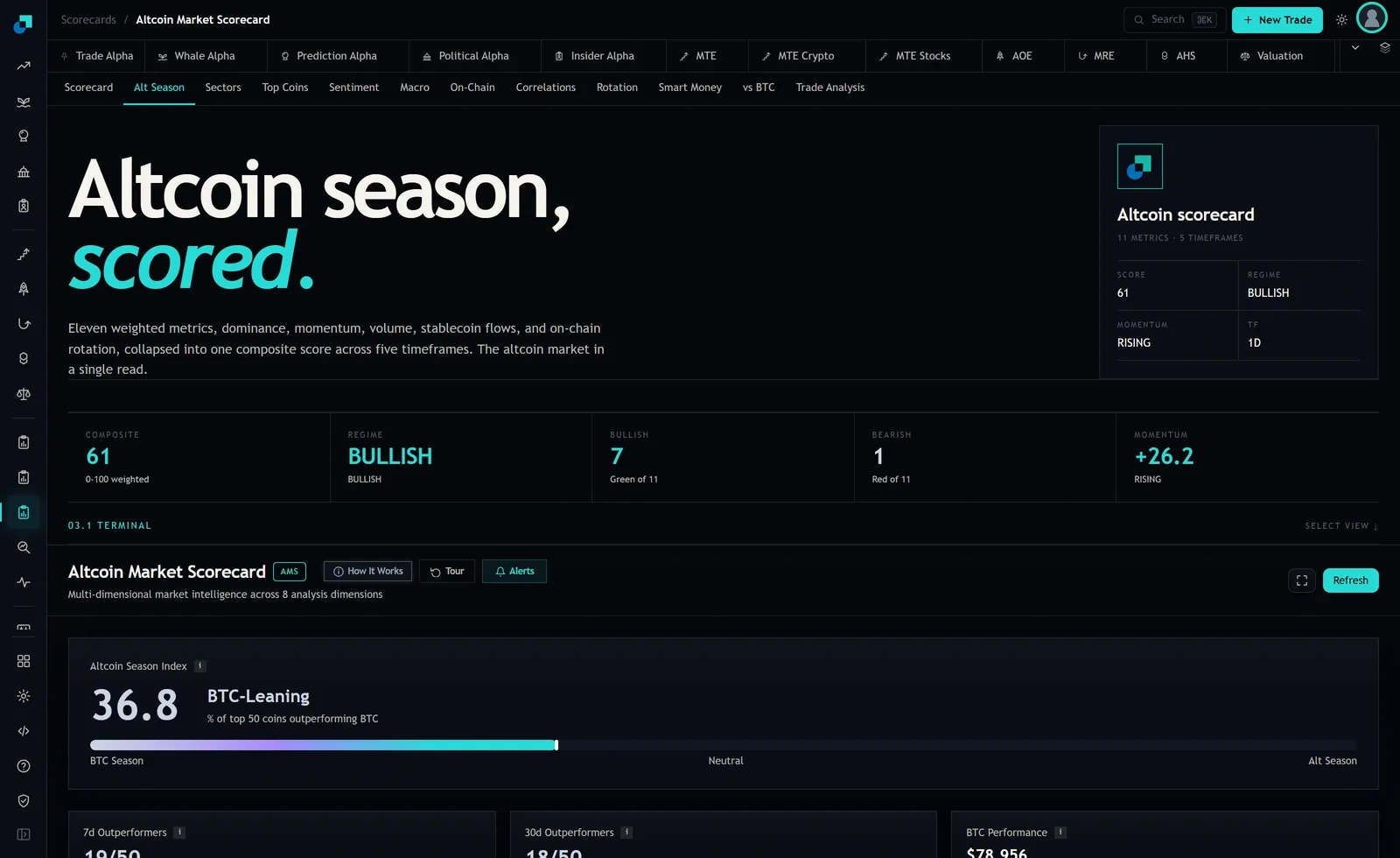
The cleanest of the three, and the one the scorecard implements. The Alt Season Index measures the percentage of the top 50 altcoins outperforming Bitcoin. Count how many beat Bitcoin over a lookback window, divide by the universe, and you have a number.
The virtue of this definition is that it is honest about what it is. It says outright that it is counting outperformance that has occurred. If sixty percent of the top 50 have beaten Bitcoin over the last month, then that is a fact about last month. It contains no claim about next month, and nobody constructing it pretended otherwise.
The circularity is structural rather than sneaky. The thing you want to know is whether altcoins are about to outperform. The thing this measures is whether they have. Those coincide only to the extent that outperformance persists, which it sometimes does and sometimes very much does not, particularly near the end of a run when breadth is at its highest and the marginal buyer has already bought.
Definition two, the dominance threshold, which is the same fact wearing a hat
The second definition says alt season has begun when Bitcoin dominance falls below some level. Dominance is Bitcoin's market capitalisation divided by the total market capitalisation, and it is one of the eleven metrics inside the composite, so it is a perfectly reasonable input. As a standalone definition it is the most circular of the three, and the arithmetic shows why.
Take a market where Bitcoin is worth 1.2 trillion and everything else together is worth 0.8 trillion. Total is 2.0 trillion, so dominance is 60 percent. Now suppose alts rally 40 percent while Bitcoin does not move. Alts are now worth 1.12 trillion, the total is 2.32 trillion, and dominance has fallen to about 51.7 percent.
Look at what that eight-point fall in dominance is. It is not a signal that alts are about to move. It is a restatement, in ratio form, of a 40 percent alt rally that has already been paid out to whoever was holding. Dominance did not fall and then alts rallied. Alts rallied, and dominance falling is the arithmetic consequence. Waiting for a dominance threshold before buying alts means waiting until the move has happened by definition, then buying.
There is a second problem worth knowing about. Dominance is a ratio with two moving sides, so it also falls when Bitcoin drops harder than alts do. A dominance threshold can be crossed in a market where everything is falling and alts are merely falling less. That is not a season, and a definition that cannot distinguish the two cases is not a definition you should size positions on.
Definition three, the index cutoff, which is doubly late
The third takes the breadth statistic from definition one and puts a threshold on it. Call it alt season when a large majority of the top 50, three quarters is the sort of level people use, have beaten Bitcoin over a rolling window of roughly a quarter.
This inherits everything from definition one and adds a second lag. It needs the outperformance to have happened, and then it needs enough of the window to have elapsed for the count to cross the cutoff. On a ninety-day lookback, a move that begins in March is not going to push the reading through a three-quarters threshold until well into the move, because the earlier weeks in the window still contain the period when alts were lagging.
Then the same mechanism works against you at the exit. The window keeps the strong weeks in the count long after the market has turned, so the cutoff stays satisfied while the move is unwinding. A binary flag built this way turns on late and off late, and the late-off is the expensive half.
The family that is not circular, and what it costs
If outcome measures are backward looking, the non-circular alternatives are the ones measuring conditions rather than results. Several of them sit inside the same composite. Funding rates and open interest describe what leverage is doing. Stablecoin flows and exchange reserves describe where spendable capital is sitting and whether coin is moving onto venues or off them. None of these is a return, so none of them is guaranteed to have already paid out by the time you read it.
The price is accuracy. Positioning and flow measures are noisier, they generate more false starts, and they are wrong more often in isolation than a breadth reading is. Stablecoins can accumulate on exchanges for weeks and then buy nothing at all. That is precisely why a composite blends the conditions metrics with the outcome metrics rather than choosing between them, and why the header of the scorecard showed a composite of 61 with a regime of BULLISH and momentum RISING rather than a single input dressed up as a verdict.
The practical version for a small account is a division of labour. Conditions measures inform whether you are willing to take a position at all. Breadth measures inform what you do with a position you already hold.
What a lagging definition is genuinely good for
None of this makes the breadth reading useless. It makes it useful for a different job than the one people give it.
The first job is confirmation for a position you are already in. If you bought before the breadth number moved and it subsequently rises, that is evidence that the move broadened beyond whatever you happened to own, which is a reasonable input into whether to let a winner run rather than trimming it early.
The second job is exit discipline, and this is where a lagging measure earns its keep. High breadth means most of the top 50 have already outperformed, which means the pool of altcoins that have not yet moved is small. That is a description of a late-stage market, and it is a sensible trigger for taking partial profits or tightening a stop, precisely because the definition only reads high after the money has been made.
So use the breadth reading to decide how much longer you keep something, and never to decide whether to start something. If your entry rule is waiting for the alt season flag, your rule is asking a measure that reports the past to tell you about the future, and it will answer confidently every time.