The alt sleeve is the position most investment committees relitigate more than any other, because the case for it changes weekly and nobody wrote down in advance what would make them change their minds. Someone brings a view, someone else brings a chart, the sleeve moves by whatever the room could agree on that afternoon, and two quarters later nobody can reconstruct why the weight is where it is. The fix is not a better view. It is a table, written when nothing is happening, that maps a regime reading to a pre-committed exposure so that changing the sleeve is execution rather than a fresh argument.
A composite score is a decent thing to hang that table on, because it produces exactly one number in a fixed range and it produces it whether or not anyone feels strongly. What follows is how I would write the policy around Blockcircle's Altcoin Market Scorecard, what the score can carry, and the three clauses that decide whether the policy survives its first stressful week.
What the composite is before you write policy about it
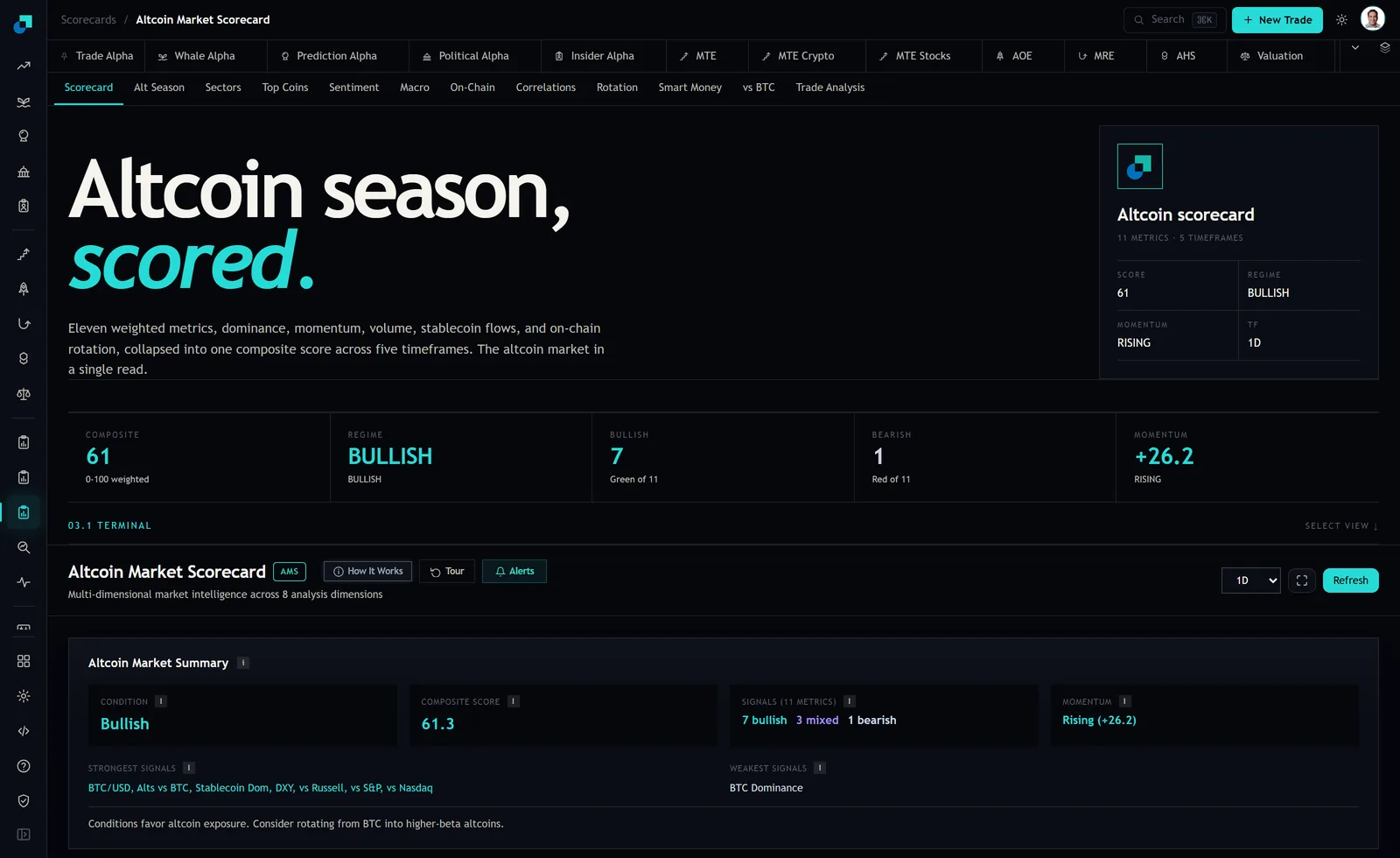
The scorecard collapses eleven weighted market metrics into one 0-100 composite and offers it across five timeframes. The eleven are named in the module itself: BTC Dominance, USDT Dominance, Altcoin Volume Ratio, Funding Rates, Open Interest, Stablecoin Flows, Exchange Reserves, Large Transaction Volume, NVT Ratio, MVRV Z-Score, and Realized Cap Changes. At the time of writing the header read a composite of 61 with a regime label of BULLISH, momentum RISING, on the 1D timeframe.
Read that list of inputs before you write a single clause, because it tells you what kind of statement the number is. Two are dominance ratios. Two are derivatives positioning. Four are flow and liquidity measures. Three are on-chain valuation ratios. What is almost absent is price momentum as such. That makes the composite a statement about market conditions, not a return forecast, and the policy language has to match. You are writing an exposure band, not a target return, and any committee member who reads the table as a forecast will eventually be disappointed on the record.
The band table, and the numbers on it that are yours
Five bands is the right granularity for a committee. Three is too coarse to be worth automating and ten gives you a rebalance every fortnight. Set a policy maximum for the alt sleeve first, entirely separately from the score, because the maximum is a mandate question and the score has nothing to say about it. Suppose that maximum is 8 percent of NAV.
| Composite band | Share of policy maximum | Sleeve weight at an 8 percent cap |
|---|---|---|
| 0 to 20 | 0 percent | 0.0 percent of NAV |
| 20 to 40 | 25 percent | 2.0 percent of NAV |
| 40 to 60 | 50 percent | 4.0 percent of NAV |
| 60 to 80 | 75 percent | 6.0 percent of NAV |
| 80 to 100 | 100 percent | 8.0 percent of NAV |
The reading of 61 in the screenshot lands in the fourth band, which implies 6 percent of NAV. Notice what just happened. The committee did not decide anything today. It decided months ago, in the abstract, and the only judgement exercised this morning was reading a number off a panel. That is the entire point of the exercise, and it is also why the table has to be argued over properly once, because you are pre-committing to obey it when it says something uncomfortable.
The obvious alternative is a continuous mapping, weight equals maximum times score over 100, which is elegant and which I would not use. A continuous mapping rebalances on every tick of the composite, and most ticks of an eleven-metric blend are noise in one or two inputs. Bands convert a noisy continuous signal into a small number of discrete states, and discrete states are what a trading desk and a compliance file can both work with.
The hysteresis clause that stops the table from trading you
A band table without a buffer is a machine for generating turnover at band edges. The composite in the screenshot sits at 61, one point above a boundary. Under a naive rule, a single point of drift moves 2 percent of the fund.
Two clauses fix this. First, a band change requires the composite to move beyond the boundary by a margin, not merely to cross it. Three points on a 0-100 scale is a reasonable margin and it is defensible on the grounds that a single input moving within its normal range can shift the blend by about that much. Second, the new reading has to persist for a minimum number of consecutive captures, five is a sensible default on a daily capture, before the trade is authorised. The sleeve moves on the fifth day, not the first.
The cost of the buffer is that you are late by construction, and you should quantify how late rather than argue about it. The cost of not having it is turnover. Each band step here moves 2 percent of NAV. On a 400 million dollar fund that is 8 million dollars of alt exposure, and at 25 basis points of all-in transaction cost you are spending about 20,000 dollars per step. Four unnecessary round trips a year is 160,000 dollars, roughly 4 basis points of the fund, spent achieving nothing. That is small enough that people wave it away and large enough that it shows up in a three-year attribution as an unexplained drag.
Naming the timeframe, so nobody shops for one
The scorecard offers five timeframes and the screenshot was taken on 1D. If the policy does not name one, you have not removed discretion, you have relocated it. A manager who wants more alt exposure will find the timeframe that gives it, and the manager will be right on the facts every time, because one of the five will always be the most favourable.
The clause needs four things in it. The module and tab. The timeframe, stated explicitly. The capture time, stated as a wall-clock time in a named zone, because a crypto composite at 09:00 London and at 21:00 London are different observations. And the named role responsible for capturing it, which is a role and not a person, so the policy survives someone leaving. Everything else in the module, the sector heatmaps, the correlations, the rotation view, is legitimate context for a committee discussion and is explicitly not binding. Say that in the document, or someone will eventually claim it was.
The clauses nobody writes until the day they need them
Three more, all of which come from things going wrong rather than from theory.
- Stale or unavailable data. If the capture cannot be taken, or the reading is older than a stated number of hours, the previous band persists and no rebalance is authorised. Log the gap. The failure mode you are preventing is a desk treating a missing reading as a signal, or worse, backfilling it later from a restated value.
- Inception and mandate changes. When the policy starts, the sleeve moves to the band implied by that day's reading over a stated number of trading days, rather than in one print. New money follows the same rule. Without this clause the first trade under the policy is the largest one you will ever do under it.
- The liquidity interaction, which is the one that matters most. The band gives you a target weight. Your capacity in the underlying alt universe gives you a different number. The binding weight is the smaller of the two, and it has to be written that way, because the composite reading a high number and your exit being thin are not independent events. The market that pushes the score to 90 is the same market where everyone else is positioned the way you are, and where the depth per unit of your book is at its worst. A policy that lets the band alone size the sleeve will put its largest position on precisely when it is hardest to reverse.