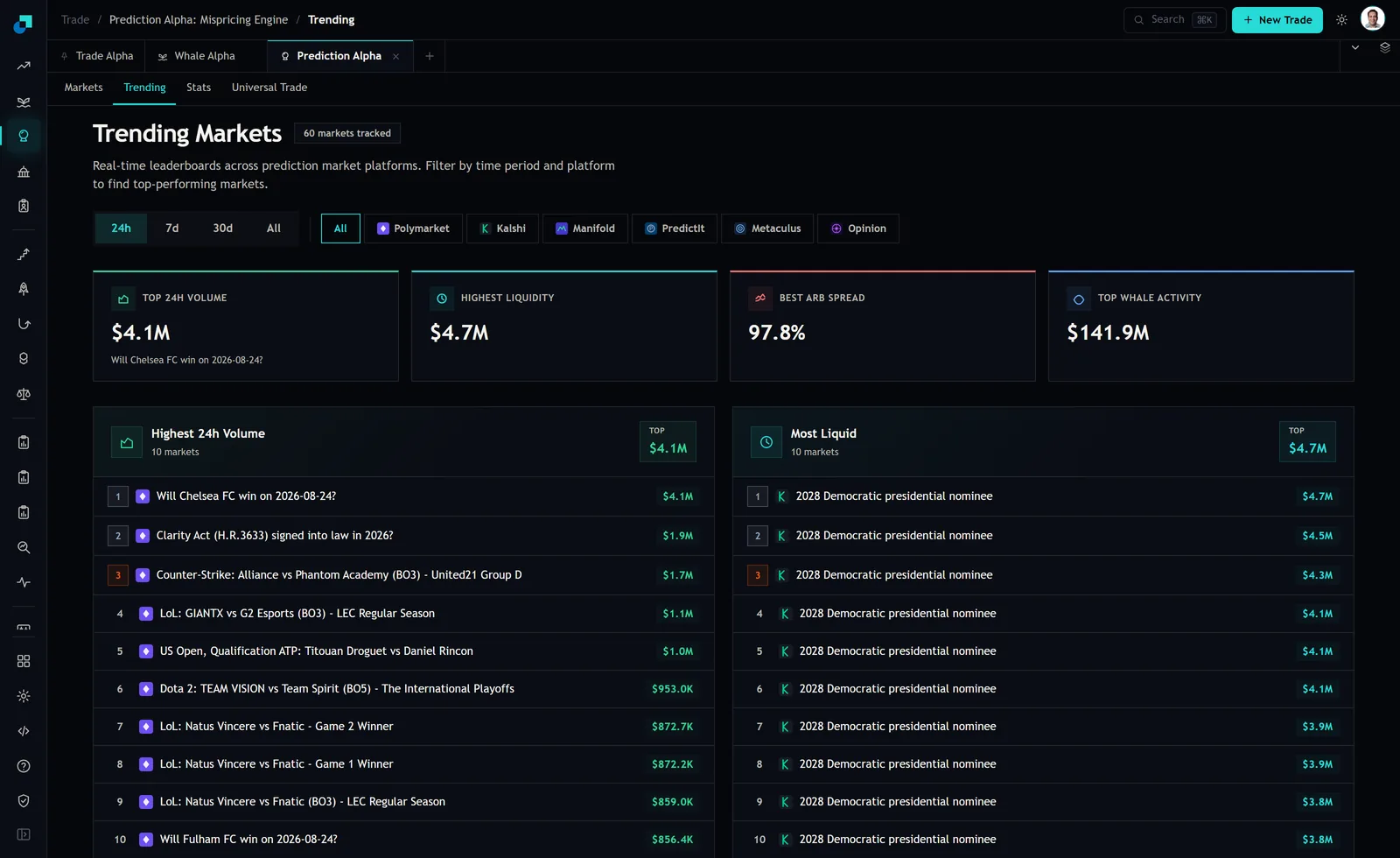
The trending page on Prediction Alpha puts four tiles across the top. Top 24h volume at $4.1M, highest liquidity at $4.7M, top whale activity at $141.9M, and the one that gets clicked, best arb spread, reading 97.8 percent.
Work out what that would mean if it were tradable. A 97.8 point gap between two venues on the same question means one of them prices the outcome at roughly one percent and the other at roughly ninety nine. You buy the cheap Yes for about a cent, buy the cheap No on the other venue for about a cent, and hold a pair that pays exactly one dollar whichever way the world goes. Two cents in, a dollar out, no directional risk. That is a fifty to one riskless return, published on a public dashboard, refreshing live.
Opportunities like that do not survive an afternoon, let alone sit on a leaderboard. So the useful question is not how to trade the 97.8, it is what the number is made of.
The same board shows you how it happens
Scroll down from the tiles and the answer is sitting in the two leaderboards underneath, in plain sight, twice.
On the left, the highest 24-hour volume board carries three separate rows reading Natus Vincere versus Fnatic Game 2 Winner at $872.7K, Natus Vincere versus Fnatic Game 1 Winner at $872.2K, and Natus Vincere versus Fnatic in the best of three at $859.0K. Three contracts, three books, three genuinely different outcomes, and if you compare the question strings they are almost the same sentence. Any matcher working on text similarity will pair them enthusiastically.
On the right, the most liquid board is worse. All ten rows read 2028 Democratic presidential nominee, ranging from $4.7M down to $3.8M. Those are ten different candidates inside one multi-outcome question, each listed under the same title. Compare any two of those titles and you get a perfect match on two contracts that can never both pay.
Neither of those is a flaw in the idea of cross-venue matching. It is just what happens when two venues write questions from templates and something has to decide, without reading, whether two sentences describe the same event. The wider the spread the matcher reports, the more likely it is that the two questions are not the same question, because genuine disagreement of that size between two real money books does not persist.
Check one, read both sets of criteria to the end
This is the check that kills most candidates and it takes about four minutes. Open both contracts on their own venues and read the full resolution rules, not the title. You are looking for five things.
- The source of truth. Two venues resolving the same football result from two different data providers can and do disagree.
- The cutoff time and its timezone. A question resolving at midnight Eastern and one resolving at midnight UTC are five hours apart, which is an eternity on an event contract.
- On a date versus by a date. These read almost identically and behave completely differently.
- What happens to a tie, a void, a postponement or an abandonment. This is where template questions diverge most often and where the fine print is longest.
- Who or what qualifies. Scope clauses about which entities, which competitions or which announcements count are the quiet killer.
If any one of those five differs, you do not have a hedge. You have two positions that will usually move together and will occasionally both lose, and the occasion when they both lose is precisely the ambiguous outcome that made the two venues write different rules in the first place.
Check two, confirm both legs are real money and both can fill
The module covers six venues and they are not the same kind of thing. The coverage list describes them as on-chain permissionless markets, CFTC-regulated US event markets, play-money community markets, academic real-money political markets, a forecasting community with calibrated probabilities, and sports and entertainment markets. Two of those descriptions are not describing a tradable price. A play-money quote is not a fill and a community's calibrated forecast is an opinion with a number attached. A spread measured against either of them is arithmetic, not an opportunity.
Then check depth on both sides for the size you actually want. If you intend $500 a leg, both books need to show that much within a cent or two of the quote. And you need funded accounts at both venues before you start, because by the time a transfer clears the spread has been arbitraged by someone who was already there. That means committing capital to two venues in advance for the privilege of waiting, which is a real cost that never appears in the spread.
Check three, the clock and the calendar
Compare the settlement dates on the two legs. If one resolves in September and the other in January, you are hedged for a few weeks and then you are holding a naked position for four months. The trending tiles will never show you that, because the tile compares prices, not tenors.
Then count the costs the tile also does not know about. A taker fee on each leg, a withdrawal or transfer cost on at least one of them, and the funding cost of capital parked at two venues until the later of the two dates. A two cent apparent edge does not survive that stack. A genuine cross-venue spread has to be wide enough to pay for four separate frictions and still leave something, and it also has to be narrow enough to be believable. That is a smaller window than people expect.
What the tile is actually good for
Treat the best arb spread number as a diagnostic of the matcher rather than as a trade idea. If the widest spread on the board is 97.8 percent, that is telling you the matching is currently loose, and the fix lives on the markets tab, where the Cross Match toggle has a threshold selector sitting next to it, showing 80 percent in the view I am working from. Raising it will cut the count of matched markets and cut the noise with it.
Then invert where you spend your attention. The spreads worth reading are the modest ones, three to six points, on questions where both legs are on real money venues with real books. Those are wide enough to pay for the frictions and narrow enough to be a genuine pricing difference rather than a category error. They are also boring, which is why they last long enough for you to check them properly, and why the top tile on the board will almost never be one of them.