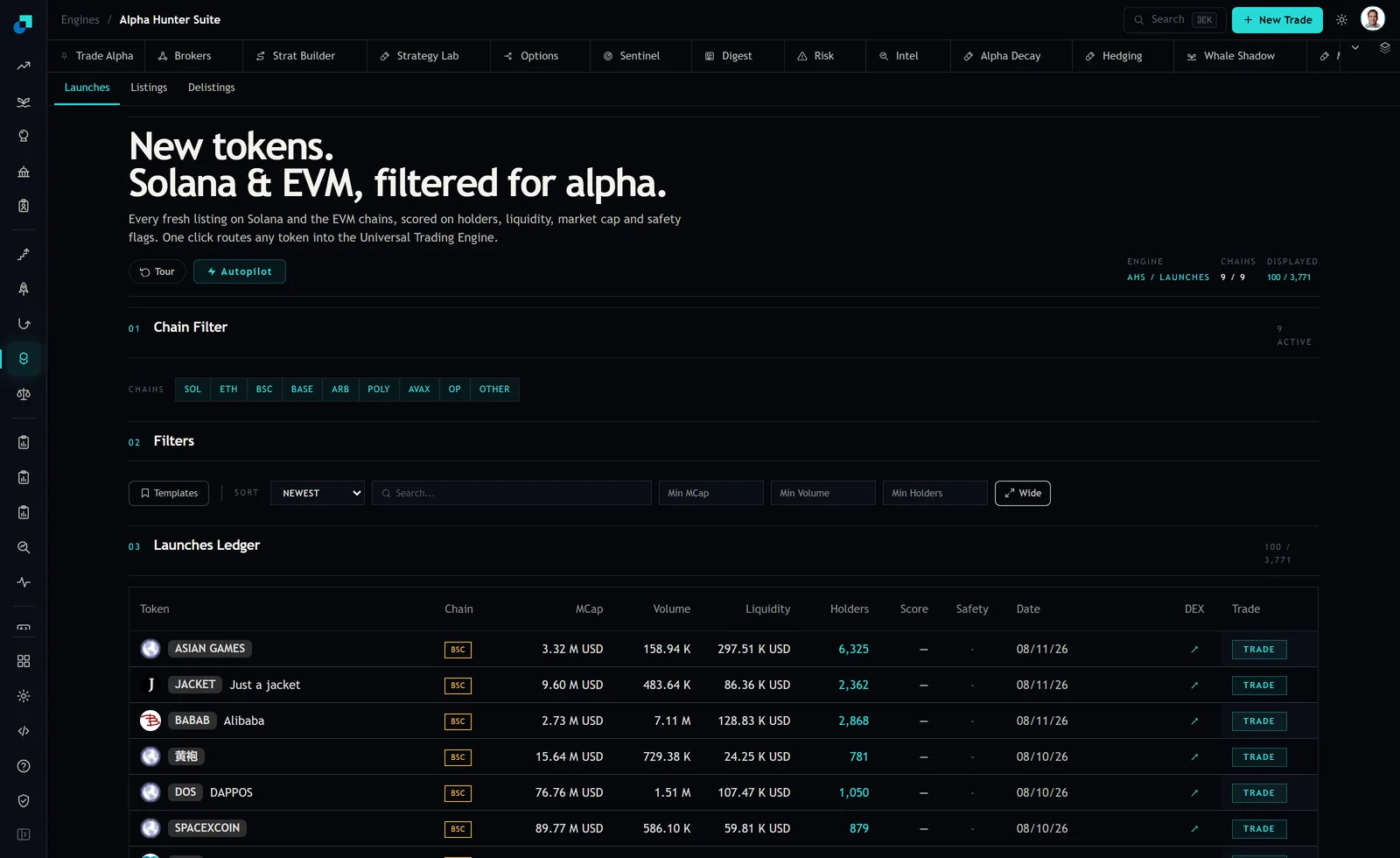
Scroll a new-token feed for two minutes and you will start recognising names from your brokerage account. On the capture in front of me there is a BSC token called SPACEXCOIN carrying an 89.77 million dollar market cap, and three rows above it a token whose symbol is BABAB and whose display name is Alibaba. Neither of those is a tokenized share. Neither claims to be, in any text the feed shows me, because the feed has no field where such a claim would go.
The specific names rotate. This week it is a space company and a Chinese e-commerce group, next week it will be a phone maker or an index proxy, and the reason is that name is a free text field and famous names are free. What does not rotate is the shape of the row, and the shape is what you can actually check.
A token name is a string, not a claim
Both the symbol and the display name on a token are set by whoever deploys the contract. There is no registry, no uniqueness constraint, and no trademark check anywhere in the pipeline between a deployer typing a name and that name appearing in a ledger row. The cost of naming a token after the most valuable company on earth is the gas to deploy it.
This is worth sitting with, because equities have trained the opposite instinct. A ticker on a stock exchange is issued, governed, unique on the venue, and maps to a security identifier that a chain of intermediaries agrees on. A token symbol maps to a contract address and nothing else. The name field is decoration attached to that address, and the address is the only identifier that means anything.
So when a row says SpaceX, the honest translation is that somebody deployed a contract and typed those letters. Everything after that, whether there is a business, a claim, an issuer, or a redemption path, is unestablished until you establish it.
What the columns say about a borrowed name
The ledger in the screenshot gives you eleven columns per launch, and four of them do real work on this problem. Take SPACEXCOIN across them. Market cap 89.77 million dollars. Volume 586.10 thousand. Liquidity 59.81 thousand dollars. Holders 879.
Eighty-nine million dollars of headline value is resting on a pool holding under sixty thousand dollars, spread across 879 addresses. Market cap here is supply multiplied by the last trade price, and on a token deployed days ago both inputs sit with the deployer. Liquidity is the only figure in that row where somebody had to actually part with money. The gap between the two is the entire story.
Compare the Alibaba-badged row. Market cap 2.73 million, liquidity 128.83 thousand, holders 2,868, and volume of 7.11 million dollars. That volume is more than twice the market cap and roughly fifty-five times the pool depth in the same window. Either a very small pool is being churned at a furious rate by genuine participants, or the volume figure is being manufactured by trading that costs the people generating it very little. You cannot tell which from the row. What you can tell is that a headline volume number is not evidence of a market you could sell into.
Neither of those rows carries a risk score and neither carries a safety tick. Nothing in the feed is asserting these are dangerous, and nothing is asserting they are fine. The verdict field is empty, and an empty field is not a pass.
What a real tokenized-equity product has to be able to answer
Genuine tokenized-equity products exist, and the thing that makes them genuine is not the name. It is that somebody specific owes you something specific. If you are looking at a row and trying to work out which category you are in, these are the questions that separate them, and they are all answered off the feed rather than on it.
- Who is the issuer, by legal name and jurisdiction? A real product names an entity you could look up in a companies register and, in most structures, a regulator it answers to.
- What exactly do you hold? A claim on a share, a claim on a fund that holds shares, or a synthetic exposure priced off a share. These are three very different things with three very different failure modes.
- Where are the underlying shares, and who says so? A custodian and some form of periodic attestation, not a screenshot of a wallet.
- How do you redeem? A product with no redemption path has no mechanism forcing its price back toward the underlying, which means the peg is a promise rather than an arbitrage.
- Who can hold it, and are you eligible? Real products almost always have jurisdictional restrictions. A token that anyone anywhere can buy with no checks is telling you something about what it is.
A mimic fails the first question. There is no issuer, because there is no product, because the name was the product. If you cannot get past question one in five minutes of searching, you have your answer and you can stop.
The two ways people lose money on these specifically
The first is the ordinary one. You buy a thin token, it moves, and you discover on the way out that the pool cannot return your position at anything near the quoted price. SPACEXCOIN's row has a market cap fifteen hundred times its liquidity. A position that looks like a few thousand dollars on the screen is a meaningful fraction of everything sitting in that pool, and price impact on the exit is the number that decides your actual result. Simulate the sell before you place the buy. Any swap interface will quote it without you holding the token.
The second is specific to borrowed names, and it is the one people do not price. The name is the asset. It is also a liability that belongs to somebody else. Trademark holders send takedown requests. Aggregators and data providers relabel or drop entries. Front ends geo-block. Exchange listing, which is the exit event a lot of these launches are implicitly sold on, becomes structurally unlikely for a token that cannot be listed under its own name without inviting a legal letter. None of that shows up as a price move until it does, and it tends to arrive all at once.
There is a third thing, which is not a loss mechanism but a reasoning error. A famous name creates a feeling of familiarity that does the work due diligence should be doing. You have opinions about the underlying company. Those opinions are entirely irrelevant to a contract that has no relationship with it, and the whole design of a mimic is to borrow the confidence attached to the name and spend it somewhere else.
Working the feed without getting caught by the names
The practical adjustment is to read these rows in an order that puts the name last. Filter first, on the numeric fields the ledger already gives you. The controls above the ledger let you set a minimum market cap, a minimum volume and a minimum holder count, and sort by newest, market cap or volume. Set a holder floor and a liquidity expectation that reflect the smallest position you would consider taking, and let the sort do the rejecting before you read a single word.
Then read what is left in this order. Chain and date, so you know how old the contract is. Liquidity, because it is the only deposited figure on the row. Holders, because concentration determines what happens when one address decides to leave. Market cap, which is the derived number and the one most likely to be misleading. Volume, checked against liquidity rather than admired on its own. Only then the name, and by then the name has no work left to do.
That ordering will not make a mimic profitable or unprofitable. What it does is stop the name from being the reason you looked, which is the only part of the process you fully control. A token called SPACEXCOIN and a token called nothing in particular, with identical columns, are the same trade with identical odds, and if that sentence feels wrong, the name is still doing work it has not earned.