Portfolios grow by accretion. You buy a thing because of a thesis, then another thing because of a different thesis, then a third because it was down and looked cheap, and eighteen months later you own eight tokens and could not defend more than four of them out loud. Nobody plans this. Everybody does it.
The cost is not obvious, which is why it persists. It shows up as trading fees on rebalances you would not otherwise do, as attention split across research you cannot keep up with, and as a false sense of diversification that makes you comfortable at a size you should not be comfortable at. This is a pruning pass that ends with one name to sell, and it takes about twenty minutes.
One name, deliberately. Cutting three at once is a portfolio rebuild dressed up as tidying, and it turns a clean decision into four decisions you will second guess. Cut one, live with it for a quarter, run the pass again.
The two inputs and where each of them lives
The pass needs two things. How similar each pair of your holdings is, and which of any pair has been the stronger performer relative to the market.
Similarity comes from the Correlations tab of the altcoin scorecard, which prints a Cross-Asset Correlation Matrix. On this capture it covers BTC, ETH, SOL, S&P 500, DXY and VIX, with the crypto values reading BTC to ETH 0.882, BTC to SOL 0.851, and ETH to SOL 0.859.
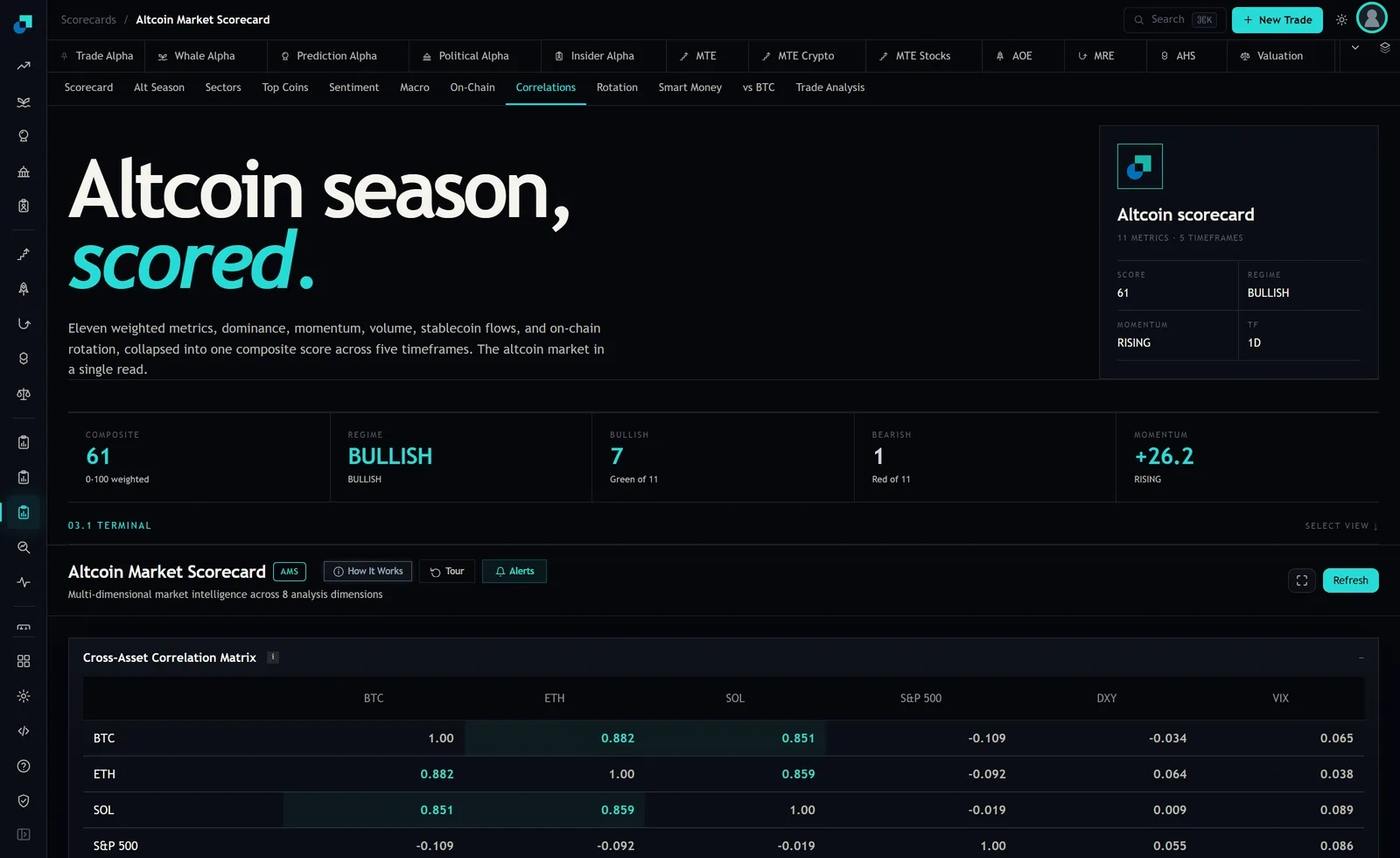
Be aware of the limit before you plan around it. The panel prints these six names. If your holdings are not on that list, the correlations for your specific pairs are not something you can read off this screen, and you will need to build them yourself from daily closes in a spreadsheet. That is a real constraint, not a detail, so decide up front whether you are pruning within the names shown or doing the spreadsheet work.
Relative strength is the second input, and the scorecard's Top Coins tab is described as individual coin momentum and relative strength analysis, which is the right place to look for it. Whatever measure you use, use the same one for every holding, and write down which one it was.
The pass, step by step
Six steps. Do them in order and do not skip step four.
- List every holding with its current dollar value. Not percentages. Dollars, because the decision at the end is a dollar decision and percentages make small positions feel more consequential than they are.
- Build the pair list. Seven holdings gives twenty one pairs. Write each pair with its correlation next to it. This is the only tedious part.
- Sort by correlation and take the top pair. That pair is your candidate. If the highest number on the list is below about 0.7, stop here. You do not have a redundancy problem and there is nothing to prune. Say so and go and do something else.
- Check that the pair is not the same bet by construction. A token and its staked or wrapped version, or two tokens of the same protocol, will top the list and are not a portfolio decision. Remove them from consideration and move to the next pair.
- Break the tie on relative strength. Look up both names. The one with the weaker reading is the cut. This is the whole judgement, reduced to a comparison of two numbers, which is the point.
- Sanity check the survivor on liquidity and cost. If the stronger name is the one you would struggle to exit, or the one with materially worse spreads, keep the weaker one instead and write down why. Redundancy is a real cost, but so is being stuck.
Worked on the numbers on the screen
Take a hypothetical 12,000 dollar portfolio holding BTC, ETH and SOL along with four smaller names. Using only the cells visible on the panel, the pair list for the three majors is short.
| Pair | Correlation | Read |
|---|---|---|
| BTC and ETH | 0.882 | Tightest pair, first candidate |
| ETH and SOL | 0.859 | Second candidate |
| BTC and SOL | 0.851 | Third |
BTC and ETH tops the list at 0.882, so that is the pair. Step four passes, since they are not mechanically the same asset. Step five sends you to Top Coins to compare their relative strength, and the weaker of the two is the cut.
Notice what the numbers are telling you underneath the procedure. The three pairs span 0.851 to 0.882, a range of 0.031. These three names are not meaningfully different from each other in how they move. Whichever one you cut, the risk profile of the remainder barely changes, which is precisely why the cut is safe to make and why holding all three was never buying you what it felt like it was buying you.
Three ways this pass goes wrong
Cutting the loser instead of the redundant one. The pass is designed to make you cut within a highly correlated pair, and only within one. If you find yourself selling a name that has no close partner on the list because it is down, you have abandoned the method and are just taking a loss with extra steps.
Treating one correlation reading as permanent. The panel gives one estimate over one window, and the window is not stated on the screen. Correlations move. A pair at 0.88 today can be at 0.6 next quarter. That is an argument for re-running the pass periodically, not for ignoring it, but it does mean you should not build an elaborate structure on one snapshot.
Forgetting the tax and fee side. The pass identifies the least useful holding. It does not know your cost basis. Selling a position at a gain has a bill attached in most places, and a redundant holding you are up 300 percent on may be worth keeping for reasons that have nothing to do with correlation. Do the arithmetic before you place the order.
What to do with the proceeds
The default should be to not immediately redeploy into another token. The pass just told you that your book is more concentrated than it looked, and the cure for that is not another name from the same block.
Two defensible destinations. Into cash or a stablecoin, which reduces total risk and is the honest response to discovering you had less diversification than you thought. Or into the survivor of the pair you just examined, which keeps your market exposure roughly constant while cutting the position count, the fee drag and the research load.
What you should not do is buy a fourth large-cap L1 because it is the one you do not own yet. Run the correlation check on it first. If it lands in the same block, you have undone the entire pass in a single trade and paid spread for the privilege.