Everybody who trades reversals in both crypto and equities eventually notices the same thing. The crypto trade is over before you have finished thinking about it, and the index trade sits there for what feels like a week doing nothing in particular. It feels like a difference in the assets. Most of it is a difference in the clock.
This matters because a reversal signal comes with a holding assumption baked into it, and if you apply the crypto version of that assumption to an index you will cut trades that had not been given a chance yet. Apply the index version to BTC and you will still be holding when the snapback has come and gone.
Bars and wall-clock are two different measurements
The Market Reversal Engine covers Bitcoin, Ethereum and Solana with multi-timeframe reversal detection, and it also covers the S&P 500, the Nasdaq 100, the Dow and blue-chip stocks. The same timeframes are on offer across both. That is the trap, because the timeframe label is a bar count and your patience is measured in hours.
Take a 15-minute setup. If the pattern you are waiting on resolves over roughly twenty bars, that is five hours on a crypto pair, start to finish, running straight through the night if it has to. Twenty 15-minute bars on a cash index is a different animal. A regular US session is six and a half hours, which is twenty six bars of that length, so twenty bars is most of one trading day. If the signal fires mid-afternoon, the resolution you are waiting for happens tomorrow, with an overnight session in between that your position had no say in.
The bar count is identical. The exposure is not. One trade owns a continuous five-hour price path and the other owns two partial sessions separated by a gap.
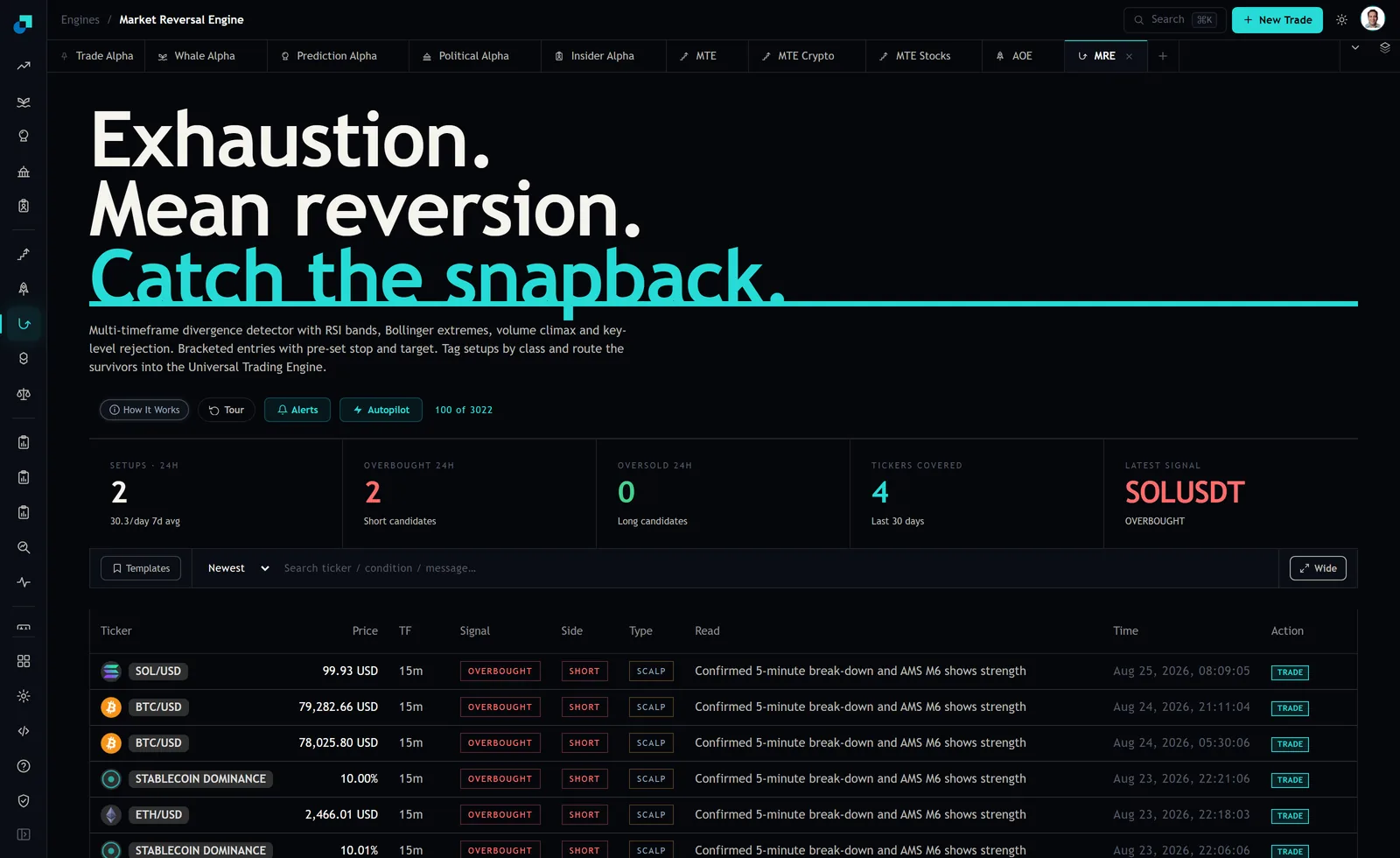
Look at the timestamps in that feed. One signal at 05:30 in the morning, two after 22:00 at night, one at 08:09. On a continuously traded pair every one of those is a live setup with a live price. Roughly half the clock on an equity index produces no signal at all, because there is no bar being closed, and the ones that do fire near the close are asking you to carry the position through hours in which you cannot act.
What continuous trading actually buys you
The reason a crypto reversal resolves faster in wall-clock terms is not that crypto traders are quicker. It is that the price path never pauses. Mean reversion is a process that needs transactions to happen, and an instrument that stops transacting for seventeen and a half hours a day is a process on hold.
There is a second effect worth naming. When an index does reopen, it reopens through an auction that has absorbed everything that happened overnight, in other markets, in other time zones. That auction can resolve your reversal in one print, which is fast, or it can gap straight past your level, which is not resolution, it is a different trade you did not choose. Crypto gives you a continuous path and therefore a chance to be wrong slowly and cheaply. An index gives you a discontinuous path and a chance to be wrong instantly.
I want to be careful about what I am claiming here. This is an argument from market structure and trading hours, not a measured statistic. MRE does not publish a resolution-time distribution by asset class, and the feed at capture showed four tickers covered over the last thirty days, all of them crypto pairs or stablecoin dominance. That is enough to tell you the crypto side is live and not enough to compare it against an index side that produced nothing in the visible window. If you want the comparison as a number, you have to measure it, and that is a smaller job than it sounds.
Measuring your own resolution times in a notebook
Keep one line per signal you actually take, or paper trade, with five fields. Ticker, timeframe, the timestamp from the Time column, the timestamp at which the trade hit either the target or the stop, and which of the two it hit.
Then compute two numbers per asset class rather than one. Elapsed clock hours, which is the honest measure of how much of your life the trade consumed, and elapsed bars, which is the honest measure of how much price action it took. Do it for twenty crypto signals and twenty index signals and the gap will either be there in your own data or it will not, and either way you will know rather than assume.
Two practical warnings. Count only signals you would genuinely have taken, because including ones you skipped turns the sample into a story about the engine rather than about your trading. And record the stops, not just the winners. A trade that stops out in twenty minutes has resolved very fast, and resolution speed is not a synonym for profit.
Two holding rules instead of one
Once you accept that the clocks differ, the rule that follows is simple and slightly annoying to implement, which is why most people do not.
On crypto, set your time stop in bars and check it in real time. If a 15m reversal has not begun to work within a small, fixed number of bars, the exhaustion read has been overtaken and the position is now a directional bet you never agreed to. The market is open, the exit is available, and there is no reason to hold a thesis that has expired. Continuous trading cuts both ways here: it makes the exit cheap, so use it.
On an index, set the time stop in sessions and size the position for the gap. Two sessions is a reasonable unit for a signal on a short timeframe. Size it so that an adverse reopen you cannot trade through is survivable, which in practice means smaller than the crypto position for the same nominal stop distance, because the stop distance on an index is a target rather than a bound. It only bounds you if the price passes through it while a market is running.
The tax on the faster market
Speed is not free and the crypto side bills you in a currency the index side does not. Signals fire at 05:30. They fire at 22:21. If the resolution takes five hours and the signal was stamped at ten at night, the entire trade happens while you are asleep, and the choice is between a resting bracket order and missing it.
That is the real argument for taking the pre-set stop and target as they ship rather than improvising them. A bracket you left in the market is a decision you made while awake. A market order at seven in the morning after reading the alert on your phone is a decision made by whoever you are before coffee, on a move that has already happened.
The index reader gets the opposite deal. The signals arrive during hours you are likely to be conscious, the resolution is slow enough to think about, and the price of that comfort is the gap. Neither is better. They are different trades wearing the same badge, and the only mistake that matters is running one set of rules across both.
What to change this week
Pick one asset class and write the two numbers down before your next signal. A bar count that ends a crypto trade, and a session count that ends an index trade. Put them somewhere you will see them when the position is open, because that is the moment the rule will be argued with.
Then take the next ten signals in that class and log the resolution time whether you traded them or not. Ten rows is not a study, but it is the difference between believing crypto reverts faster and knowing what your own fills did, and it costs about thirty seconds per signal.