Nobody publishes the terms. When a token lists on a venue, the depth that appears on both sides of the book is usually there because somebody was paid or incentivised to put it there, and the arrangement behind it is a private contract between the issuer and a market maker. You will not read it. What you can do is observe its consequences, because a contract with a term and a strike behaves differently from capital that arrived because it wanted to be there.
This matters to holding period more than to entry. If the depth you are relying on to exit is contractual, then it has an end date you do not know, and the position has a risk you have not written down. That is a governance problem before it is a trading problem.
What the ledger gives you, and the sampling job it leaves behind
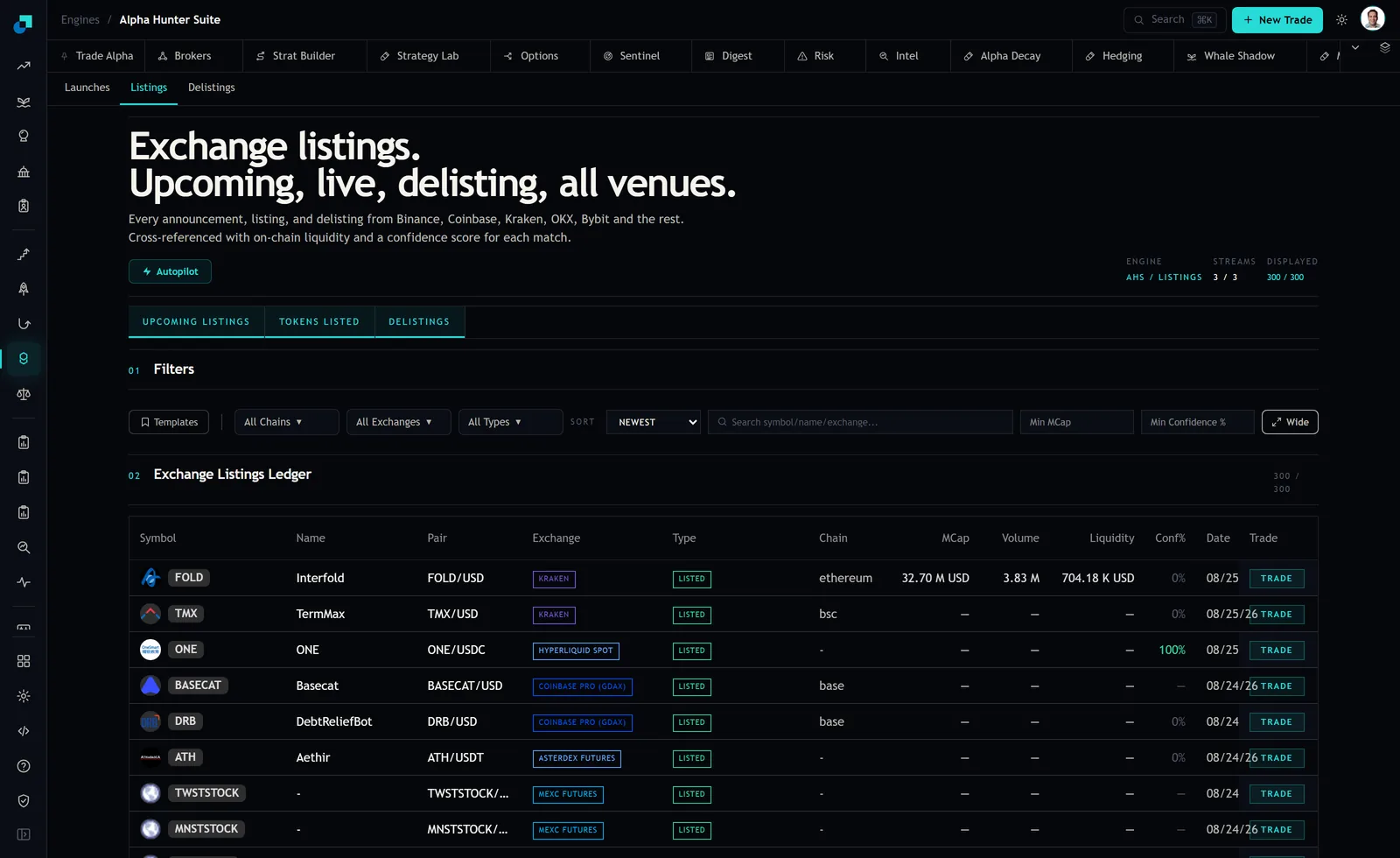
Be exact about the raw material, because the procedure depends entirely on it. The exchange listings ledger carries Symbol, Name, Pair, Exchange, Type, Chain, MCap, Volume, Liquidity, Conf% and Date, across three streams that showed 300 of 300 rows at capture. It is a ledger of events with current readings attached. It does not render charts, and there is no depth history panel on it.
So the time series does not exist until you build it. That is the actual first step and it is unglamorous: snapshot the rows you care about on a fixed schedule, keyed by pair and venue rather than by symbol, and keep the snapshots. A weekly cadence is enough to see a term structure. A daily cadence is better if you intend to catch a step change close to when it happens.
The second thing to be exact about is coverage. At capture, the Liquidity column was populated on some rows and blank on others. One Kraken row showed 704.18 K of liquidity against a 32.70 M cap on ethereum, while several rows on the same screen showed no cap, volume or liquidity at all. Your sampler has to record the blank as a blank rather than as a zero, because a missing reading and an empty pool are entirely different observations and conflating them will produce a decay curve that is an artifact of coverage.
The shape a contractual arrangement leaves behind
The structure that is commonly described in this market pairs a loan of tokens to the market maker with an option for the maker to buy those tokens at a reference price, usually anchored near the listing. The maker quotes both sides using borrowed inventory, and the option is what compensates the risk. You are not going to verify any of that for a specific token. What you can do is ask whether the observable behaviour is consistent with it.
Three signatures are worth recording. The first is arrival. Organic depth accretes, because it comes from many participants making independent decisions over days. Contracted depth tends to be present at close to full size on day one, because the obligation starts when the market starts.
The second is stability. Depth that is somebody's obligation tends to hold a level through conditions that would move discretionary capital. Sitting flat through a drawdown is the interesting observation, not sitting flat generally.
The third is termination. Capital that leaves for its own reasons tapers. An obligation that ends, ends. A step change in depth that is not accompanied by a corresponding move in volume or price is the single most informative thing in the whole series, and it is only visible if you were sampling before it happened.
The confound that undoes most of this
Here is the limitation that has to sit in the memo rather than in a footnote. The Liquidity figure on the listings ledger is on-chain pool depth. The module cross-references announcements with on-chain liquidity, which is a chain-side measurement. A market-making arrangement on a centralised venue operates in that venue's order book, which is a different pool of capital entirely.
The consequence is direct. A venue market maker can start, run and terminate an arrangement without the on-chain liquidity figure moving at all, and a DEX pool can be drained by an unrelated liquidity provider while the venue book is untouched. So the inference you can support from the ledger alone is about on-chain depth behaviour, and any claim about a venue's book requires venue data you have to source separately.
That is not a reason to skip the exercise. On-chain depth around a listing is genuinely informative, and for tokens whose primary market is on chain it is the relevant book. It is a reason to write down which book you measured, every time, because a depth series that silently mixes the two is worse than no series.
Turning the inference into a position rule
An inference of this kind cannot be a trade signal, because it is a hypothesis about a contract you have not seen. It can be a constraint, and constraints are where it earns its keep.
Start by classifying the depth behind each position as verified, inferred or unknown. Verified means you can see the capital and identify who owns it. Inferred means the behaviour is consistent with an arrangement whose end date you do not know. Unknown is the honest default and it should be the largest bucket.
Then set the holding period against the classification rather than against the thesis. A position whose exit depends on inferred depth gets a shorter maximum horizon and a mandatory reassessment at fixed intervals, because the risk is not that the price falls, it is that the exit route closes while the price is fine. A position whose exit depends on verified depth can carry the horizon the research supports.
The trigger to write into the position record is the step change. If sampled depth for a pair drops by more than a stated fraction between two consecutive observations, without a corresponding move in volume, the position goes to a review that has a default action attached. Default actions matter more than thresholds here, because the moment this fires is exactly the moment when doing nothing feels reasonable.
Writing it down as an inference, not a finding
The reporting discipline is the part that survives contact with a compliance review, and it is simple to state. What you observed goes in one column. What you inferred goes in another. They never merge.
Observed is the sampled depth series with its source, its cadence, and its gaps. Inferred is the sentence that says the depth behaviour around this listing is consistent with a term-limited arrangement, and that the desk has therefore capped the horizon at some number of weeks. Nobody should be able to read your note and come away believing you know the terms, because you do not, and the value of the process is destroyed the moment someone downstream treats a hypothesis as a fact about a counterparty.
The last thing to record is what would falsify it. Depth that keeps accreting past the point where an arrangement would plausibly have ended, spread across identifiable independent providers, is evidence against the inference and should be allowed to relax the constraint. A framework that only ever tightens is not a framework, it is a bias with a spreadsheet attached.