The question people ask after their first insider buy signal is how long to hold it, and they usually expect the answer to come from a table of returns by horizon. That is a reasonable expectation and the Insider Alpha performance page is built to answer exactly that question, with four tiles across the top for 7D, 30D, 90D and 365D forward returns. On the day I read it, three of those four tiles were empty. So this is the other version of the article, the one where you decide the holding period yourself, from arithmetic you can do at your kitchen table.
What the four horizon tiles said, and what they could not say
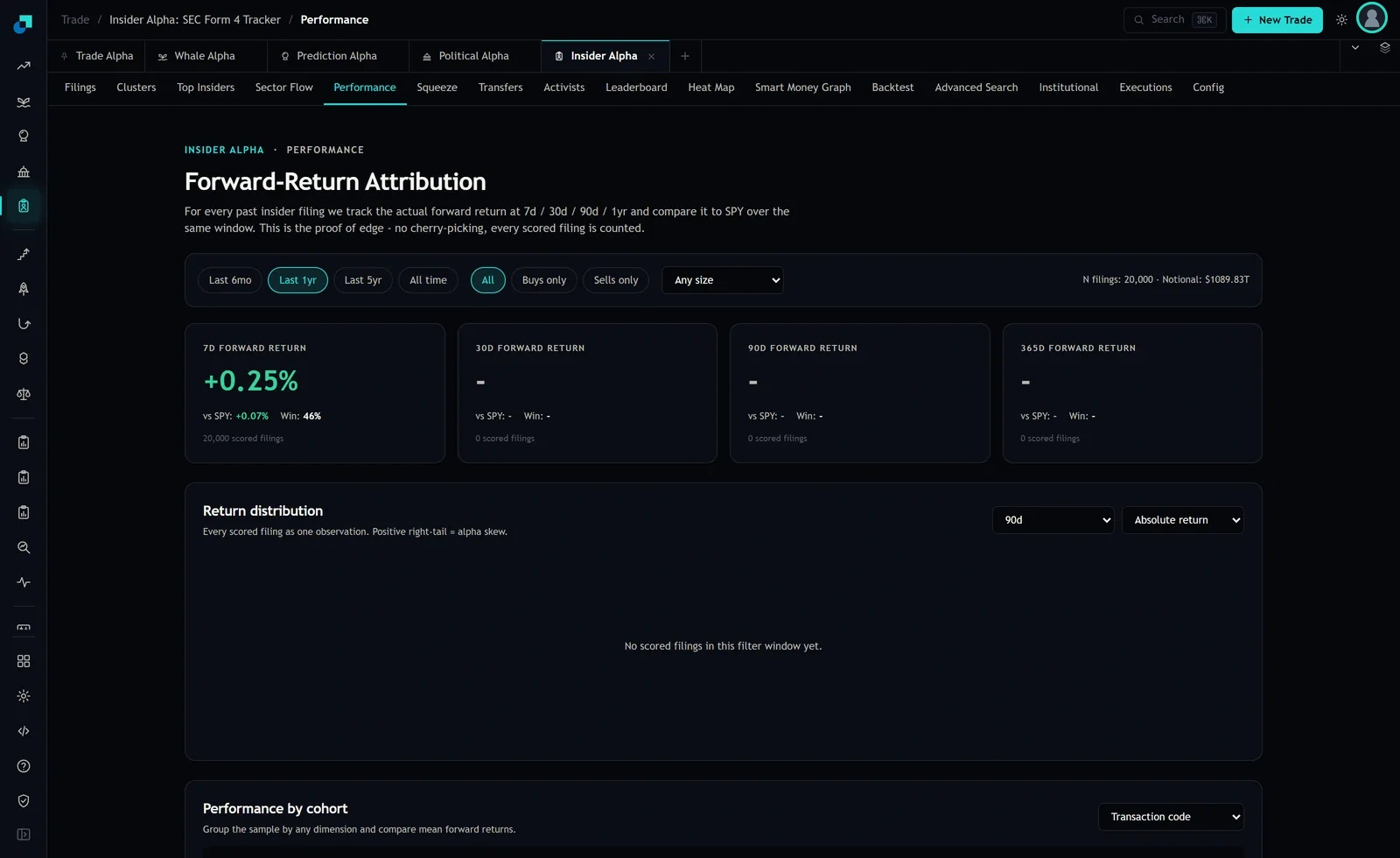
With the range set to last 1yr, the side selector on All and the size dropdown on Any size, the panel read as follows. N filings of 20,000. The 7D forward return tile showed plus 0.25 percent, against SPY at plus 0.07 percent, with a 46 percent win rate on 20,000 scored filings. The 30D, 90D and 365D tiles each showed a dash for the return, a dash for the SPY comparison, a dash for the win rate, and zero scored filings underneath.
Zero scored filings is not a return of zero. It is an absence of data at those horizons in that filter window, and treating one as the other is the fastest way to reach a confident wrong answer. So I cannot tell you what the module measured at thirty or ninety days, because it did not report a measurement, and I am not going to fill that gap with a number from memory.
What I can do is give you the seven day figure and let it discipline the rest. Plus 0.25 percent against SPY at plus 0.07 percent is a difference of 0.18 percentage points, or eighteen basis points, over a week, before any cost at all. That single number does more work in choosing a holding period than any horizon table would, and here is why.
The round trip toll decides your horizon before the returns do
Every hold has a fixed toll on the way in and out, and a holding period is simply the distance you spread that toll over. Change the horizon and you change how many times a year you pay it.
Say you trade a liquid name with a one cent spread at twenty dollars a share. That is five basis points of spread, and you pay roughly half of it going in and half coming out, so call the round trip ten basis points once you allow for a little slippage. If you hold for a week and repeat, you pay that toll about fifty times a year in that slot. If you hold for a quarter, you pay it four times.
Now put it in dollars on a real position. On two thousand dollars, ten basis points is two dollars. Fifty round trips a year in that slot costs you a hundred dollars of friction on a two thousand dollar allocation, which is five percent of the capital, before you have been right or wrong about anything. On four round trips a year the same friction is eight dollars.
Two things fall out of that immediately. Short holds need a much larger per trade edge to survive, and eighteen basis points of gross weekly edge does not obviously clear a ten basis point round trip plus the tax and the attention. And the moment you widen the name selection into anything with a two percent spread, a four hundred basis point round trip buries a short hold entirely no matter how good the signal was.
The three real candidates and what each one demands of you
Rather than a return table, think of the choice as three operating modes with different requirements.
- The one week hold. Requires you to be at a screen during market hours, requires tight spreads, requires you to accept that a 46 percent win rate means most individual trades close red and the average is carried by a minority. Highest friction bill, most decisions, most opportunities to override your own rules.
- The one quarter hold. One entry, one calendar exit, roughly four round trips a year per slot. Friction becomes a rounding error. You will sit through drawdowns you would have stopped out of on a weekly clock, and you will hold through at least one earnings report, which is the event most likely to make the position unrecognisable.
- The one year hold. Effectively a position rather than a trade. Friction is negligible, single name risk is not, and you have to be honest that you are now making a business judgment that the insider's purchase was only the prompt for.
The seven day figure tells you something useful about all three. A 46 percent win rate with a positive average means the money is in a right tail, and a right tail needs time to arrive. Cutting winners early is exactly the behaviour that removes the tail and leaves you with the majority of losers. That argues against the short hold for anyone who is not watching continuously, regardless of what the missing tiles would have said.
The default rule for someone who cannot watch the tape
If you have a job and you check your account in the evening, here is the rule I would run, stated so plainly that you can write it on an index card.
Enter once, on the day you see the filing, in a name whose spread you have actually looked at. Set a calendar exit ninety days from the entry date and write that date in the order note. Do not set a stop loss on the position. Instead, size it so that a total loss of the position is a loss you can absorb without changing anything else, because in the names where insider signals are strongest, a stop is a device for converting a gap into a realised loss at the worst available price.
Then the only two things that break the calendar exit. First, a change in the business fact that made you enter, which for most people means an announcement rather than a price move. Second, hitting a pre written profit target that you decided on before entry and that you wrote down next to the exit date. Everything else, including a bad month, waits for the date.
The reason this works for a time constrained person is not that ninety days is magic. It is that a calendar exit removes the decision that people get wrong, which is the intraday one. You are not choosing a holding period because the data says ninety days is optimal. You are choosing it because it is the shortest hold where the friction stops mattering and the longest hold you will actually respect.
How to check the horizon question yourself when the tiles fill in
The panel is not frozen, and the filters are the whole point of it. When you next open it, do this in order rather than reading the big number first.
Set the range to the longest option available, which on capture were last 6mo, last 1yr, last 5yr and all time. Set the side selector to Buys only, because a purchase and a sale are different objects and mixing them tells you about neither. Then set the size dropdown to the smallest trade you would actually act on, using the buckets provided at 25 thousand, 100 thousand, 500 thousand and one million dollars.
Now read the scored filings count under each tile before you read any return. If the horizon you care about shows a real sample, you have your answer and you should compare it against the SPY line beside it rather than against zero. If it shows a small sample, a fraction of a percentage point is noise and you should not size a position on it. And if it shows zero, as three of the four did for me, the honest conclusion is that the module could not answer the horizon question that day, and your calendar exit stands on cost arithmetic and temperament instead. That is a weaker foundation than measured returns and it is still a foundation, which is more than most people have when they open a position and then invent the exit afterwards.