Every screen you use has a default, and defaults are decisions somebody else made for you. On the Activists tab in Insider Alpha the WINDOW row offers 7d, 30d, 90d and 1y, and it opens on 30d. For most of what you would want to do with activist filings, that is the wrong one.
This is not a criticism of the default. Thirty days is a sensible compromise for a screen that has to open on something. It is a criticism of leaving it there, which is what almost everybody does, on almost every tool, forever.
Filing screens are sparse, and price screens are not
The habit that makes short windows feel natural comes from price data. A week of price is hundreds of bars. A week of volume is a distribution. You can compute things from it. Seven days of anything price shaped is a real sample.
Filings do not work like that. A holder crossing five percent at a given company is a rare event for that company, often a once in several years event. Ownership schedules across the whole market arrive at a rate measured in a handful a day, not thousands. Tender offers are rarer still. When you set a seven day window on a filing screen you are not zooming in on a busy dataset, you are asking a sparse one for a sample it may not contain.
The consequence is that an empty short window tells you almost nothing. It is the expected outcome a large fraction of the time. People read it as "the market is quiet" or worse as "this tool is broken", when the honest reading is "seven days is not long enough to distinguish between those two things and a normal week".
What the empty state does and does not tell you
Here is the screen as it captured, on its defaults, and it is worth looking at precisely because there is nothing in it.
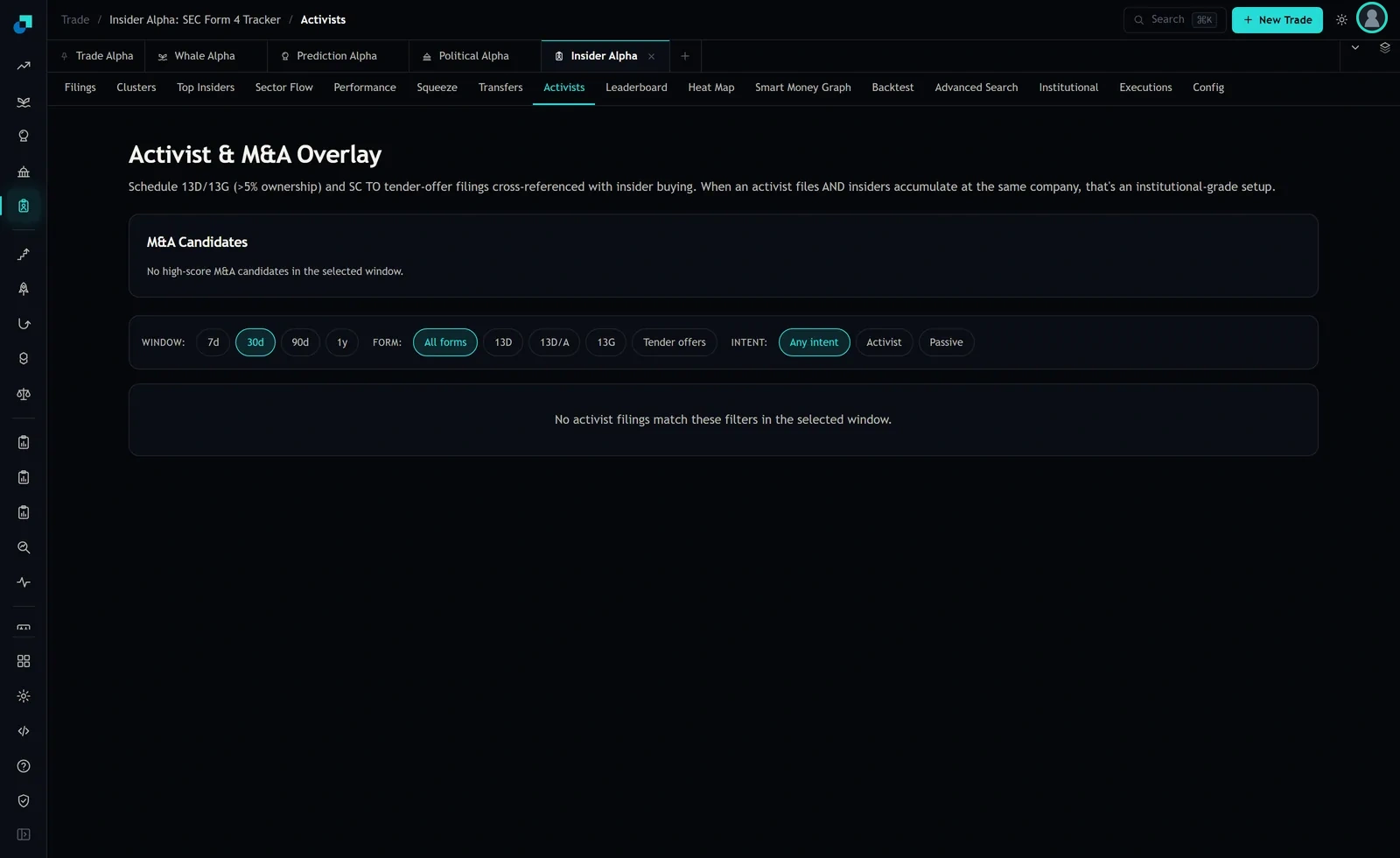
Two readings are available and you cannot choose between them from this image alone. It may be a genuinely quiet thirty days, which happens. It may be that coverage in that particular window is thin. What you should not do is treat an empty result on the broadest possible filter combination, all forms and any intent, as evidence about the state of the market. It is one observation of a sparse process.
The practical response is mechanical. When a screen comes back empty on the default, step the window out one notch before you draw a conclusion. If 90d fills in and 30d did not, you learned that the month was quiet. If 1y is still thin, you have learned something about the data rather than about the market, and you should find that out before you build a routine on top of it.
What each window is actually for
Once you stop treating the window as a zoom control and start treating it as a choice of question, the four settings sort themselves out.
- 7d is a monitoring glance. The only question it answers is whether anything landed since you last looked. Use it for that and expect it to be empty most of the time. Do not run analysis on it.
- 30d is a middle setting that mostly inherits the weaknesses of both neighbours. It is too short to show a build and long enough that you stop checking daily. If you find yourself here by default, ask which of the other three you actually wanted.
- 90d is where a stake becomes a shape. An original filing plus the amendments that followed it fit inside a quarter, and that sequence is the difference between knowing someone owns six percent and knowing whether they are adding, holding or leaving.
- 1y is a research window. It is what you open when you are underwriting a specific company and want the full ownership history rather than the recent flow. It is too much material to read as a feed.
Why the short window hides the thing you are looking for
The reason 90d earns its place is worth stating on its own, because it is the whole argument for not living on 7d.
A campaign is a sequence. Someone crosses the line and files. They add and file an amendment. They send a letter and file another. Perhaps they take the stake up again. Each of those documents on its own is a fact of modest size. Read in order, they are a story with a direction, and direction is the only part that is useful to you.
A seven day window shows you one frame of that. You see a filer at 6.2% and you have no idea whether they were at 5.1% two months ago and are building, or at 9% and are on the way out. Those two situations look identical in a snapshot and mean opposite things. The window is the difference between them.
Combine the window with the FORM row and you can be more precise still. FORM to 13D/A at 90d gives you the amendment traffic on its own, which is where escalation shows up. FORM to 13G at 1y gives you the standing list of large passive holders on a name, which is a useful thing to have written down for entirely different reasons.
A two window routine that takes ten minutes a week
What I would actually do with this screen, given a normal retail portfolio and a normal amount of time.
Once a week, 7d with FORM on All forms and INTENT on Any intent. This is a glance. You are looking for names you recognise. Most weeks there will be nothing relevant to you and that is fine, it costs a minute.
Once a month, 90d, and this time go name by name for the companies you actually own. You are not screening the market for ideas here, you are checking whether the ownership picture under your own positions has changed. A new large holder, an amendment stream that has started moving, a tender offer on a name in your account. These are things you want to find because they change what you own, not because they are trade ideas.
Once a year, or whenever you are seriously considering a new position, 1y on that single company before you buy. Who is large, how did they get there, and has anyone been trying to change the company. Fifteen minutes of reading before you commit money to a name is the cheapest research you will ever do, and the long window is what makes it possible.
The failure I see most is the opposite of all this. People leave the window on the default, check it too often, see nothing, and conclude the screen is not useful. The screen was fine. The question being asked of it was seven days wide and the answer needed a quarter.