Every alert I have ever abandoned was abandoned in the same way. I set it up on a Sunday feeling organised, it fired eleven times on Tuesday, I stopped reading them by Thursday, and I muted the app the following week without ever formally deciding to. The rule was still running two months later. I just was not looking at it.
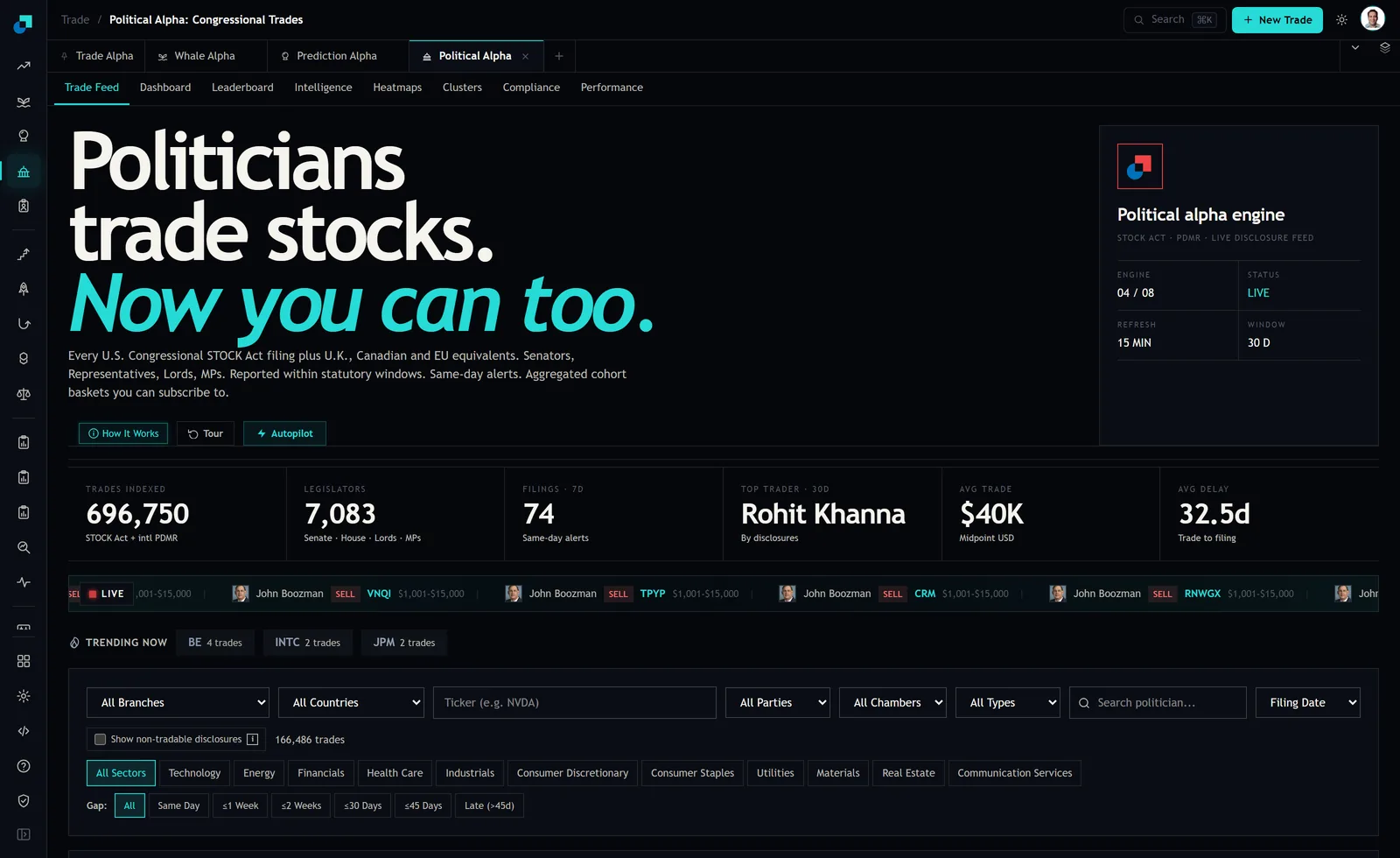
That is not a discipline problem, it is a design problem, and the fix is arithmetic you can do before you build anything. The Political Alpha header strip gives you the number you need. At capture it showed 74 filings over the trailing seven days flagged as same-day alerts. That is your worst case, unfiltered, for the fastest slice of the feed alone. Ten notifications a day. Nobody reads ten a day about anything.
Work out your notification budget first
Pick the number of alerts per week you will genuinely open and read properly. Not aspire to read. Actually read, on a weekday, when work is busy. For most people the honest answer is somewhere between three and eight.
Everything after that is subtraction from 74. If your budget is five a week, you need filters that remove roughly ninety three percent of the same-day stream and you need to know which ninety three percent before you start clicking. Building the rule first and tuning it down afterwards never works, because the tuning happens in the same week the alerts are annoying you, which is the week you make the worst decisions about them.
Three combinations that hold up
These are the three shapes I have seen survive a month of real use. They are different in kind, not in degree, and you should run one of them rather than a blend of all three.
The watchlist alert. Set the ticker field to names you already own or already follow, and nothing else. The Gap setting can stay wide. This is the highest signal-to-noise construction available because you have replaced the hard question, which is what to buy, with an easy one, which is whether anything has happened in the names where you have already done the work. Volume is naturally low because a specific ticker only appears in the feed occasionally. The trending strip at capture showed the busiest names of the moment sitting at four trades and two trades, which tells you what per-name frequency actually looks like.
The sector alert. Pick one sector chip, set Gap to Same Day, and accept everything inside it. Health Care showed 39 buys and 52 sells over a thirty day window on the sector heatmap at capture, which works out to a manageable few filings a week rather than ten a day. This one is for people who have a sector view already and want a supporting stream rather than a discovery stream. The trap is picking Information Technology, which was carrying 81 buys and 106 sells over the same window and will bury you.
The cluster alert. Ignore individual filings entirely and only ask to hear when several members converge on the same name. The module has a Clusters tab that groups exactly this, and the dashboard tile counting active clusters read 1 at capture. One. That is the whole point. A cluster alert fires rarely by construction, and rarity is the property that keeps an alert alive on your phone.
The channel does more work than the rule
This is the part people skip and it matters more than the filter. Blockcircle's alerts desk supports email, Discord, Telegram and webhook delivery, and the choice among them changes the behaviour of the alert far more than a tweak to the conditions does.
A push notification demands a response now. That is correct for something you would act on within the hour and wrong for almost everything in a disclosure feed, where the header showed an average delay of 32.5 days between the trade and the filing. If the information is already a month old, a notification that interrupts your afternoon is lying to you about its urgency, and your brain learns that lesson quickly and starts ignoring the channel.
So route disclosure alerts to a channel with no urgency attached. Email into a folder you read on a schedule. A dedicated Discord or Telegram channel you open deliberately rather than one that pings. The rule then becomes a queue rather than an interruption, and a queue that gets read weekly is worth vastly more than an interrupt that gets muted.
What not to alert on
Two categories that will destroy a good rule.
- Sells, at least by default. The sector heatmap at capture had sells outnumbering buys in most sectors, and a large share of that is tax timing, mandated divestiture and account maintenance rather than anybody's opinion. Alerting on sells triples your volume and adds close to nothing.
- The smallest disclosure band on its own. The live ticker was showing a run of consecutive filings all in the $1,001 to $15,000 range. That is a real trade and it is not a conviction signal, and if your alert fires on every one of them you have built a paperwork notifier.
Review the alert, not just the trades
Put a recurring fifteen minutes in the calendar, monthly, to review the rule itself. Three questions, and they take about a minute each once you have the habit.
How many did it fire in the last month, and how many did you open. If the second number is under half the first, the rule is too loose and you should tighten it now rather than wait for the mute. How many led to research, and how many of those led to a position. If it fired thirty times and produced nothing you looked into twice, the rule is not selective, it is just noisy in a way that feels productive.
And the one nobody asks. What did it miss. Go into the feed manually, look at what came through in the period, and check whether the two or three genuinely interesting filings actually triggered your alert. A rule tuned entirely for volume reduction eventually filters out the thing it was built for, and the only way you find that out is by looking at the unfiltered feed on purpose every so often.
The rule that survives is almost always narrower and duller than the one you first want to build. That is the trade. A boring alert you still read in March beats a comprehensive one you muted in January, and the comprehensive one costs you more, because for two months you believed you were being told things.