Every performance table you did not construct yourself is a table of survivors. This is not a criticism of the table. It is a structural property of ranked lists, and it is the first thing a diligence process should test when a whale following strategy comes across the desk with a leaderboard attached to it.
What makes on chain cohorts different from manager databases is that the raw material for the correction is usually still there. A fund that closes stops reporting and disappears from the vendor's file. A wallet that goes to zero does not disappear from a blockchain. It sits there, permanently, with its full history intact, and the only reason it is missing from your analysis is that something in your pipeline filtered it out.
The bias sits in the filter, not in the source
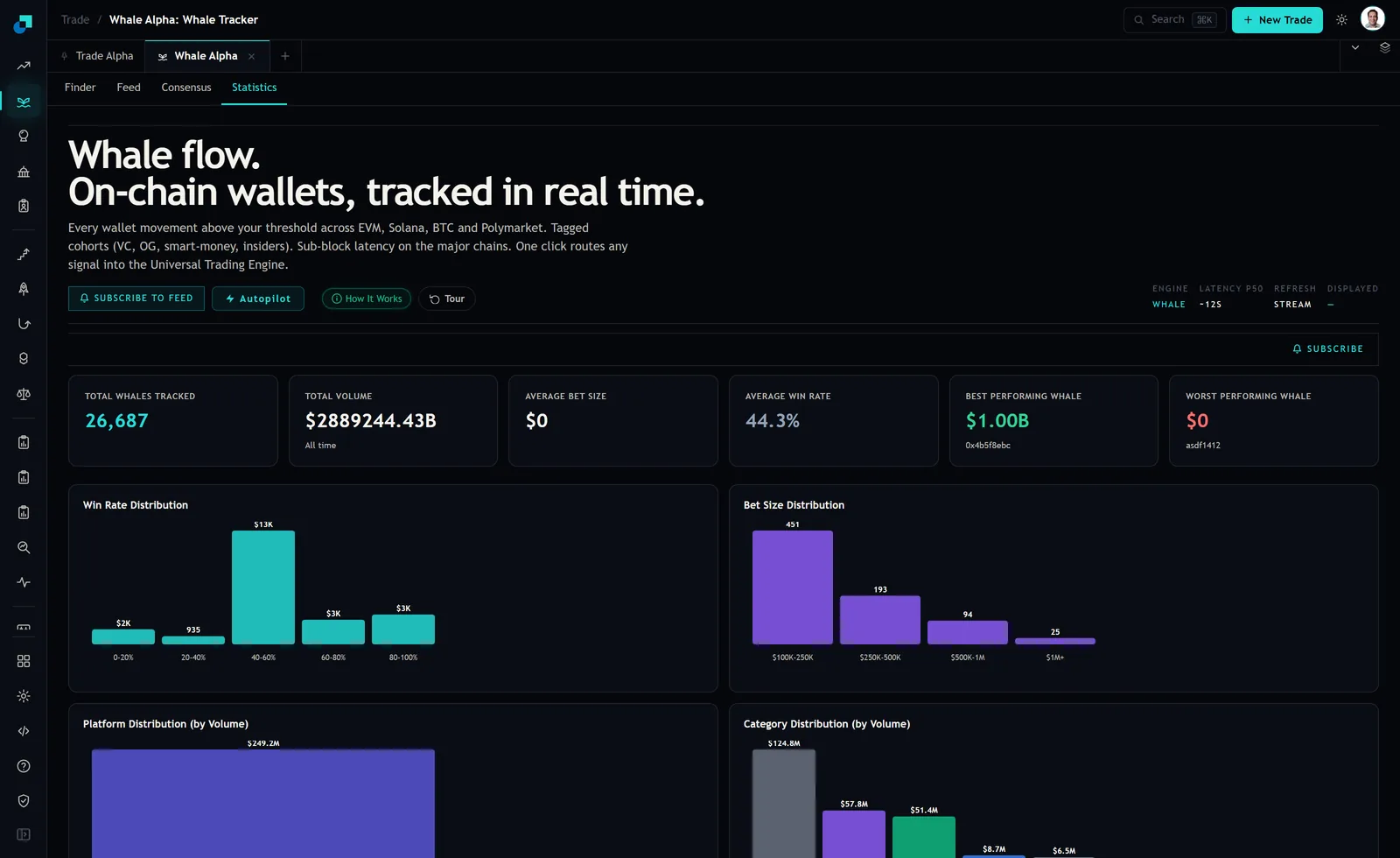
The Whale Alpha Statistics tab at capture is a useful demonstration of this. It reported 26,687 whales tracked, an average win rate of 44.3 percent, a best performing wallet at one billion dollars against the address 0x4b5f8ebc, and a worst performing wallet at zero dollars against a handle reading asdf1412.
Read that last tile carefully, because it is doing more work than it appears to. A wallet at zero is present in the census. It is named. It is being scored. The dataset has not quietly dropped it for being uninteresting. Meanwhile the Finder view at the same capture displayed 123 rows out of 957, which is a filtered subset, and any statistic you compute over those 123 rows is a statistic about a set whose membership you defined.
That distinction determines who owns the problem. If the vendor were dropping dead wallets, you would be stuck with an unfixable bias and the correct response would be to discount the whole dataset. Because the vendor is not dropping them, the bias is entirely a consequence of how you selected, which means it is measurable, correctable, and your responsibility to document.
Define death before you go looking for it
The procedure fails at step one if you let the definition of a dead wallet be settled after you can see which wallets it removes. Fix it in writing first, and pick something a reviewer can apply independently and get the same answer.
- Inactivity. No qualifying trade for a stated number of days, chosen relative to the cohort's own trade frequency rather than to a round number. If your median wallet trades weekly, ninety days of silence is death. If it trades quarterly, that same rule kills half your live population.
- Capital destruction. Realised equity below a stated fraction of peak equity, which catches the wallet that is still technically transacting but has nothing left to transact with. This is the case a pure inactivity rule misses entirely.
- Venue exit. A wallet whose activity migrates entirely off the venues you can observe. It is not dead, but it is unobservable to you, and for measurement purposes those are the same thing. It must be treated as a delisting rather than a survivor, and the treatment has to be stated.
Then set the reinstatement rule, which is the step that determines the size of the correction. A wallet that stops being observable does not simply vanish from the series. It takes its terminal outcome with it. If it went to zero, the sleeve that was following it took that loss. If it went quiet at a profit, the position closed at whatever the last observable mark was and the capital rotated to cash or to the cohort median. Both treatments are defensible. Choosing after seeing the results is not.
Reconstructing the table point in time
The mechanical core of the rebuild is that cohort membership must be evaluated as of each historical date, using only what was knowable on that date. This is where most reconstructions quietly cheat.
Pick your formation dates on whatever cadence the strategy would actually rebalance on. At each date, apply your selection filter using only data up to that point. Record the resulting membership list and freeze it. Then track the forward return of every wallet in that frozen list through to the next formation date, including the ones that died in between, marked at their terminal outcome under the reinstatement rule.
The wallets that would be in a leaderboard built today never enter the calculation as of a past date unless they qualified as of that past date. That single constraint is the entire difference between a reconstruction and a story. It is also the reason the exercise takes days rather than an afternoon, because it requires history for wallets nobody is currently interested in.
The haircut, and why I am not going to quote you a figure
The size of the correction is a function of your cohort, your window, your death definition and your reinstatement rule. Change any one of those and the number moves materially. Anyone who hands you a single universal haircut for whale leaderboards is selling you a number they cannot have measured, and it will not survive the first serious question about it.
What I can tell you is the shape of the arithmetic, so you can bound it before you build. If a top twenty list is formed and four of those wallets die over the measurement period at a total loss, the reinstated cohort return is the survivor return scaled by sixteen twentieths, plus four twentieths of whatever the terminal outcome was. Total loss on those four turns a survivor average into eighty percent of itself before any other effect. Partial recovery on the dead names reduces that. Higher attrition increases it, quickly.
So the two inputs that actually drive the answer are the attrition rate over your window and the terminal severity of the wallets that go. Both are directly countable from the census, and both should be reported as standalone figures in the research note, not folded into a single adjusted return where a reviewer cannot see them.
What the file needs to contain when this is challenged
Assume the question will be asked, because on a strategy with a leaderboard in the pitch it always is. The file should hold the death definition with its date stamp, the reinstatement rule with the same, the formation dates and frozen membership lists, the attrition count per period, the survivor only statistic and the reinstated statistic side by side, and the difference between them stated as the haircut with its inputs visible.
Two additional items are worth having ready. The first is the same reconstruction under a deliberately harsher death definition, which shows the reviewer that the conclusion is not an artefact of a threshold you happened to pick. The second is a plain statement of what remains uncorrected, because there is always something: wallets that were never indexed, activity on venues outside the coverage set, and the wallet that changed addresses and now appears in your data as one death and one new entrant. Naming the residual bias you cannot fix is what makes the corrections you did make credible.