Restricted and control stock does not appear on the tape spontaneously. It travels through a defined sequence with paperwork at several stages, and each stage is observable before the shares are sold. Most desks watch only the final stage, which is the sale itself showing up in a Form 4. The stages before it are where the useful information is, because they tell you about supply that is being prepared rather than supply that has already hit.
Four steps between a restricted share and a print
Step one is acquisition, whether by grant, private placement, exercise or transfer. Step two is the holding period, which for restricted securities of a company that files Exchange Act reports runs six months, and one year where the issuer is not a reporting company. Step three is the notice, Form 144, which an affiliate must file when sales during any three month period will exceed 5,000 shares or 50,000 dollars, and which is filed at or before the sale order is placed. Step four is the sale, subject to the volume limitation, the current public information condition and the manner of sale requirement that routes the trade through a broker's transaction.
The reason to lay the sequence out explicitly is that each step has a different lead time. The holding period is knowable months in advance. The notice arrives days or hours ahead of the print. And transfers, which reset or preserve holding periods depending on their form, sit upstream of both.
One piece of plumbing matters for anyone building a feed. Form 144 notices are filed electronically on EDGAR rather than on paper, which makes them machine readable and makes an automated watch list practical rather than clerical.
Where the transfers panel sits in that sequence
Be precise about what the Insider Alpha Transfers view covers, because it is upstream of Rule 144 rather than a Rule 144 feed. The page describes itself as covering gifts, trust fundings, divorce transfers and estate planning moves, with data sourced from insider filing footnotes and transaction codes. That is step one territory, the movement of shares between holders, not the notice that precedes a sale.
At capture, with the window set to 90d, type on All and signal on Any signal, the header read 741 total transfers with a total absolute value of 170.94 million dollars. The breakdown showed Gift To Family at 569 events worth 12.00 million dollars across 411 insiders, Estate Plan at 133 events worth 142.35 million dollars across 34 insiders, and Divorce Settlement at 37 events worth 6.35 million dollars across 23 insiders. The Estate Plan group below carried 18 events with columns for Filed, Ticker, Insider, To, Shares, Value, Signal and Reasons.
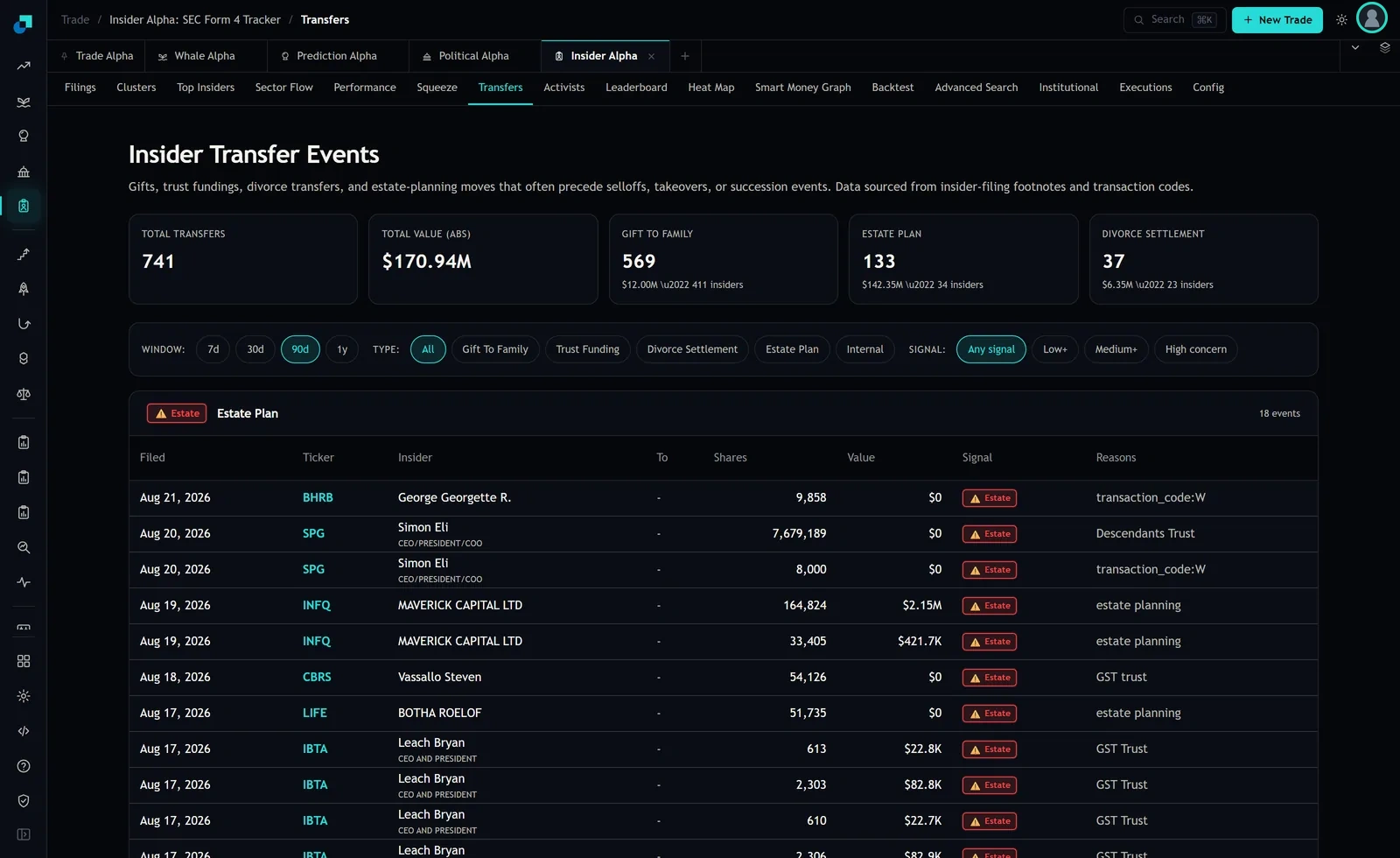
Two details in that table are worth an execution desk's attention. The Reasons column exposed the underlying basis for the classification, with values including estate planning, GST trust, Descendants Trust and the literal string transaction_code:W, which is the code the SEC transaction table assigns to acquisitions and dispositions by will or the laws of descent and distribution. And several rows carried a Value of zero dollars against large share counts, one of them close to 7.7 million shares, which is what you would expect from a transfer rather than a sale and is a reminder that the value column here is not a proxy for market impact.
What is not on this screen is any Form 144 content. I looked for a notice feed and did not find one on the captured pages, so the notice leg of this workflow has to be built against EDGAR directly. The module gives you the transfer leg, which is the earlier and quieter half.
The volume formula and which of its two tests actually binds
For an affiliate selling equity securities, the rule caps sales in any three month period at the greater of one percent of the outstanding shares of the class, or the average weekly reported trading volume during the four calendar weeks preceding the filing of the notice. Two tests, and the rule takes the larger, which means the binding constraint flips depending on how liquid the name is.
| Shares outstanding | One percent test | Daily volume | Average weekly test | Quarterly cap | Cap in days of volume |
|---|---|---|---|---|---|
| 500m | 5.0m | 4.0m | 20.0m | 20.0m | 5.0 |
| 100m | 1.0m | 300k | 1.5m | 1.5m | 5.0 |
| 40m | 400k | 50k | 250k | 400k | 8.0 |
| 20m | 200k | 15k | 75k | 200k | 13.3 |
The last column is the one to internalise. In the liquid rows the volume test binds and the cap is five days of volume per quarter, which is a manageable overhang. In the thin rows the one percent test takes over and permits a single affiliate to sell eight or thirteen days of normal volume in three months. The rule is more permissive in illiquid names, not less, which is the opposite of the intuition most people carry.
Note also the reference period. The volume test looks back at the four calendar weeks preceding the filing of the notice, so an affiliate who files after a period of unusually heavy trading locks in a larger allowance for the following three months. Elevated volume around an event therefore expands the legally available supply for the quarter that follows it, which is a structural reason for post event weakness that has nothing to do with anyone's view of the business.
What a transfer does to the volume allowance
This is where the transfers panel and the volume formula meet, and it is the part that is easy to get wrong.
A bona fide gift does not restart the clock. The recipient can generally tack the donor's holding period, so shares that were already seasoned in the donor's hands remain seasoned. What a gift can do is move shares from an affiliate to someone who is not one, and a non affiliate holding seasoned shares of a reporting issuer is not subject to the affiliate volume cap at all. That is the transformation to watch: not a change in ownership economics, which may be modest, but a change in the regime governing how fast the shares can be sold.
The rule anticipates the obvious arbitrage. It contains aggregation provisions that combine sales by donees, pledgees, trusts and estates with sales by the donor or settlor for a defined period after the transfer, so a transfer does not immediately create a second independent allowance. The practical effect is a delay rather than a block, and a delay is something an execution desk can put a date on.
Which is why the panel's categories are worth separating rather than aggregating. Gift To Family at 569 events and 12.00 million dollars is a high count of small moves, mostly noise for supply purposes. Estate Plan at 133 events and 142.35 million dollars across only 34 insiders is the opposite shape, and it is where a change in selling regime is worth modelling.
Reading the notice as an execution input rather than a signal
Do not treat a Form 144 as a directional call. It is a statement of intent to sell within a reasonable time under a rule that requires a bona fide intention, filed by someone whose reasons are frequently personal, and it is filed by a great many people who have no view on the price at all. Trading it as sentiment is a category error.
Treat it instead as a supply schedule. What it gives you is an upper bound on shares that may reach the market from that holder during the period, an approximate start date, and a broker. Combine that with your own average daily volume series and you get a percentage of expected volume that is committed to one seller, which is a genuine input to your own participation plan for the same days. If a filer has noticed an amount equal to six days of volume and you were planning to accumulate at fifteen percent of volume that week, you are competing with a large, price insensitive, legally constrained counterparty, and the sensible response is to widen your window or step aside.
The last piece of hygiene is to reconcile notice against execution. A notice is permission, not obligation, and a substantial share of noticed amounts are never fully sold. Keep a running comparison between what was noticed and what subsequently appeared in the Form 4 record, per filer. Filers who consistently sell their full noticed amount are a different planning input from filers who notice and then do nothing, and after a few quarters that distinction is a fact about a specific account rather than a guess, which is exactly the kind of thing an execution desk can act on without asserting anything about anyone's motives.