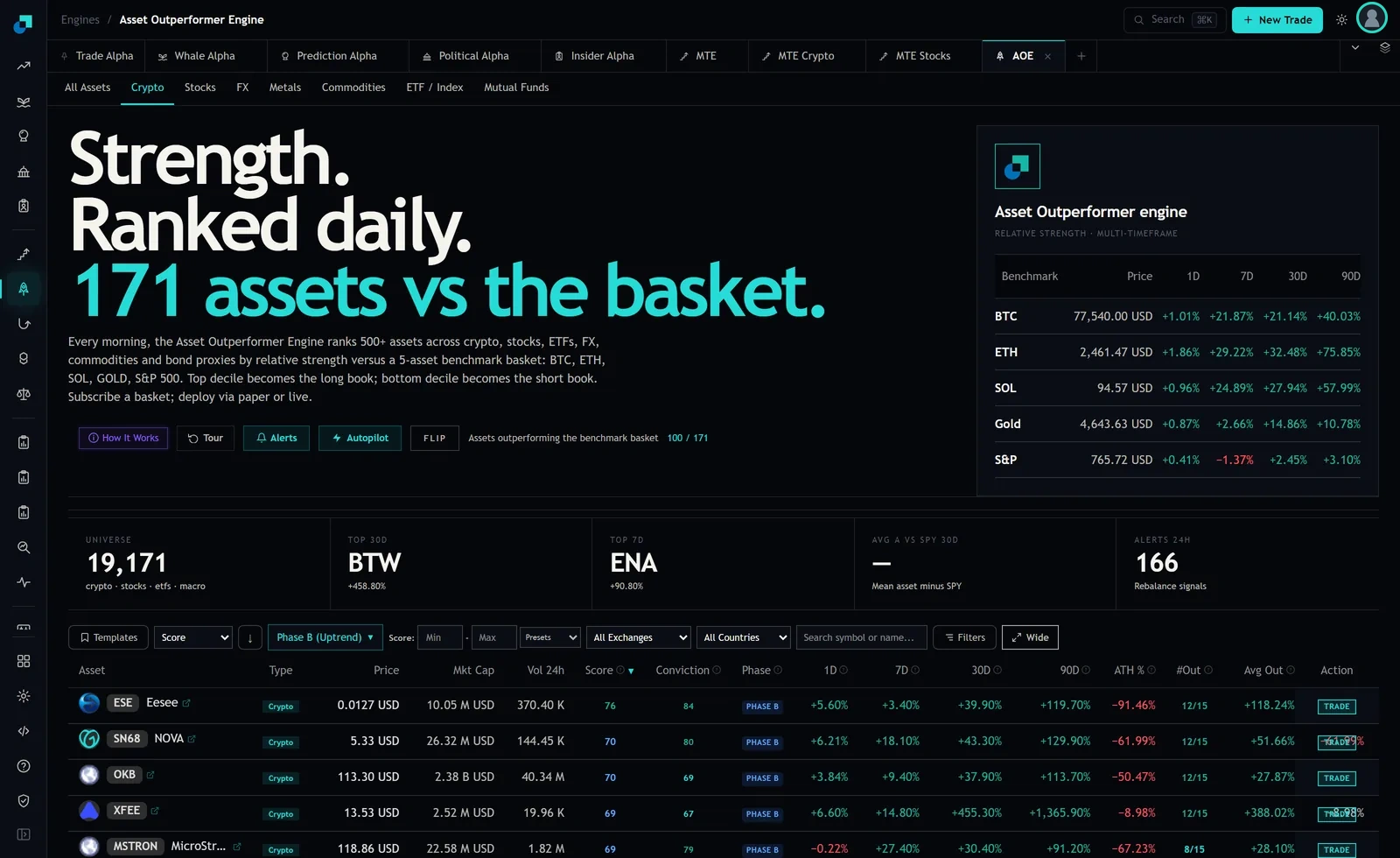
Fifth row down the crypto tab at capture, sitting between XFee and Tectum, was a ticker reading MSTRON. The Type cell said Crypto. The score was 69, which put it inside the top five tokens on the board. The full name in the Asset column read MicroStrategy, in brackets, Ondo Tokenized Stock.
That is not a token in the sense that the four rows above it are tokens. It is a wrapper around the shares of a listed US company, and the price, the returns and the score attached to it are all describing that company's equity. The ranking is doing exactly what it was asked to do. The problem is what you conclude from it if you did not notice.
What the row is actually tracking
Everything on that row is downstream of an equity. The price at capture was 118.86 dollars, which is a share price, not a token price. The 1D column read minus 0.22 percent while all five benchmarks on the panel were positive. The 7D read plus 27.40 percent, the 30D plus 30.40 percent and the 90D plus 91.20 percent. Those are moves in a company's stock, delivered to you in a crypto wrapper.
The comparison the board is making is therefore between a US-listed equity and a set of crypto assets, scored against a basket that contains both crypto and equity benchmarks. That is not nonsense, but it is not the comparison you think you are making when you scan the crypto tab looking for a token to buy. You are looking for relative strength among tokens, and one of your candidates is not one.
It also runs on a different clock. The underlying shares trade in an equity session with fixed hours and closed weekends, while Bitcoin, Ethereum and Solana on the benchmark panel trade continuously. So the daily and weekly return cells for a wrapper and for a token are being measured over windows that do not line up, and the small negative day on that row is exactly the shape you would expect from a wrapper whose underlying was not open for part of the period being measured.
Three tells that catch a wrapper in seconds
You do not need to know the ticker conventions. Three things on the row give it away.
- The name carries a parenthetical. Both wrapped rows visible on the crypto tab at capture spelled it out in the Asset column as an Ondo Tokenized Stock. Anything with a bracketed qualifier after a recognisable company name deserves a second look.
- The ticker is a real equity ticker with something bolted on. MSTRON and BMNRON are the two on that board, and in each case an ordinary listed-company ticker has picked up a two letter tail. A crypto ticker rarely looks like a company abbreviation with a suffix.
- The price is share shaped. Tokens on that board were quoted at 0.0127, 5.33, 113.30 and 13.53 dollars, so a share-like price is not proof by itself. What is close to proof is the price sitting next to the market cap. At 118.86 dollars and a 22.58 million dollar market cap, the implied count of units outstanding is under two hundred thousand. No listed company has two hundred thousand shares. The market cap cell is measuring the wrapper, not the business.
That last observation is the useful one, and it generalises. On a wrapper row, market cap and 24 hour volume describe how big and how liquid the wrapper is. They tell you nothing about the underlying company or about the depth of the real equity market behind it. The wrapper on that board showed 1.82 million dollars of daily turnover, which is the number that would govern your fill, and it bears no relationship to how much of the actual stock changes hands.
The rule to apply before you compare tokens
The board has a search box on the toolbar, and the fastest version of this is to type the word Tokenized into it and see what comes back. Whatever appears is the set you are about to exclude. Do that once each session before you rank anything, because the membership changes.
Then set the rule and stop thinking about it: if the Asset name contains a bracket naming a tokenized equity, the row leaves the crypto shortlist. Not because the instrument is bad, but because it is answering a different question than the rest of the board.
One caution about relying on this being tidy. Of the two wrappers on the crypto tab at capture, one was scored and ranked fifth, while the other, a wrapped BitMine Immersion Technologies, sat further down the same tab with a dash in every price and return column and a score of 0. So wrappers do not appear in a single consistent block that you can learn to skip by position. Some are ranked, some are unscored, and the only reliable filter is the name.
Skewing the board is a bigger effect than one row
One wrapper in a top five is not, by itself, a disaster. The effect that costs you money is subtler and it works through comparison.
When you scan a ranked board, you are implicitly calibrating. You are learning what a score of 69 looks like, what kind of 30 day move earns a place in the top rows, how much market cap a top ranked name usually carries. Wrapped equities sit inside that calibration carrying return profiles generated by an entirely different market, and they drag your sense of the distribution around. A token that fails to keep up with a wrapped equity in a strong equity tape has not necessarily failed at anything, and a token that beats one has not necessarily achieved anything.
It also distorts the diversification you think you are getting. If you build a five name basket off the crypto board and one of them is a wrapped stock, you have four crypto positions and one equity position, which is a different portfolio from the one you set out to build and behaves differently in a crypto drawdown. That can be a good thing. It should still be a decision rather than an accident.
When the wrapper is the point
There is an honest case for these instruments, and it is worth stating rather than dismissing. If you want exposure to a listed company and cannot easily open a US brokerage account, a tokenized wrapper is a route to that exposure, and the crypto tab is where you will find it.
If that is what you are doing, change the comparison set to match. Move to the Stocks tab, which ranked 522 assets at capture against the same benchmark basket, and see where the underlying company actually sits among its peers. Ranking a wrapped equity against Hathor and Acurast tells you almost nothing you can use. Ranking the underlying against other equities tells you whether the company is strong, which is the question you were really asking.
And hold one risk in mind that no column on this board reports. Owning a wrapper means owning an issuer's token that references a share, rather than owning the share. Whether that token can be redeemed, by whom, and under what conditions is a question about the issuer, and the answer is not on the row. Go and find it before you size the position, not after.