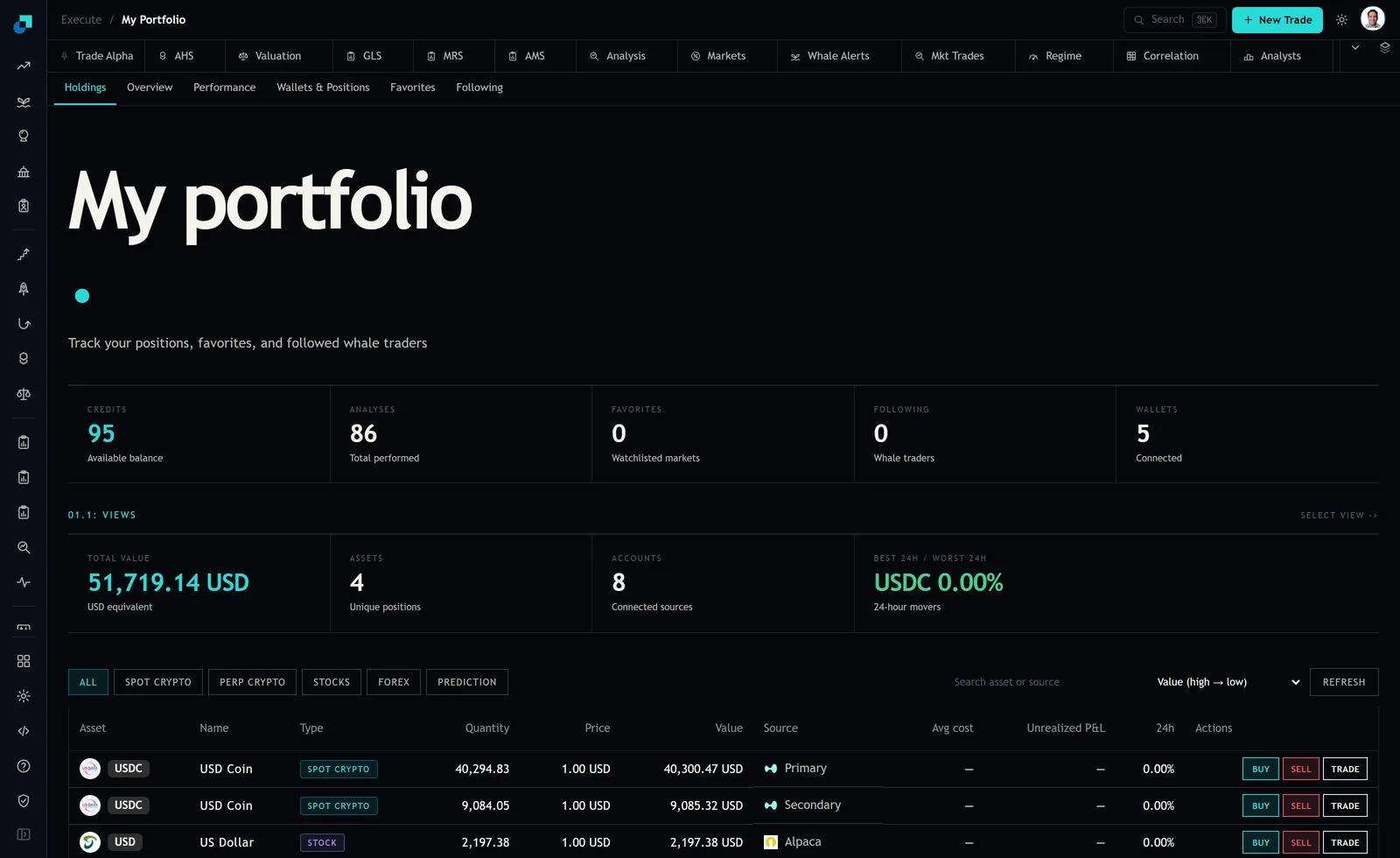
The Total Value tile in the capture reads 51,715.70 USD and the Assets tile reads 4 unique positions. Both are correct and neither is the number you should be sizing your next trade against, because a stablecoin balance counts as an asset and as value, while behaving in your book like cash sitting in a current account.
There is a tell for this on the same screen. The BEST 24H and WORST 24H tile shows USDC at 0.00 percent. The same stablecoin is occupying the best and the worst slot at a change of nothing, which happens when the book does not contain enough assets with a moving price to fill both ends. A book like that is mostly dry powder, and the total value figure will not say so.
What the tile is measuring
Total Value is the USD equivalent of everything connected. That is the right definition for the question how much money do I have, and the wrong one for almost every other question you ask a portfolio screen. If you hold 51,715.70 and 40,000 of that is USDC, then your invested capital is roughly 11,700 and your cash is roughly 77 percent of the book. Those two figures produce completely different trades.
The Assets tile has the same property. Four unique positions sounds like a small but real portfolio. If one of the four is a stablecoin, you have three positions and a cash pile, and your actual diversification is thinner than the tile implies. The count treats a dollar token as a holding, which is technically true and practically misleading.
Two denominators and which one your rules mean
Every position sizing rule you have ever read uses a percentage, and the percentage is meaningless until you say what it is a percentage of. There are two candidates and you need both.
Total value is the right denominator for drawdown questions. If everything you own fell by a third, how much money is that, and can you live with it. Cash included, because cash is what makes the answer survivable.
Invested capital, meaning total value minus the stablecoin balance you are treating as dry powder, is the right denominator for concentration and conviction questions. If you follow a rule like no single position above 20 percent, applying it to the 51,715.70 total gives you a 10,343 dollar cap. Applying it to the 11,700 of actually invested money gives you a 2,340 dollar cap. That is a four times difference in the size of the trade you are about to place, driven entirely by which number you used.
My rule of thumb is that risk limits run on total value and conviction limits run on invested capital. The first one keeps you solvent. The second one stops you telling yourself you are diversified when three quarters of the book is a dollar token and the rest is one bet.
The maths that makes the cash look invisible
Here is the arithmetic that catches people. Say you are up 20 percent on your invested sleeve of 11,700, which is a very good outcome. That is 2,340 dollars of gain. Against the full 51,715.70 total, the book is up 4.5 percent and it feels like nothing happened.
The reverse is where the real damage is. Suppose the invested sleeve halves. You have lost 5,850, and the total value tile drops from 51,715.70 to about 45,865, a fall of 11 percent. Somebody reading only the tile concludes they had a bad quarter. What actually happened is that half of the money they were actually risking is gone, and the position sizing that produced it has not been examined because the headline number softened the blow.
Cash in the book is genuine protection and I am not arguing against holding it. What I am arguing against is letting it launder the performance of the part of the book that is taking risk. Judge the invested sleeve on its own terms and hold the cash decision separately.
When stablecoins are genuinely a position
All of the above assumes the stablecoin is doing nothing but waiting. Sometimes it is not, and then it belongs in the invested column with everything else.
- It is earning yield somewhere. Lending, a pool, a staking product. Then it is a credit position with a counterparty and a smart contract behind it, and the yield is the compensation for that risk. That is a position and it should be sized like one.
- It is posted as margin. Collateral behind a perp is not dry powder. It is spoken for, and the amount you can actually deploy tomorrow is what is left after it.
- It is a large single issuer holding. A dollar token is a claim on an issuer, and the risk is small but it is not zero and it is not the same as a bank balance. If 40,000 of a 51,715.70 book is one token, that concentration is worth being deliberate about, and splitting across two issuers costs you almost nothing.
- It is not on a chain you would choose. Stablecoin balances have a habit of accumulating wherever the last trade left them, which is a bridge risk you never consciously accepted.
Rewriting your rules in terms of invested capital
The practical change takes about fifteen minutes and it holds for months.
- Read the Total Value tile and write it down. In the capture that is 51,715.70.
- Add up every stablecoin row across every source. Wallets, exchanges, margin balances, everything. Split it into two lines, spoken for and free.
- Subtract the free stablecoin balance from the total. What is left is your invested capital, and it is the denominator for every concentration rule you have.
- Recalculate your largest position as a share of that number rather than the total. Most people find their biggest holding is ten to twenty points larger than they thought, and some find it is more than half.
- Write both numbers at the top of whatever you keep your trading notes in, and refresh them monthly rather than daily.
Then set the cash level on purpose instead of by accident. The honest question is what percentage of the book you want available for the next opportunity, and once you have answered it, a stablecoin balance far above that figure is not dry powder any more, it is a decision you have not made yet. The tile will never tell you that. It counts the dollars and moves on.