Most small accounts do not fail because the owner picked bad tokens. They fail because the owner looked at the market forty times a week, and each look was an invitation to do something, and the something cost money. A routine is the cheapest fix available. Fixed day, fixed length, fixed order, and a cap on how many decisions can come out of it.
This is the fifteen minutes I would build around the Altcoin Market Scorecard for an account in the low thousands. It is deliberately boring, and the boring parts are the ones doing the work.
The fifteen minutes, in order
Pick a day and an hour and keep them. Sunday evening or Monday morning both work. What matters is that it is the same slot every week, because a routine that moves gets skipped, and a routine you skip in bad weeks is a routine that only ever runs when you are feeling good about the market.
- Minutes zero to three. Open the scorecard on your chosen timeframe and write down three numbers by hand. The composite, the regime label, and the momentum label. In the screenshot below those read 61, BULLISH and RISING on 1D. Write them in the same file every week so you build a history.
- Minutes three to seven. Open the Sectors tab and note which sectors are leading and lagging. One line. You are looking for whether the strength is in the sectors you actually own.
- Minutes seven to ten. Check your own holdings against Bitcoin over the week on the vs BTC view. Count how many of your positions beat it and how many did not. That count is your personal breadth, and it is a more useful number than any market-wide reading for deciding what to do next.
- Minutes ten to thirteen. Write one sentence describing what you are going to do, including the case where the sentence is "nothing this week". Writing it before you open your broker is the point.
- Minutes thirteen to fifteen. Close everything and note the date of your next session. If you are tempted to keep going, that temptation is the thing the routine exists to interrupt.
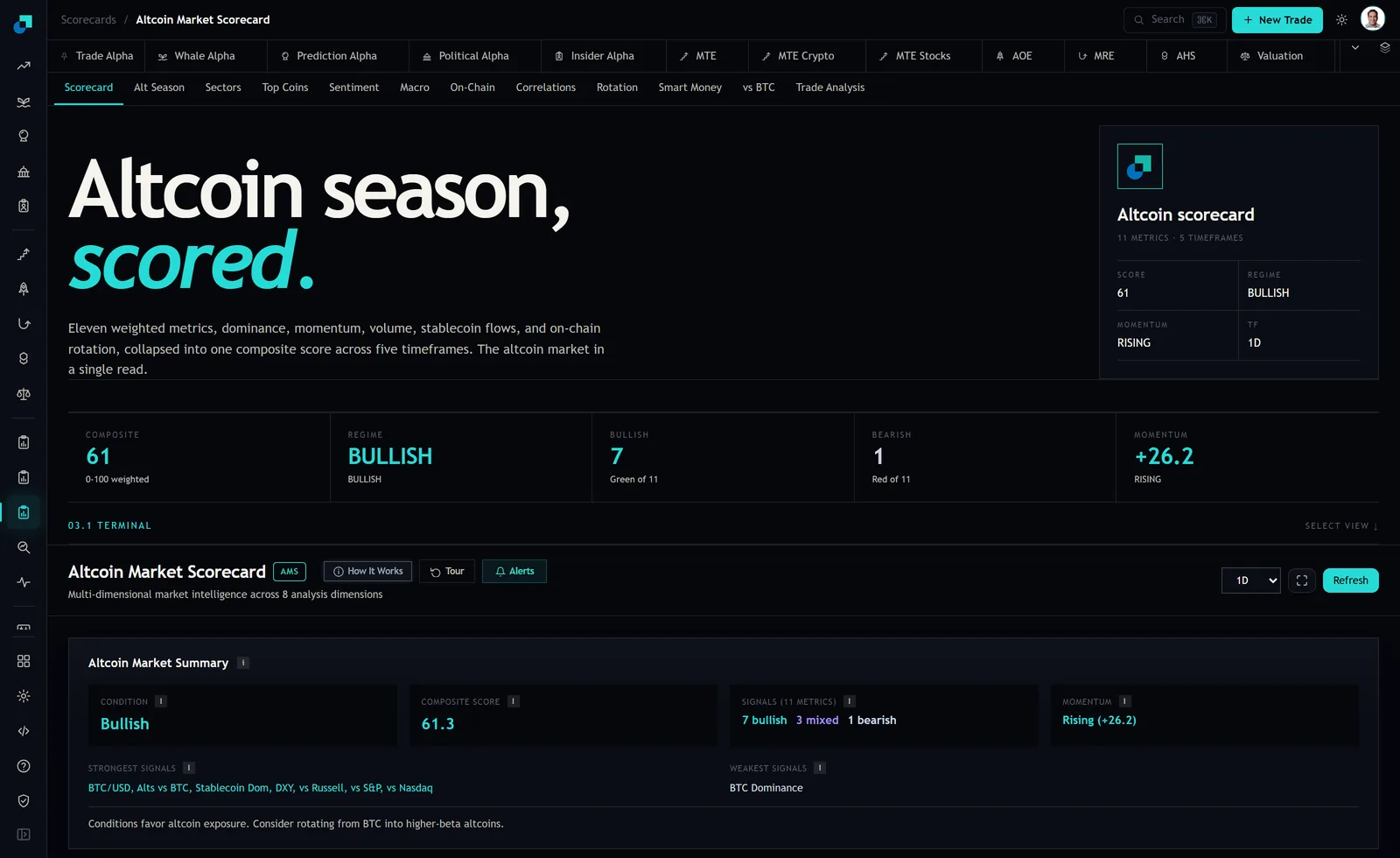
Why the numbers get written down before you look at your account
This ordering looks fussy and it is the single highest-value rule in the whole routine.
If you check your portfolio first, you do not read the scorecard afterwards. You audit it. A red week makes a composite of 61 look like a panel that is missing something, and a green week makes the same 61 look like confirmation that you are a genius. Same number, two different articles read into it, and the difference is entirely what you saw ten seconds earlier.
Writing the reading down in a file, by hand, before the account is open, breaks that. It also gives you something no single reading gives you, which is a series. After three months you have twelve entries, and you can see whether the composite has been grinding up or down, which is far more informative than today's value. You will also catch yourself, because the file records what you said you would do next to what you actually did.
The two readings that justify looking off schedule
The routine is weekly, but not rigidly so, and it is worth being precise about what earns an extra look rather than leaving it to how you feel on the day.
The first is a change in the regime or momentum label. Those labels are summaries of the same eleven-metric blend that produces the composite, so they move less often than the number does. When one of them flips, something has changed at a level above day-to-day drift, and looking at the module to see what is a legitimate use of your time.
The second is a move of several points in the composite inside a single day. The composite is a weighted blend of eleven inputs, which include slow-moving measures such as exchange reserves, stablecoin flows, NVT and MVRV alongside faster ones such as funding rates and open interest. No single input carries enough weight to move the blend by several points on its own. So a large one-day move means several inputs moved together, and that is a genuinely different event from a price move in one token.
Even then, the off-cycle look is a look. Not a trade. The rule I would set is that an off-cycle session can only ever produce a risk-reducing action or a note to consider something at the next scheduled session. Anything that increases exposure waits for the routine, because urgency is the reliable marker of a decision you are going to regret.
The readings that never justify an extra look
A shorter list, and worth putting somewhere you will see it.
A single point of movement in the composite. On a 0-100 blend of eleven metrics, one point is inside the range that ordinary drift in a single input can produce. Sixty-one to sixty-two is not news, and treating it as news is how a weekly routine becomes a daily one.
A green day, or a red one. Price is not one of the things you are checking here. If your process reacts to price on a Wednesday, you do not have a weekly routine, you have a price alert with extra steps.
Somebody else's opinion. A post, a video, a group chat message. If it contains information, it will show up in the numbers you check on your scheduled day. If it does not show up there, it was not information.
And the worst one, a position that has moved against you. This is the moment the routine is protecting you from, and it is precisely when you will most want to break it. The scorecard has nothing to say about your entry price. Opening it after a bad move is not research, it is looking for permission.
What the routine costs and what it saves
Run the numbers on a 5,000 dollar account, because the case for cadence discipline is arithmetic rather than temperament.
Suppose an unstructured approach leads to two adjustments a month, each moving about 1,500 dollars out and back in. At a realistic all-in cost of 0.20 percent per leg, including the spread you actually cross, that is roughly 6 dollars per adjustment and about 144 dollars a year, near enough 2.9 percent of the account. A weekly routine with a hard cap of one change per session, and most sessions producing none, plausibly cuts that to three or four changes a year, which is under 25 dollars. The gap is more than two percent of the account annually, and unlike your token selection it is a return you can bank in advance by doing less.
The other saving does not show up in a fee statement. A capped routine means you cannot fully unwind on a bad Tuesday, which removes the single most expensive action available to a small account. If the honest output of three consecutive sessions is "no change", the routine is not underperforming. It is doing exactly the job you built it for, and the temptation to add steps to it because it feels too quiet is the next thing to resist.