Automation does not usually fail one trade at a time. It fails on the day a regime turns and nine strategies that looked independent all decide the same thing within a few hours of each other. Every individual order is correct. The book that results is three times the exposure you thought you had agreed to, entered at the worst prices of the week, and you were not at your desk.
A daily cap is the control that makes that day survivable. It is two numbers, they are different numbers, and both should be derived from the strategy's own history rather than picked because they sound sensible.
What the page tells you, and what I am not going to claim
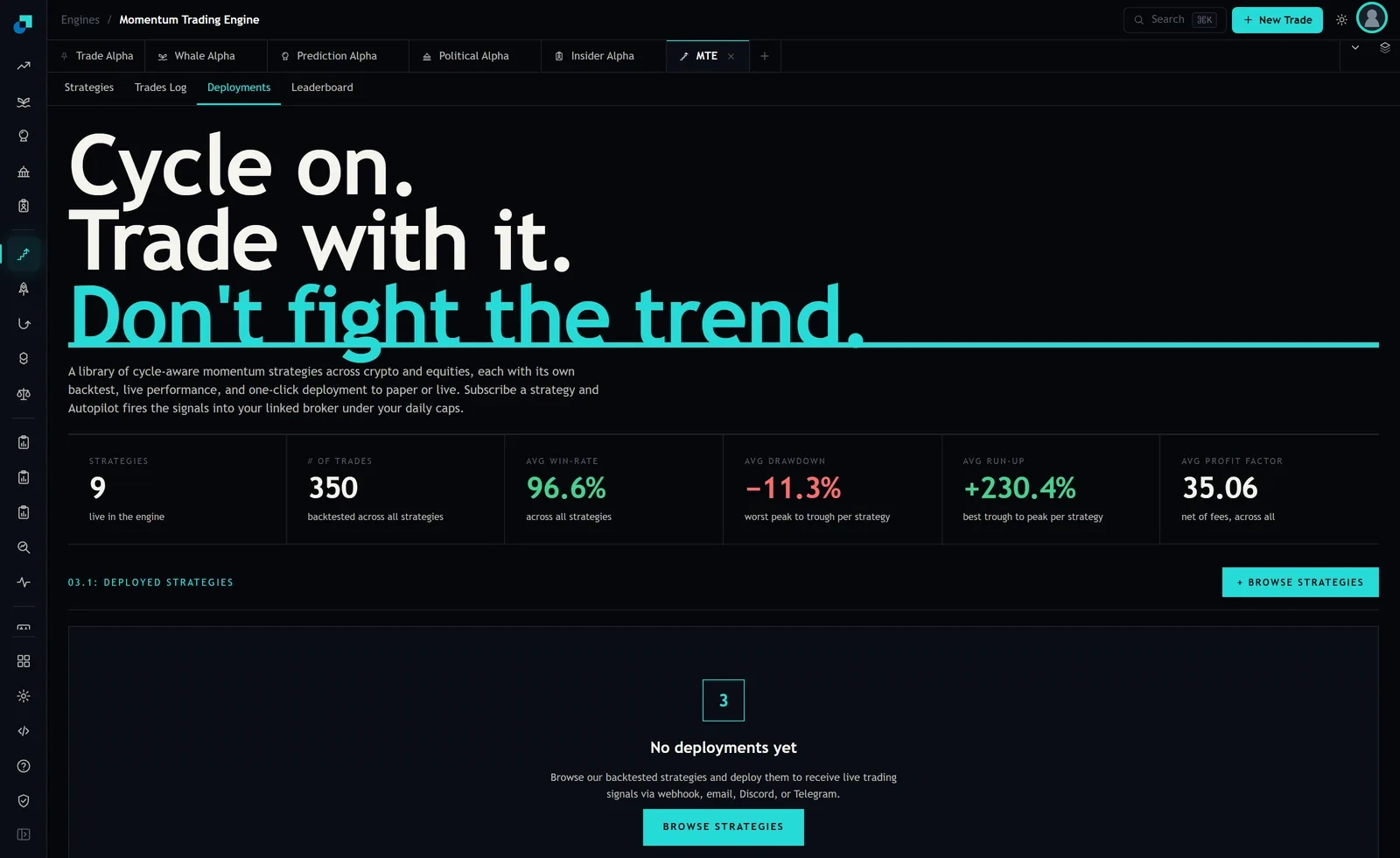
The description at the top of the engine says it plainly: subscribe a strategy and Autopilot fires the signals into your linked broker under your daily caps. So the caps are the engine's own framing of how automated execution is bounded, and the linked broker is where the orders land.
Here is the honest limit of what I can show you. The deployments panel at capture was an empty state, headed DEPLOYED STRATEGIES with a browse action, reading that there were no deployments yet and that you browse the backtested strategies and deploy them to receive live trading signals via webhook, email, Discord or Telegram. I did not see the cap form itself, so I am not going to describe fields, units or enforcement behaviour I have not looked at. What follows is how to arrive at the two numbers and how to verify what your setup actually does with them, which is the part that is yours regardless of what the form looks like.
The trade count cap comes from the worst cluster day, not from a round number
Do not pick three because three feels reasonable. Compute it.
Take every strategy you intend to run and pull its closed trades. Bucket the entries by calendar date, across the whole book at once rather than per strategy. Count the entries in the busiest single day. Then count the busiest day in each quarter, so you can see whether the maximum is one freak session or a recurring pattern.
That maximum is the number your cap has to handle, and the arithmetic behind it is unforgiving. The engine reports 350 trades backtested across 9 strategies, roughly 39 each. Spread evenly over a couple of years, 39 entries per strategy is about one every two to three weeks, so on any given day the expected number of signals across nine strategies is well under one. The average is not the problem. The problem is that momentum entries are not independent draws, because a trend beginning across an asset class triggers the same condition in multiple configurations on the same session. A book whose average day is 0.3 signals can absolutely produce a six signal day, and if you sized your account for the average you are now six positions deep in one direction.
Set the cap at the observed worst day if you can carry that exposure, and below it if you cannot. Setting it below the historical maximum is a deliberate choice to miss trades on exactly the days the strategy was most active, which is a real cost and you should know you are paying it rather than discovering it later.
The notional cap is a loss tolerance calculation and it is unrelated to the count
The count cap limits how many things can go wrong. The notional cap limits how much each one costs, and you derive it backwards from the daily loss you are willing to take.
Work it with real numbers. Take a 25,000 dollar account and a daily loss tolerance of 2 percent, which is 500 dollars. If your strategy's stop sits roughly 8 percent from entry, then each 1,000 dollars of new notional risks about 80 dollars. Divide 500 by 80 and you get 6,250 dollars of new notional as the day's ceiling, across all strategies combined.
Now cross-check that against the count cap. If your worst cluster day was six entries and your notional ceiling is 6,250 dollars, then each new position on such a day is about 1,040 dollars. Ask yourself whether a 1,000 dollar position is worth taking at your commission level after the round trip costs. If it is not, you do not have a cap problem, you have too many strategies for the size of the account, and the fix is to run four rather than nine.
The engine's average drawdown tile reads minus 11.3 percent, described as worst peak to trough per strategy, and it is worth using as a sanity input while remembering what it is. It is a backtest figure, averaged across the library, from samples of a few dozen trades each. A worst case computed from 39 trades is the worst thing that happened in a small sample, not a bound. Assume yours is larger and set the notional cap accordingly.
Two limits that are not the daily cap and still decide your outcome
A daily cap constrains new activity. It says nothing about the book you have already accumulated, and that is where the second failure mode lives.
You need a total open exposure limit as well, expressed in gross notional, because five consecutive days at a six position daily cap is thirty open positions and no daily cap will have objected once. And you need a per position cap, because a cap on the day's total does not stop one signal consuming the entire allowance while five others get rejected behind it, which quietly turns a diversified book into a single bet.
Also decide the interaction with direction. A daily cap that counts a long and a short as two units of risk is treating an offsetting pair as if it were a doubling. That may be what you want for simplicity, but decide it deliberately rather than inheriting it.
Test the cap with a live order before you rely on it
A limit you have configured and never triggered is a limit you are assuming, and this is the check that separates people who have caps from people who have cap settings.
Set the cap deliberately low for one session, low enough that the next signal exceeds it, using the smallest position size your broker allows. Then answer three questions from the record afterwards. Did the order get rejected, and did you see the rejection or did it happen silently? Where did the rejection appear, at the engine or at the broker? And what happened to the signal that was blocked?
That last one matters more than it sounds. A blocked signal that is dropped means you simply did not take that trade. A blocked signal that queues and fires the next session means you took the trade a day late, at a different price, in a position the strategy's backtest never held, and your live record will diverge from the paper one for a reason you will struggle to reconstruct months later. Those are two very different systems and you should know which one you own before the cluster day arrives rather than after.
Then write the two numbers, the count and the notional, at the top of the same page where you keep your strategy list, with the date you set them and the cluster day figure they came from. When you add a tenth strategy, the cluster day arithmetic changes and the caps are stale from that moment. Almost nobody goes back and redoes it, which is why the fastest way to breach a cap you set carefully is to keep subscribing.