The header on the whale tracker says the module covers every wallet movement above your threshold across EVM, Solana, BTC and Polymarket, with tagged cohorts covering VC, OG, smart money and insiders. That last word is the one that will stop a strategy in review, and it will stop it for a reason that has nothing to do with the strategy.
None of what follows is legal advice and none of it substitutes for your own counsel. It is the set of questions I have watched compliance ask about cohort-tagged wallet data, in the order they get asked, and what you can and cannot answer from the screen itself.
The first question is about provenance, and the screen cannot answer it
Compliance will not open with a question about materiality. It will open by asking where the tag came from. Is a wallet marked as an insider because someone matched a public disclosure, because a wallet self-identified, because it appeared in a leak, or because a heuristic guessed from transaction patterns. Those four origins carry completely different answers to everything that follows.
Look at what the feed actually gives you. The table columns at capture were Whale, Market, Dir, Amount, Platform, Entry, Current, PnL, Win Rate, Smart Score and Time. There is no tag column, no confidence field, and no as-of date on the classification. The tags are described in the module's header copy, and the rows in front of you do not carry them.
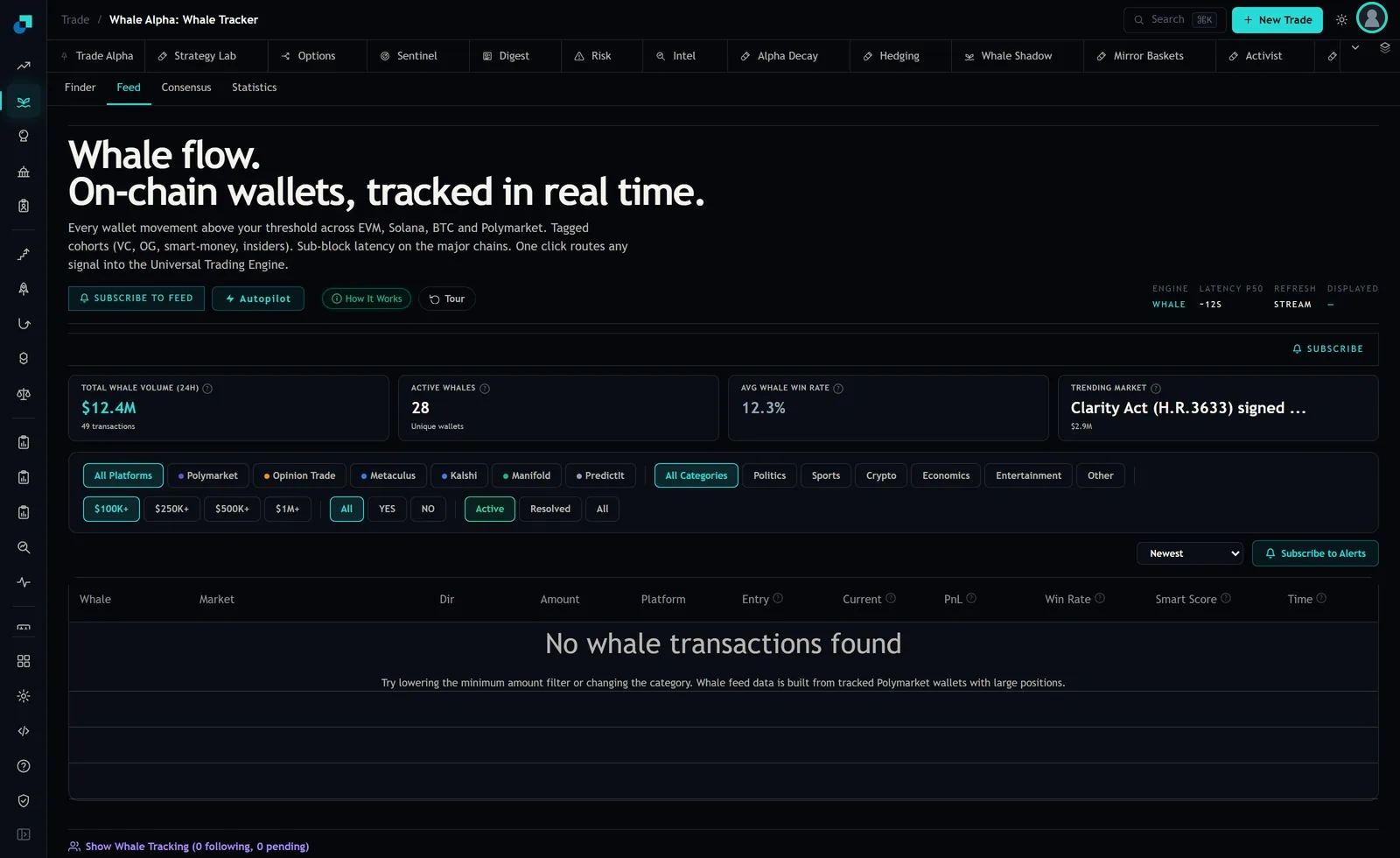
So the honest answer to the first question is that the tag is a vendor assertion you cannot evidence from the product surface. That is not a reason to stop. It is a fact that has to be written into the file in those words, because the alternative is a memo that implies a verification you never performed.
Public data is not automatically clean
The argument that gets made in the room is that everything here is on a public blockchain, so there is no confidentiality question. The reason that argument does not close the matter is that the long-standing framing in this area turns on how information was obtained and whether someone breached a duty in passing it on, not on how obscure the information is. Data being technically visible to anyone with a node does not by itself resolve the question.
Three fact patterns are worth separating before you take the question to counsel, because they get very different answers.
Raw chain observation. You watch an address and see a transfer. Nobody told you anything. This is the cleanest case, and it is the one most on-chain research actually is.
Attribution from public disclosure. You link an address to a named entity using filings, a company blog post, or a court document. Still clean on provenance, and the risk moves to whether your attribution is correct rather than whether you were allowed to know.
Attribution from a private source. A tag arrives from a vendor without a stated basis, and the basis may be a leak, a scraped internal system, or a relationship someone had with the entity. You cannot tell from the tag which of those it is, which is exactly why the question gets escalated. This is the pattern where a desk needs an answer from counsel before the first trade, not after the first profit.
What the desk can establish on its own
Two things, and they are worth doing before the escalation rather than after, because they often make the escalation short.
First, restate the tag as a hypothesis with a confidence level and put the wallet's observable behaviour next to it. If a wallet tagged as an insider trades a prediction market on political outcomes, ask what the insider relationship would even be. The module's own empty-state text says the feed is built from tracked Polymarket wallets with large positions, which tells you the selection rule for the population is size, not privilege. A tag applied to a population selected by size is describing the wallet, not the mechanism by which it knows things.
Second, build the trade thesis without the tag and see whether it survives. If your reason to take the position is the wallet's track record, its clip size, and the market's pricing, then the tag is decoration and you can drop it from the memo entirely. If the thesis collapses without the word insider, you have learned that the tag is load-bearing, and a load-bearing tag whose provenance is unknown is the thing compliance exists to catch.
The fields the trade file has to carry
The record is not a formality. It is the only thing that lets you reconstruct, months later, what you saw and why you acted, and reconstruction is the entire job when the question arrives.
- The screen, the tab, and the exact filter state. This one is not optional and the capture proves why: the tiles read 12.4 million dollars over 49 transactions with 28 active wallets, while the table returned no rows, because the size and status filters were set the way they were. Without the filter state the reading is unreproducible.
- The row as displayed, copied rather than summarised, including the timestamp and the platform.
- The tag, if it influenced anything, recorded as vendor-supplied and unverified, with the date you read it and the wording the product used.
- The independent thesis, written before the position, and explicitly separable from the tag.
- The approver, and if the tag was load-bearing, the counsel sign-off and its date.
One more field earns its place: the negative. If you checked whether the tagged wallet's identity could be corroborated from public sources and could not do it, write that down. An unrecorded failed check looks identical to a check nobody ran.
Where I decline
Three situations, decided in advance so the decision is not made under time pressure with a position in front of you.
A tag whose basis the vendor will not describe, on a trade whose thesis depends on the tag. Decline until the basis is described, because you cannot document what you were not told, and undocumented is where the review goes badly.
A tag that implies a relationship with a specific named individual or issuer, rather than a cohort label. Cohort labels like VC or smart money describe a type. A tag that effectively names a person is a different object and should route to counsel before it routes to a trader.
And any situation where the desk cannot reproduce the screen. The tracking control at the bottom of the feed read zero following and zero pending at capture, meaning nothing was pinned, so what any reviewer sees when they open the same page later is whatever the default filters produce. If the file does not carry the state, the trade cannot be defended, regardless of how good the reasoning was at the time.