An optimistic oracle works on a presumption. Somebody asserts what happened, posts a bond behind the assertion, and if nobody objects inside a defined window the assertion becomes the truth and the contract settles against it. The design is deliberate: most outcomes are uncontroversial, so making the default path cheap and the objection path expensive is the correct engineering trade.
It is also a design that hands your desk a decision it is usually unprepared to make. Some fraction of the time the assertion will be wrong, or right under a reading of the criteria you did not anticipate, and your position will settle to zero on a question you believe you won. At that moment the position stops being a trade and becomes a bounded option with a strike, a premium and an expiry, and the desk has hours rather than days to price it.
The cash flows, before any of the drama
Strip the mechanism to its money. A proposer posts a bond and asserts an outcome. A challenge window runs. A disputer posts a bond of their own and the question escalates to whatever adjudication layer the venue specifies. The adjudicator returns a decision, the losing bond is forfeited, and some portion of it flows to the winner while some portion is retained by the system.
Five parameters govern everything: the bond size, the length of the challenge window, the length of the escalation period, the share of the forfeited bond the winner receives, and who is eligible to adjudicate. Every one of those is set by the venue and can be changed by the venue. I am not going to quote figures for any of them, because a number in a blog post has no date on it and these parameters move. Pull them from the venue's own documentation, record the date you pulled them, and re-pull them before you rely on them.
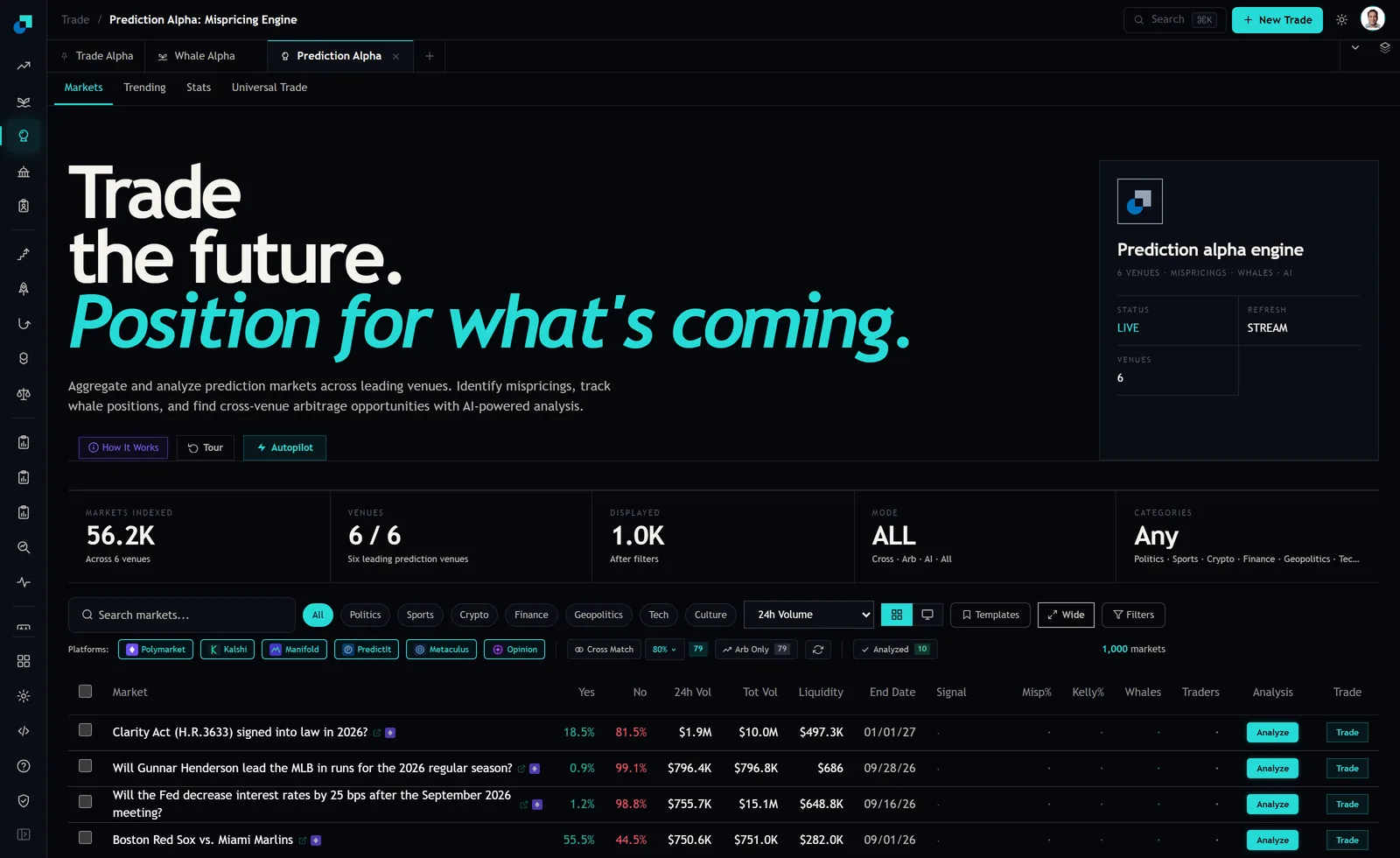
That absence in the screenshot is the operational point. The markets table gives you an End Date and stops. Which oracle governs the row, how long the challenge window runs, and what the bond costs are not fields in the feed, which means they are fields in your own pre-trade note or they do not exist anywhere your risk committee can find them.
The breakeven probability, written so a committee can check it
Define five terms. D is the disputed notional, meaning what the position pays you if the correct outcome is restored, against zero if it is not. B is the bond you must post. The fraction k is the share of the forfeited counterparty bond retained by the system, so you receive B times (1 minus k) if you win. C is your own cost of running the dispute: analyst hours, counsel review, monitoring, and the operational load of doing all of it inside the window. Finally P is the probability the adjudication goes your way.
Disputing is worth more than accepting when P times the sum of D and B times (1 minus k), minus (1 minus P) times B, exceeds C. Solve for P and you get a breakeven of (B plus C) divided by (D plus B times (2 minus k)), ignoring the financing cost of the bond, which is small unless the escalation period is long.
Now put assumed numbers through it, and treat them strictly as placeholders for your own. Suppose the bond is 5,000 dollars, half the forfeited bond is retained by the system, and your fully loaded cost of running a dispute is 12,000 dollars. On a disputed notional of 180,000 dollars, the breakeven probability is 17,000 divided by 187,500, which is 9.1 percent. You should dispute even when you think you will probably lose, because the position dwarfs the toll.
Hold those same parameters and shrink the notional to 9,000 dollars. The breakeven becomes 17,000 divided by 16,500, which is above one. There is no probability at which disputing is rational. You take the loss.
Your own cost, not the bond, sets the threshold
Rearrange for the notional at which a dispute becomes rational at a confidence you would actually assert. At 60 percent confidence with the same placeholders, you need the disputed notional to exceed roughly 21,000 dollars. Below that, a fund that is right and knows it is right should still walk away.
Notice which term drives that threshold. The bond is 5,000 and the internal cost is 12,000, so more than two thirds of the toll is your own organisation. Venues set bonds low enough to keep disputes accessible. Nothing stops a fund from making them inaccessible to itself by requiring three senior sign offs and an external opinion before a bond can be posted. If your process cost is 40,000 dollars, your dispute threshold sits near 70,000 dollars of notional and you have quietly written off every smaller position. That may be the right answer. It should be a decision rather than a discovery.
The uncomfortable corollary is about how you build positions. If a dispute is uneconomic below roughly 21,000 dollars, then every position under that size is short a free option on a bad resolution, and the counterparty who benefits from a sloppy assertion knows the arithmetic as well as you do. Splitting a view across many small questions to look diversified can leave you with no defensible position anywhere, because the ambiguity that hits all of them at once has to be fought one bond at a time.
Three ways the probability term goes wrong
The first and largest error is answering the wrong question. P is not the probability that you are correct about the underlying event. It is the probability that the adjudication mechanism returns your answer. Those are different populations with different information and different incentives, and the gap between them is widest exactly where you feel strongest, because a resolution that is obviously wrong to a specialist may be entirely defensible on the literal text of the criteria. Read the criteria as an adjudicator would, not as an analyst would.
The second is the clock. The challenge window runs on the venue's schedule, not on your business hours, and it does not extend for a weekend or a holiday. A dispute capability that exists only when a specific analyst is at their desk is not a capability. It needs a rota, an escalation path with named authority to post a bond, and an alert wired to the resolution rather than to the price.
The third is capital residency. Both the bond and, depending on the venue, the disputed collateral are frozen through escalation. That is a period during which the capital earns nothing, cannot be redeployed and may sit across a reporting date. If you run a monthly mark, decide in advance how a position in active dispute is carried, because the honest answer is neither the disputed value nor zero.
What goes in the file before the order goes out
Three artefacts, all of them cheap if written before the trade and impossible to reconstruct afterwards. A pre-trade resolution note recording the mechanism, the adjudicator, the challenge window in hours, the bond size, and the date those were confirmed. A standing dispute mandate carrying the breakeven formula with your own C plugged in, a stated notional threshold, and the name of the person authorised to commit the bond without convening anything. And a monitoring assignment tied to the End Date on the row, so that somebody is watching during the window rather than reading about the settlement afterwards.
The last line of that mandate is the one worth arguing about now rather than later. It should say what the desk does when the notional falls below the threshold and the resolution is wrong anyway. The answer is that you accept it, book it, and record the instance, because the running count of accepted bad resolutions is the only honest input you will ever have into the probability you were pricing at the start.