Category chips are the first thing anyone touches on a screener and the last thing anyone questions. You want politics contracts, you click Politics, you assume you are now looking at the politics contracts. On Prediction Alpha that assumption is wrong in a way that is easy to demonstrate and easy to work around once you know it is happening.
Seven chips, twenty buckets
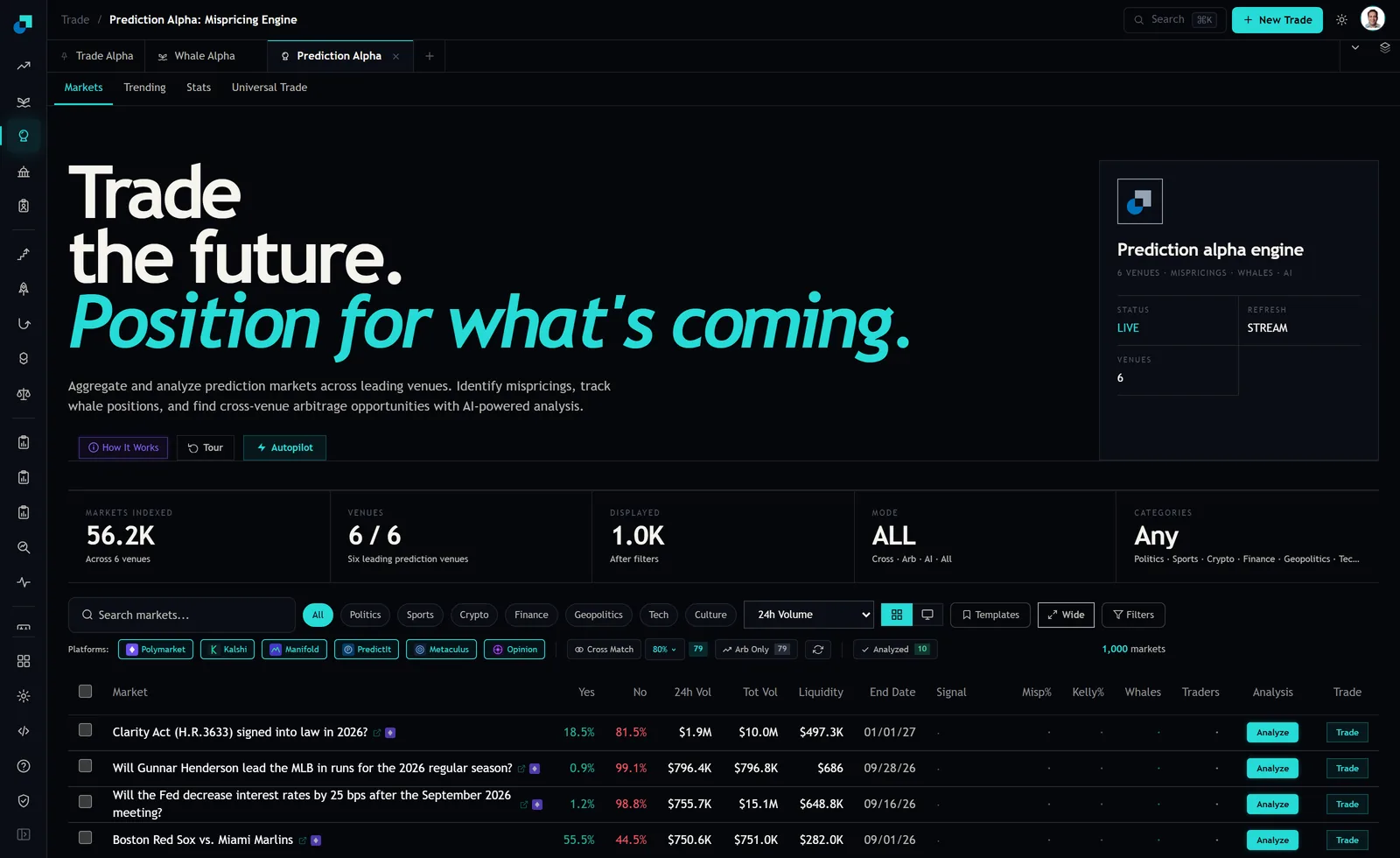
The markets tab gives you a row of category chips reading All, Politics, Sports, Crypto, Finance, Geopolitics, Tech and Culture. The header tile above them says the same thing, listing Politics, Sports, Crypto, Finance, Geopolitics, Tech and Culture as the category options. Seven real choices plus an escape hatch.
Now open the stats tab on the same module. The headline tiles read TOTAL MARKETS 33,737, PLATFORMS 6, CATEGORIES 20. Twenty, not seven. And the category breakdown chart lower down names all twenty, ranked by listing count.
Reading that chart from the top: Sports 47,154, Other 33,257, Politics 12,898, Tech 4,610, Elections 4,164, Geopolitics 3,083, Crypto 2,822, Finance 2,255, Culture 1,510, Entertainment 1,325, Economics 727, Science 444, Financials 402, Companies 256, Science and Technology 70, Economy and Business 64, Climate and Weather 26, Law 25, Environment and Climate 24, Health and Pandemics 24.
Line the two lists up. Sports, Politics, Tech, Geopolitics, Crypto, Finance and Culture appear in both. Thirteen do not have a chip, and the thirteen include some of the larger buckets on the platform.
The biggest bucket without a chip is called Other
Start with the one that should bother you most. Other holds 33,257 listings, which makes it the second largest category on the platform and close to a third of the categorised universe. There is no chip for it. There is no way to say show me the ones nobody could classify.
Then look at Elections at 4,164, which is larger than Geopolitics and larger than Crypto, both of which do have chips. Is Elections folded into the Politics chip, or is it unreachable the same way Other is? The screen does not say, and that ambiguity is the practical problem. If Elections is inside Politics, then clicking Politics gives you 17,062 listings rather than the 12,898 the chart shows, and any counting you do off the chip is wrong. If it is not, you are missing four thousand contracts in the category you thought you had selected.
The same question applies to Entertainment at 1,325, which may or may not sit under Culture, and to Economics at 727 and Financials at 402, which may or may not sit under Finance. Every one of those is a boundary you cannot see and cannot verify from the chip row.
Why the taxonomy looks like this
The shape of the twenty makes the cause fairly clear, and it is not carelessness. Look at the near duplicates in that list. Finance and Financials. Economics and Economy and Business. Tech and Science and Technology. Climate and Weather and Environment and Climate.
Those are not four pairs of subtly different concepts. They are the internal vocabularies of six separate venues, merged into one list. Each venue labels its own contracts, one calls a bucket Finance and another calls it Financials, and the aggregator keeps both because guessing that they are the same thing would silently destroy information. Anything that did not map onto a recognisable label at all landed in Other, which is why Other is enormous.
Understanding that changes what the chips are for. A chip is not a property of a contract. It is a rollup that somebody defined to make a seven item row fit on a screen, sitting on top of a twenty item list that was itself assembled from six vocabularies. Two contracts under the same chip can come from different venues, different labelling conventions and completely different underlying buckets.
Search the wording, not the category
The practical workaround is to stop using the chip as your primary filter and start using the search box next to it, because search operates on the market text rather than on the taxonomy.
The thing that makes this work is that event contract titles are unusually literal. They have to be, because the title is doing legal work at resolution. So the wording is predictable and searchable in a way that ordinary asset names are not. If you want election contracts, search the words that appear in election contract titles, things like nominee, winner, elected, or a specific office or district. If you want rate contracts, search the language rate questions use rather than clicking Finance and hoping.
The evidence that this reaches things the chips do not is in the capture itself. The trending tab's arbitrage board is full of contracts titled as individual House district winners, and the volume board is full of individually named fixtures. Those are findable by their wording in seconds and effectively unfindable by category, because the category they sit in is either a rollup or Other.
Two habits make search work better here. Search for the noun that must appear rather than the topic you are interested in, because the topic is your word and the noun is theirs. And run two or three phrasings for the same idea, since six venues will not have chosen the same one.
Save the view, or you will rebuild it every week
Once you have a combination that reaches what you want, which is usually a search term plus a venue selection plus something in the Filters panel rather than a chip at all, save it. The module supports saved views with custom filters and sorting, and this is the single highest value thing on the page for anyone doing a weekly pass.
The reason is not convenience. It is reproducibility. A screening pass you cannot reproduce exactly is not a pass, it is browsing. If you rebuild the filters from memory each week, the population you are looking at drifts, and any impression you form about whether a category is getting more crowded or thinner is an artefact of your own inconsistency rather than a fact about the market.
So build two or three saved views deliberately, one per genuine research interest, and write down what each was meant to capture. Include the venue chips in the saved state, because venue is often a cleaner cut than category on this platform: the venues have genuinely different listing conventions and a venue filter tells you something real about who is on the other side, which is more than a chip can do.
And when you do want a category level count, take it from the stats tab chart rather than from the chip, because the chart names all twenty buckets and shows the counts. The chip will give you a filtered table. The chart will give you the population. Those are different things, and mixing them up is how a reasonable sounding claim about how much of the platform is politics ends up being off by four thousand contracts.