The book says the fund is long 40 units of silver. The venue statement says 39.9987. Nobody has stolen anything, and the difference is not interesting in itself. What is interesting is that operations will now spend forty minutes deciding what kind of wrong it is, and if the desk has not written down the taxonomy in advance, those forty minutes will be spent inventing one from scratch, differently each time, by whoever happens to be in the seat.
Breaks come in four types. They have different causes, different evidence trails, and different people who are entitled to sign them off. Classifying before investigating is the single change that turns reconciliation from a daily improvisation into a process a reviewer can follow.
Why a connected-account list is the first artefact
Before any of this works you need an authoritative statement of what the book is reconciling against. The Brokers panel is where that statement lives on this platform, and it is worth reading precisely rather than glancing at.
At capture the connections desk showed 3 accounts connected, named as Alpaca, Hyperliquid (API Wallet) and Hyperliquid (API Wallet). The catalog behind it read 195 showing, split 115 crypto exchanges and 80 stock and forex brokers, across 7 regions, with 186 tagged consumer and 9 institutional. The catalog number is irrelevant to reconciliation. The connected number is the whole ballgame.
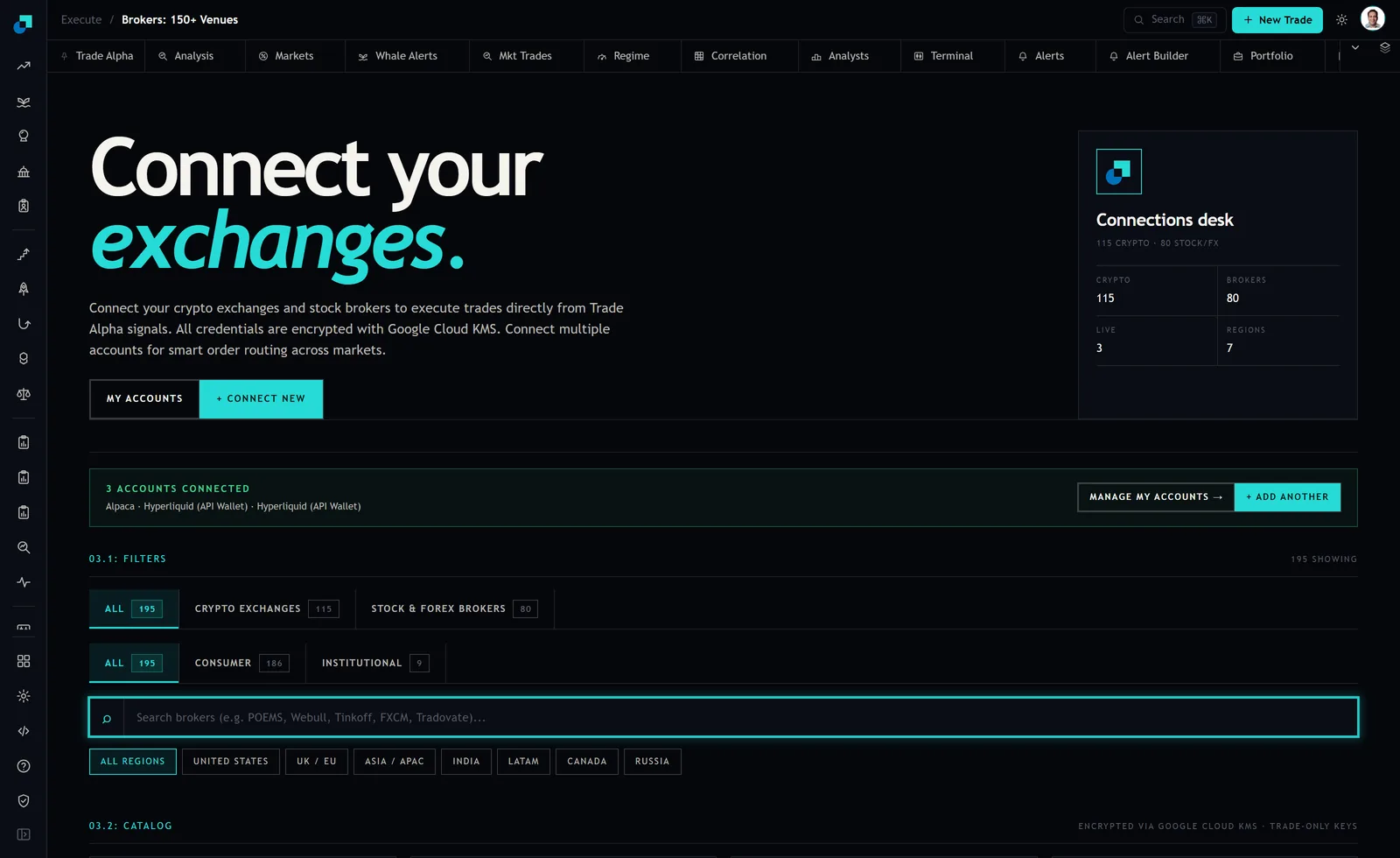
Notice the shape of that list. Two of the three connections point at the same venue under the same label. Whatever your internal reason for two API wallets, a reconciliation process that keys on venue name rather than on account identifier will silently sum them, or silently pick one, and both failures look identical in the output. Key on the account, always. The venue is an attribute of the account, not the identity of it.
Break type one, timing
The position is right and the clock is wrong. This is the most common break and the least dangerous, and the failure mode is treating it as anything else.
The evidence that resolves it is a timestamp with a stated timezone on both sides, plus a stated cut convention. The platform side is helpfully explicit here. The Trade Alpha counters label today's trades as opened today in UTC, and the feed rows carry a signal time. Your custodian or broker statement will be cut on its own convention, which for a US equity account is a business-day close and for a crypto venue is an arbitrary line drawn through a market that never stopped.
A timing break is confirmed, not merely suspected, when the same trade appears on both sides in adjacent periods and the cumulative position agrees at the later cut. That last clause is the test. If you cannot demonstrate convergence at the later cut, you have a quantity break wearing a timing break's clothes, and the standing instruction should be that ageing past one cycle promotes it automatically to the next category.
Break type two, quantity
The unit count genuinely differs. This is the type that costs money and the type most likely to be misfiled as timing.
The usual causes are mundane and they are worth enumerating in the procedure so that the investigator works a list rather than a hunch. Fees charged in the base asset rather than the quote, which is normal on crypto venues and turns a clean 40 into 39.9987. Partial fills where only the filled quantity reached the book. Funding and financing accruals on perpetual instruments, which change the cash leg continuously and the position leg not at all, and which people therefore forget to model. Corporate actions on the equity side. Transfers between two accounts at the same venue, which is precisely the exposure created by that pair of same-venue connections above.
The evidence is fill-level, not position-level. A position statement cannot resolve a quantity break because it is the thing in dispute. You need the venue's own execution records and your own order records, joined on an identifier that both sides carry, and if no such identifier exists that is the finding to escalate rather than the obstacle to work around.
Break type three, price
The units agree and the valuation does not. Price breaks rarely stop trading and frequently distort attribution, which is why they get tolerated for months and then surface in a performance review.
Three causes account for most of them. The first is that one side recorded the decision price and the other recorded the achieved average fill. In the Trade Alpha feed a row carries an Entry price and an Exit price against a signal time, and every visible row at capture had an Order type of MARKET. That entry figure is an anchor for measuring your own execution against, not a claim about what your account paid, and a book that ingests it as a fill price has manufactured a price break on purpose.
The second is fee treatment, where one side reports gross of commission and the other net. The third, on perpetuals, is mark price against last traded price. Both are legitimate numbers and they are not the same number, and unrealised profit and loss computed on one while margin is computed on the other will disagree by an amount that varies with volatility.
The resolving evidence is the fee schedule and the valuation convention, both written down in advance. A price break you can only resolve by asking someone what they meant is not resolved, it is deferred.
Break type four, instrument identity
Both sides are internally correct and they are describing different instruments. This is the rarest type and the one that has the largest tail, because it can persist undetected across many cycles while quietly breaking every risk aggregation that keys on ticker.
The condition is easy to create on a multi-venue setup. A metals exposure can exist as spot, as a perpetual contract, or as a tokenised claim, and all three may present under a symbol that looks like the same thing to a human reading a row. An equity ticker on a US broker and a tokenised representation of the same underlying on a crypto venue are not fungible, do not settle alike, and do not carry the same rights, and no amount of quantity matching will tell you they are different.
The evidence is an instrument master that carries venue, contract type, settlement asset and multiplier as first-class fields, and a rule that reconciliation joins on the instrument key rather than on the display symbol. If your master does not distinguish spot from perpetual for the same underlying, you do not have a reconciliation process, you have a coincidence detector.
Who signs, and in what order
Classification without ownership produces a tidy spreadsheet and no resolution. Assign each type a signer before the break exists.
- Timing breaks are signed by operations, with an automatic promotion rule if the break survives one cycle.
- Quantity breaks are signed by operations for known mechanical causes and escalated to the desk head above a stated notional threshold, expressed in units and in currency.
- Price breaks are signed by whoever owns the valuation policy, because the resolution is almost always a convention decision rather than a data correction.
- Instrument identity breaks go to whoever owns the instrument master, and the correction is a master change, never a manual adjustment to the day's book.
The book is declared clean when every break carries a type, an owner, an evidence reference and a resolution or an agreed ageing. A clean book is not a book with no breaks. It is a book where every break is classified and owned, and the distinction matters because the first definition tempts people to make breaks disappear rather than explain them.
One control that belongs alongside this and is frequently omitted. The connected-account list itself needs a reconciliation, on its own cadence, against the list of accounts you approved. The Brokers panel states that credentials are encrypted with Google Cloud KMS and that keys are trade-only, which is a meaningful reduction in scope, but scope is not the same as inventory. If the live count moves and no approval preceded it, that is not a configuration change to be noted in passing. It is an incident, and it is the one break type that will never show up in a position comparison because it changes what you are comparing against.