The complaint arrives in a predictable form. The composite has clearly rolled over, anyone looking at the chart can see it, and the regime label is still sitting there saying the same thing it said last week. It feels like the dashboard is asleep. Sometimes it is worth understanding why a lag exists before deciding it is a defect, because the version of this tab with no lag at all would be considerably worse to trade against, and most people who ask for a faster label would return it within a month.
The complaint, and what is actually visible on the tab
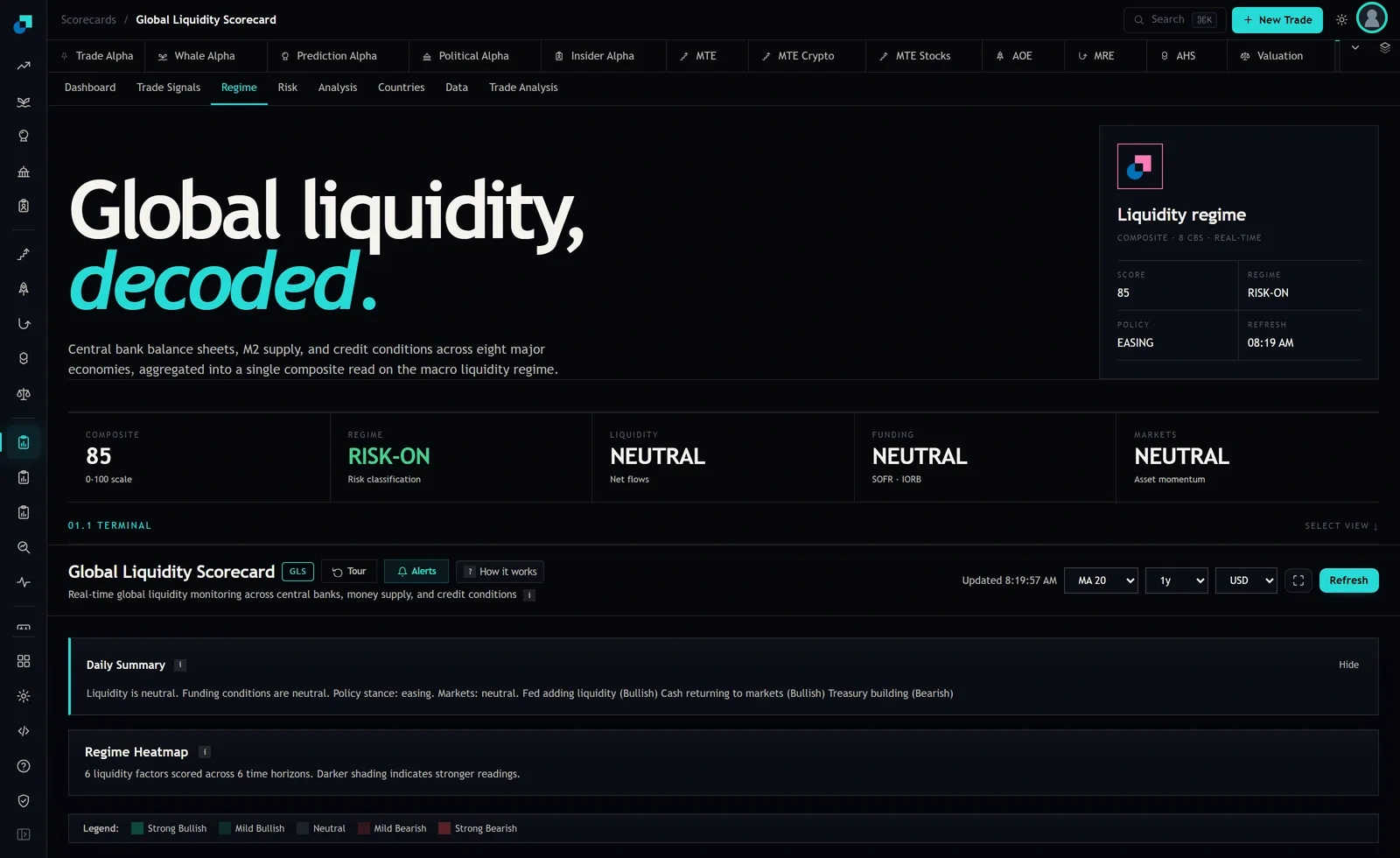
Start with what the screen shows, because the answer is partly in there. The strip across the Regime tab reads COMPOSITE 85 on a 0 to 100 scale, then REGIME RISK-ON with a sub-label of "Risk classification", then three component reads: LIQUIDITY NEUTRAL on net flows, FUNDING NEUTRAL on the SOFR and IORB relationship, and MARKETS NEUTRAL on asset momentum.
Notice what that combination rules out. If the label were a plain instantaneous threshold on the three component reads, three neutrals would not produce a risk-on classification. So whatever generates the label is drawing on more than an immediate vote of the panels sitting next to it. The Daily Summary underneath is consistent with that: it describes liquidity as neutral, funding as neutral and markets as neutral, while separately reporting a policy stance of easing and naming drivers with directions attached, two marked bullish and one marked bearish.
What you cannot see anywhere on that tab is the rule. The module does not publish the threshold that produces the classification, and it does not publish a confirmation window. I am not going to tell you it waits three days, or five, or that there is a setting controlling it, because I cannot verify any of that and a confidently invented number is exactly the sort of thing you would end up trading against. What I can tell you is why the gap between a continuous score and a discrete label exists in every construction of this kind, and what that means for you.
Why any label on a continuous score has to lag it
A composite is a number that can take any value between 0 and 100. A label is a word. Converting the first into the second requires a boundary, and boundaries create a specific and unavoidable problem: a score sitting near the boundary will cross it repeatedly on ordinary noise, and a label that follows every crossing will flip back and forth without anything meaningful having happened.
That is not a hypothetical failure. It is the default behaviour, and it is why almost every practical classifier built on a continuous input includes some form of stickiness. The standard approaches are to require the score to move past the boundary by a margin before the label changes, to require the crossing to persist for a set number of readings, or both. The general name for that behaviour is hysteresis: the level at which the label switches one way is deliberately not the same as the level at which it switches back.
The effect is exactly the lag people complain about. The score turns first, the label follows once the turn has proven itself. From inside the process it looks like the dashboard is slow. From outside it is the difference between a label that means something and a label that changes twice a week.
There is a second, more mundane source of lag stacked on top of that. The underlying inputs arrive on weekly and monthly calendars. Central bank balance sheet data, monetary aggregates and credit series are published on schedules, and no dashboard can know something before the data exists. The refresh stamp in the module header tells you when the page last recomputed, not when a central bank last told the world anything. On most mornings the honest answer is that nothing new arrived.
What the buffer costs you and what it buys
Make the tradeoff explicit, because you face the same one in your own rules.
The cost is that you enter each state late. If a regime genuinely runs for months, missing the first stretch of it costs you a modest fraction of the state. If regimes are short, missing the opening stretch can cost you most of the value, because the entry lag consumes a large share of the total duration.
The benefit is that you do not trade the false ones. Every crossing that reverses without confirmation would have generated a round trip, and every round trip costs a spread on the way in and a spread on the way out. On a retail-sized account those costs are not a rounding error. Ten avoided false flips a year is a real number on your statement.
The asymmetry is what settles it for most people. A late entry costs you part of a gain. A whipsawed entry costs you actual money and, more expensively, costs you confidence in the process, which is what causes people to abandon a rule right before the state it was built for arrives. A label that is boring and occasionally late is far easier to keep following than one that is fast and frequently wrong.
Reading the score and the label as two separate instruments
The practical resolution is to stop expecting the two fields to agree and start using them for different jobs.
The composite is your early-warning instrument. It moves continuously, so it can be falling for weeks while the label is unchanged, and that divergence is information rather than a malfunction. A composite drifting steadily toward the bottom of its range under an unchanged risk-on label is a completely different situation from a composite sitting mid-range under the same label, and only one of those is a reason to stop adding.
The label is your commitment instrument. It is what you attach an allocation change to, precisely because it does not move on noise. Use it for the decision that has a cost attached.
The heatmap is the bridge between them. Six liquidity factors scored across six time horizons on a five-level scale from strong bullish to strong bearish will typically show the short horizons deteriorating before the long ones, and before any word on the strip changes. A grid that has gone split, with the short horizons disagreeing with the long ones, is a turn in progress. A grid that is coherent across horizons is a state that is holding.
The rule I would write instead of complaining about the lag
Since you cannot see the module's confirmation rule, build your own on top of the fields you can see, and write it down before you need it.
Log one line a week: date, composite, regime label, policy label, the three component reads, and whether the heatmap looked coherent or split. Ninety seconds. Then define two triggers rather than one. A composite trigger that reduces new buying, which is allowed to fire on the score alone and costs you nothing because it only stops you doing something. And an allocation trigger that changes what you hold, which requires the label to have changed and to have held for two or three consecutive weekly readings.
Splitting the response that way gives you the early warning without paying for it. The cheap action, which is declining to add, can be fast and occasionally wrong. The expensive action, which is turning over positions, has to be slow. Most of the damage people do with regime dashboards comes from applying the speed appropriate to the first to a decision that belongs in the second.