The Top Insiders tab hands you a ranked list, and the rank is doing something very specific that is worth being clear about before you act on it. At the time of writing the visible board ran from 100.00 M USD at the top down to 21.26 M USD eight rows later, sorted on a column headed 30d Buy $. That is a ranking of how much money somebody spent. It is not a ranking of how often they were right, and for an account measured in thousands rather than millions those are close to opposite questions.
What the board is actually sorted on
Here is the visible list as it stood, filer and dollars and trade count. SITRA J SCOTT, President and CEO, 100.00 M USD across one trade. Catalyst4, Inc., 98.71 M USD across six. Forbion Growth Opportunities Fund III Cooperatief U.A., 64.80 M USD across two. DART KENNETH BRYAN, 54.24 M USD across three. TPG GP A, LLC, 50.00 M USD across one. Huang Jack Jiajia, Chief Executive Officer, 41.35 M USD across twelve. Chimovits Erez, 34.92 M USD across two. WARREN KELCY L, 21.26 M USD across two.
Three things jump out of that list before you get anywhere near performance. Only two of the eight rows carry anything in the Titles column, which is to say only two of them are officers. The rest are funds and holding entities filing as ten percent owners, and a fund buying into a company is a different act from a chief executive buying shares in the company they run. Two of the eight rows point at the same ticker, BRVE, so the top of the board is not eight independent situations, it is seven. And one row has no ticker resolved at all.
The header tile is running a different clock again. It reads TOP INSIDER 7D at 589.61 M USD while the table column is 30d Buy $, so the filer named in the tile and the filer at the top of the table need not be the same person. If you are going to quote a number from this screen, know which window it came from.
The column that would answer the question was blank
The board already has the right columns. Win Rate is there. So are Holdings $ and Top % Float, which between them would let you ask whether a purchase was material to the buyer or a rounding error. On the capture in front of me, every one of those three columns was empty on every visible row.
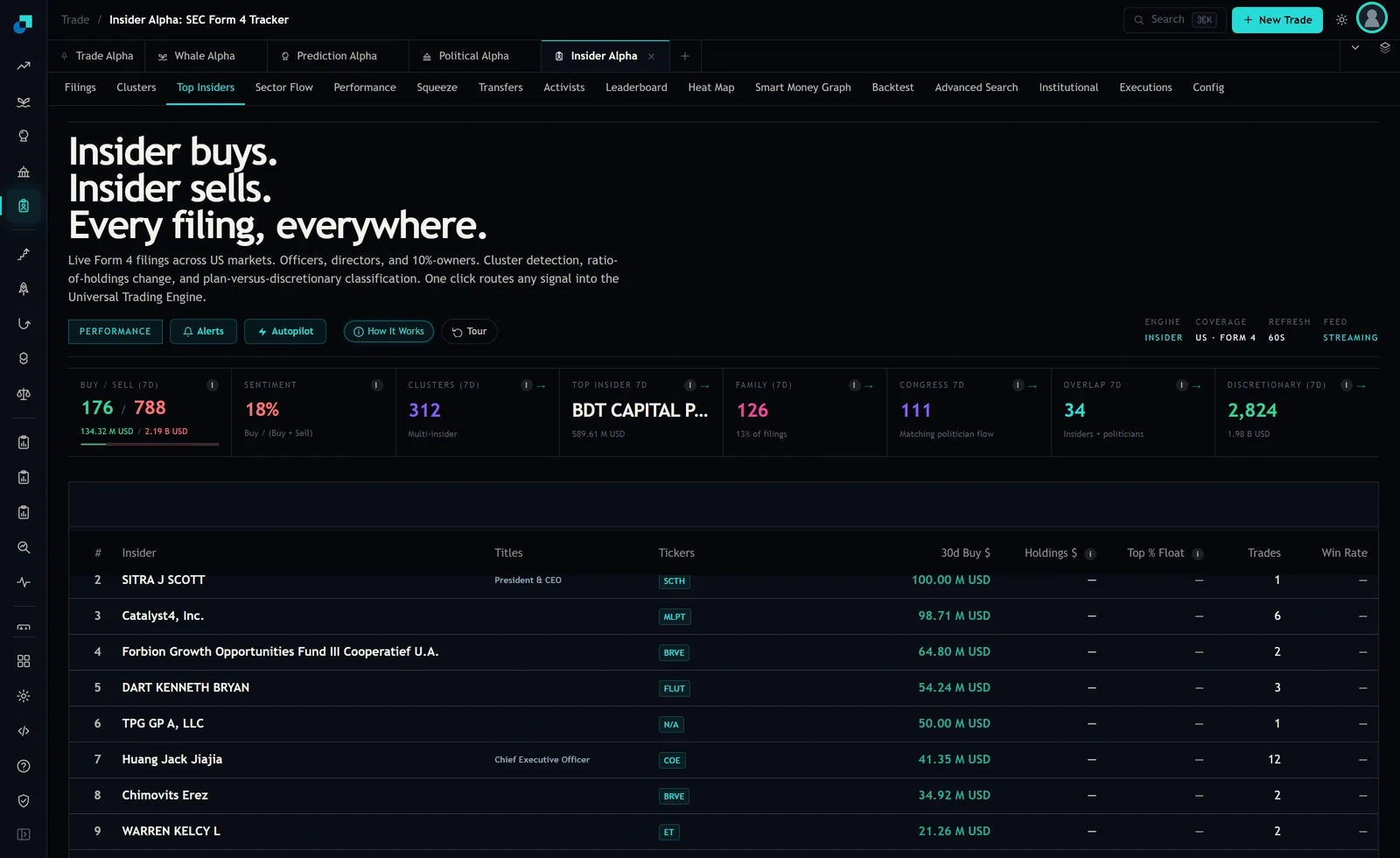
I am not going to tell you to sort on Win Rate instead, because on the board I looked at there was nothing in it to sort. That matters more than it sounds. The whole appeal of a consistency ranking is that it is harder to fake with one enormous cheque, and the moment you find yourself reasoning about a column that is not populated you have started writing fiction about your own process. Check it on the day you use it. If it has filled in since, the rest of this article is about what to do with it. If it has not, the rest is about the two columns you do have.
Trades is the only consistency proxy that was populated
Run down the trade counts in that list: one, six, two, three, one, twelve, two, two. That is the raw material for any consistency judgement available on this screen, and it is thin.
A filer with one trade has no track record. They have an event. You cannot distinguish a person who buys their own stock once a decade at exactly the right moment from a person who buys once a decade and is usually early, because in both cases the sample is one. The same is true at two and three. The only row on that board with anything approaching a series is the chief executive with twelve trades, and twelve is still small enough that a run of good luck is entirely ordinary.
This is the part where dollar rank and consistency rank actually collide. The single biggest buyer on the visible board bought once. If you rank on dollars you put them first. If you rank on anything resembling repeatability they do not make the list at all, and the twelve-trade officer sitting in sixth place on dollars moves to the front. Those are two genuinely different shortlists produced from the same eight rows.
Why dollar size is the wrong axis for a small account
A 100 million dollar purchase tells you about the buyer's balance sheet. It tells you very little about their conviction, because conviction is a fraction, not a total. The officer who puts a quarter of their liquid net worth into their own company at market prices has told you something. A sponsor fund deploying committed capital into a position it already controls has told you something else entirely, and the two look identical in a column headed 30d Buy $.
There is also a practical problem. The names at the top of a dollar-ranked board are frequently names where the buying itself is the liquidity. If a single filer accounted for 100 million dollars of purchases in a month, you are not going to be trading alongside them at a similar price, and by the time the filing is public you are trading against whatever their buying already did to the price. A 2,000 dollar position in a name that just absorbed a nine figure order is a different trade from the one the filer made.
The columns that would have let you correct for this are the blank ones. Top % Float in particular is the fraction that turns a dollar figure into a statement about the company rather than about the buyer. Without it, dollars are just size.
A shortlist rule you can run this week
Given what is actually populated, here is a filter that is defensible on a Tuesday evening with a brokerage account open.
- Require the Titles column to be non-empty. That keeps officers and directors and drops the funds and holding entities, whose purchases are usually negotiated rather than made in the open market.
- Require a trade count above a floor you decide in advance and write down. Given the counts I saw, a floor of five leaves you almost nobody, which is the honest outcome rather than a broken filter.
- Collapse duplicate tickers. Two rows on the same name is one idea, and treating it as two is the fastest way to double your position size without deciding to.
- Then open the underlying filings for whatever survives. The board is a way to allocate attention, not a way to allocate money.
What this costs you is real and you should price it before adopting it. You will throw away every one of the largest purchases on the board, including situations that turn out to matter enormously. A sponsor buying a controlling stake is often the most consequential thing happening at a company, and this filter deletes it. You are trading away the biggest events for a shortlist where the sample size is at least arguable.
That trade is right for a small account for one reason. You cannot afford to be in twenty situations, so the thing that kills you is not missing the best one, it is taking three positions on the strength of three single filings and discovering afterwards that you had no basis for any of them. A consistency filter is mostly a device for making yourself hold fewer, better documented opinions. On the current board it will hand you a shortlist of roughly one name, and one name you can actually explain is a better week's work than eight you cannot.