Buried in the Asset Outperformer Engine's FAQ is a sentence that changes what the crypto tab means. The engine includes a machine learning asset classifier that identifies meme coins and stablecoins, both are excluded from results by default, and you can toggle them on or off in the advanced filters panel. That is not a cosmetic preference. It is a universe decision, made by a model, before the ranking you are reading was computed, and most people who use the crypto tab have never touched it.
One hundred and seventy-one names out of three thousand
The crypto tab's hero line on the capture I am working from reads 171 assets versus the basket, with a counter underneath reading 100 of 171 outperforming. The page also describes crypto coverage as 3,000 plus tokens by market cap. So the ranked crypto list is a small fraction of what the engine covers, and the classifier is one of the reasons, alongside whatever scoring and data requirements a token has to clear to receive a score at all. I cannot tell you from the screen how much of the gap the classifier accounts for, and I would not guess at a number. What I can tell you is that the direction of the effect is known and one-sided: whatever the classifier flags, you do not see.
That is worth internalising before you draw conclusions from the list. A ranking of 171 names is not a ranking of the crypto market. It is a ranking of the crypto market minus two categories that were removed by a model you cannot inspect.
One exclusion is structural and the other is a judgement
The two exclusions get bundled into one FAQ answer and one toggle, but they are not the same kind of decision at all.
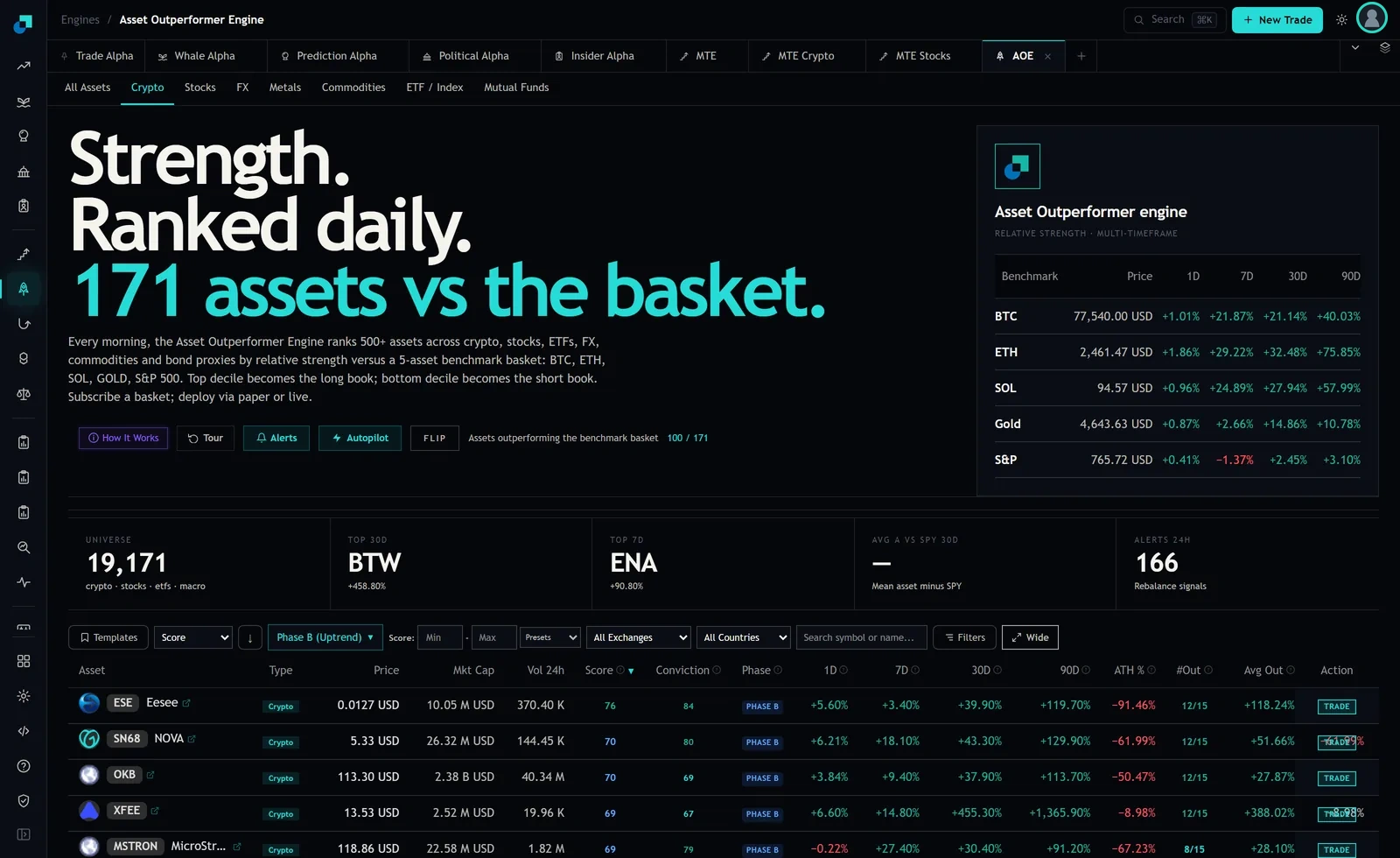
Excluding stablecoins is close to structurally necessary, and the benchmark panel on the same screen shows why. Over the seven days in that capture, BTC was up 21.87 percent, ETH up 29.22 percent and SOL up 24.89 percent. A stablecoin's entire design goal is to not move. Against a basket like that it loses every one of the fifteen benchmark-and-timeframe comparisons the engine runs, every single scan, forever. It would therefore live permanently in the bottom decile, which the page describes as the short book. A permanent short list populated by assets engineered to stay flat is not a signal, it is a funding-cost trade wearing a relative-strength costume. Removing them cleans up the bottom of the board far more than the top.
Excluding meme coins is a different proposition. In a risk-on tape, memes are not an odd corner of the ranking, they are the cohort that generates the largest relative-strength readings on the board. Filtering them out is a decision to cut the right tail off the distribution. It makes the list calmer, more defensible and considerably less representative of what actually outperformed. Both choices are reasonable. Only one of them is forced by the arithmetic, and the product ships them behind a single toggle.
Where the classifier has to guess
Here is what I do not know and will not pretend to. The FAQ says the classifier is machine learning based. It does not disclose the features, the training set or the error rate, and there is no per-row label or confidence indicator anywhere on the board, so you cannot look at a token and see what the classifier thought of it. You can only observe presence or absence.
What I can say is where any classifier doing this job has to guess, because the categories themselves are fuzzy. A token that launched as a joke and later shipped a product with real usage is genuinely both things at once. An infrastructure chain that happens to be named after an animal looks like a meme to a name-based feature and nothing like one to a usage-based feature. A yield-bearing or partially collateralised token is neither a stablecoin nor a normal risk asset, and which side it lands on will depend on whether the model is reading its price variance or its stated purpose.
The default list contains a live example of category strain. Ranked fifth on the capture at a score of 69 is MSTRON, MicroStrategy as an Ondo tokenized stock, showing a 30-day move of +30.40 percent and 24-hour volume of 1.82 million. It is not a meme and not a stablecoin, so the classifier correctly left it in. But its relative strength is the relative strength of a leveraged bitcoin proxy equity, wrapped as a token, ranked against a basket that is already three-fifths crypto. Nothing is broken. It is just a reminder that passing the classifier is not the same as belonging in the comparison you think you are making.
The two times I switch it off
The first is an absence audit, and it takes about a minute. You hold or watch a token and it is not in the 171. You do not know whether that is because the classifier removed it, because the engine does not cover it, or because it covers it but did not score it this scan. Open the advanced filters panel, turn the exclusions off, and search the symbol. If it appears, the classifier was the reason and now you know. If it still does not appear, the reason is somewhere else and you have eliminated the most likely candidate. Either way you have converted a guess into a fact about your own holdings, which is the highest-value thing this toggle does.
The second is when the cohort is the trade. If you have already decided you want risk-on crypto exposure this month, then filtering out the highest-beta corner of the market means the board is ranking everything except the thing you decided to buy. Switch the exclusions off and the board changes job: it stops being a discovery tool for the whole market and becomes a comparison tool inside a cohort you have already chosen. Ranking eight meme coins against each other on breadth and average outperformance is a real use of this engine. Using the default view to conclude that memes are not running is not.
What you should expect when you flip it is more of a shape that is already visible in the default view. Look at the ATH percent column on the capture: Eesee ranks first at a score of 76 while sitting 91.46 percent below its all-time high. NOVA scores 70 at 61.99 percent below. OKB scores 70 at 50.47 percent below. Strong relative strength inside a deep drawdown is normal on this board, and turning the classifier off will produce a lot more of it, with the drawdowns deeper still.
Turning it back on before you size anything
Two disciplines make this safe to do at all. The first is the volume column, and it matters more with the filter off than on. XFee is in the default list at a score of 69 with a 30-day move of +455.30 percent and a 90-day of +1,365.90 percent, and 24-hour volume reading 19.96 K. Compare that to OKB at the same tab, scoring 70 with volume of 40.34 million. Those two names are not in the same business as far as your ability to get out is concerned, and the score column does not distinguish them. If the default view already contains a name where a four-figure position would be a visible share of the day's trade, the toggled-off view will contain many.
The second is restoring the default. A filter you changed for one specific audit and then forgot about is the most common way a screen quietly stops meaning what you think it means. Three weeks later you are reading a board that includes a category you deliberately excluded, drawing conclusions about market breadth from it, and wondering why the ranking has become so volatile. Flip it back the moment the audit is done, and if you genuinely want the memes in permanently, make that a written decision rather than a leftover.
The one thing I would not do is treat the toggle as a way of improving the ranking. It does not make the engine better or worse at scoring. It changes which population is being scored, and every downstream number you read, the count of 171, the 100 outperforming, the breadth of the top decile, is a number about that population. Change the population deliberately, note when you did it, and read the numbers as answers to the question you actually asked.