When a live deployment underperforms its backtest there are two possible explanations and they demand opposite responses. Either the strategy has stopped working, in which case you should stop trading it, or your execution is leaking money, in which case the strategy is fine and you should change how you send orders. Guessing wrong is expensive in both directions.
You cannot separate them from a live record alone. You can separate them almost perfectly by running the same strategy twice, once in paper and once with real money, from the same start date. The paper twin is the control arm. Whatever it earns that you do not is yours to explain.
What a deployment is on this engine, and why the twin is cheap
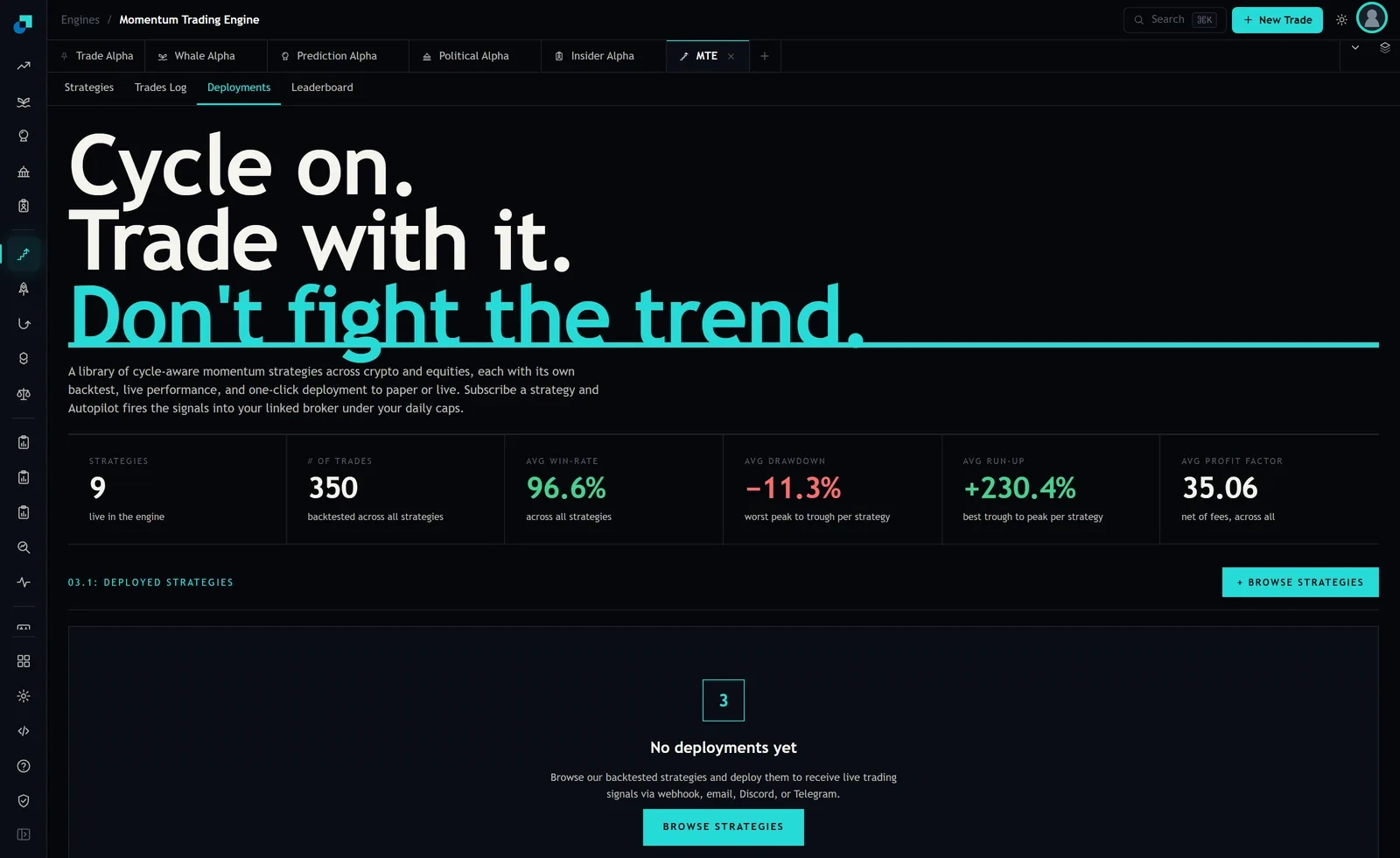
The page description is worth reading literally. It describes a library of cycle-aware momentum strategies across crypto and equities, each with its own backtest and live performance, with one-click deployment to paper or live, and says that when you subscribe a strategy Autopilot fires the signals into your linked broker under your daily caps.
The deployments panel itself carries a section headed DEPLOYED STRATEGIES with a browse action, and at capture it was empty, stating that there were no deployments yet and that you browse the backtested strategies and deploy them to receive live trading signals via webhook, email, Discord or Telegram.
Two things follow. Paper and live are both named as deployment destinations, so running the twin does not require building anything. And a deployment is fundamentally a signal delivery arrangement, which means the same signal stream feeds both arms. That is exactly the property a control arm needs. The signals are identical by construction, so any difference in outcome cannot be the strategy.
The three gaps, and which one you can actually fix
Once both arms are running you have three records instead of two, and each difference has a name.
| Comparison | What the gap measures | What you do about it |
|---|---|---|
| Backtest against paper | Forward signal generation versus historical replay | Nothing. If this is large the strategy is the problem |
| Paper against live | Your execution: delay, spread, size, rejections | Change how you route and when you send |
| Backtest against live | The total, which is what you feel | Decompose it into the two rows above |
The first row is the one people never think to measure and it is the most valuable. A backtest is a replay over historical candles with the benefit of a completed bar. A paper deployment generates signals forward in time, in real conditions, with no hindsight and no ability to revise. If a strategy's paper record diverges from its backtest while paying no costs at all, you have learned that the backtest was measuring something the live signal generator does not reproduce, and no execution improvement will ever close that gap.
Keeping the twins honest enough to compare
A control arm only works if it differs from the treatment arm in exactly one respect. Five rules, and none of them are optional.
Same instrument, same timeframe, same configuration. If the live arm runs a 1day configuration and the paper arm runs the 4h version of the same idea, you are measuring two strategies rather than one execution.
Same start date and same end date. Comparing a paper arm you started in March with a live arm you started in January produces a difference that is mostly the market.
Same assumed position size, expressed in units rather than dollars. Percentage returns hide size effects, and size effects are precisely what execution quality is about.
No interventions in either arm. The moment you close a live position by hand and leave the paper one open, the comparison is over for that trade. Record the intervention and exclude the pair.
And write down the paper arm's fill assumption on day one. This is the rule people skip. If you do not know whether the paper record is filling at the signal price, the candle close or something else, you cannot interpret the gap you are about to measure.
Putting a dollar figure on the gap
Run both arms for at least twenty completed trades before you conclude anything, because a handful of trades will be dominated by two or three unlucky fills.
Then convert. Say the live arm underperforms the paper arm by 1.4 percent over twenty round trips on a 5,000 dollar position. That is 70 dollars, or 3.50 dollars per round trip, which is 35 basis points on a 1,000 dollar notional and 7 basis points on the 5,000. Now hold that against the engine's own trade frequency. It reports 350 backtested trades across 9 strategies, roughly 39 per strategy, so a per-round-trip cost of 35 basis points annualises to something in the region of 13 percent of turnover for a strategy running at that pace. That is the number that decides whether the configuration is viable for you, and it is not a number anyone else can compute on your behalf, because it depends on your broker and your habits.
The decision rule I would use is simple. If the paper minus live gap is the dominant term, spend a month on execution before touching the strategy: use limits rather than market orders where the strategy allows it, avoid sending at the open on daily signals, and check whether your fills cluster on one instrument. If the backtest minus paper gap is the dominant term, execution work is wasted effort and the honest move is to stop funding that configuration.
Where the control arm will lie to you
A paper arm is a model of trading, not trading, and it flatters you in four specific ways. It assumes you get filled. It assumes you get filled in full rather than partially. It assumes no rejection, no outage, no margin call and no halted stock. And it assumes your order does not move the price, which is true for retail size on liquid names and stops being true on thin ones.
All four biases run the same direction, so treat the measured gap as a floor on your real execution cost rather than an estimate of it. The real number is worse, and it is worse by more in exactly the conditions where you most need it to be small, which is a fast market on a gapping instrument.
One more caution about the paper arm's psychology. A paper record you can see every day, sitting slightly above your live record, is a standing invitation to override the live arm in order to close the gap. That is the failure this exercise is meant to prevent. Look at the two records once a month, on a scheduled day, with twenty trades of evidence, and leave them alone in between. The control arm is a measurement instrument. It is not a second opinion.