A contract resolves against you on a Thursday morning off the first release of a statistic. Six weeks later that statistic is revised, and on the revised number your position was right. You have a loss booked, a settlement notice in the file, and a forecast that turned out to be correct. Nothing about that sequence is unusual, and almost no event-contract process has a place to put it.
The asymmetry is the whole subject. Revisions run in both directions over time, so the P&L effect washes out across enough trades. What does not wash out is what the asymmetry does to contract selection, to your measurement of your own skill, and to the conversation about a position that lost money for a reason that later turned out to be wrong.
Two kinds of settlement fact
Sort every contract you look at into one of two buckets before anything else. In the first, the determining fact is final at the moment it is observed. A scoreboard at full time. A scheduled central bank announcement. A signed statute. A certified election result. The number the venue reads on the settlement date is the number that will still be true in a decade.
In the second, the determining fact is provisional at the moment it is published. Most major statistical series are in this bucket by design. The first release is an estimate built from incomplete returns, it is scheduled to be revised as more returns arrive, and it is subject to periodic methodology and seasonal adjustment updates that can move the historical series long after anybody is looking. The long-running observation in the macro data literature is simply that first prints and final values differ often enough that anything built on first prints has to be tested on first prints. Nothing about that is controversial, and it applies directly to a contract that settles on one.
The distinction is not about how important the release is. It is about whether the venue is reading a fact or an estimate. Contracts in the second bucket carry an exposure that contracts in the first do not, and it is not in the quoted price.
Rank the rows on this screen by revision exposure
Take the visible rows on the Prediction Alpha markets tab and sort them by this criterion rather than by volume. Boston Red Sox against Miami Marlins, quoted 55.5 Yes and 44.5 No with an End Date of 09/01/26, sits at the bottom of the exposure ranking. A final score is final.
The Fed contract, on a 25 basis point decrease after the September 2026 meeting, quoted at 1.2 percent Yes with $15.1M of total volume and $648.8K of liquidity, is close behind. A committee decision announced at a scheduled minute is an event, not an estimate, and it does not get restated.
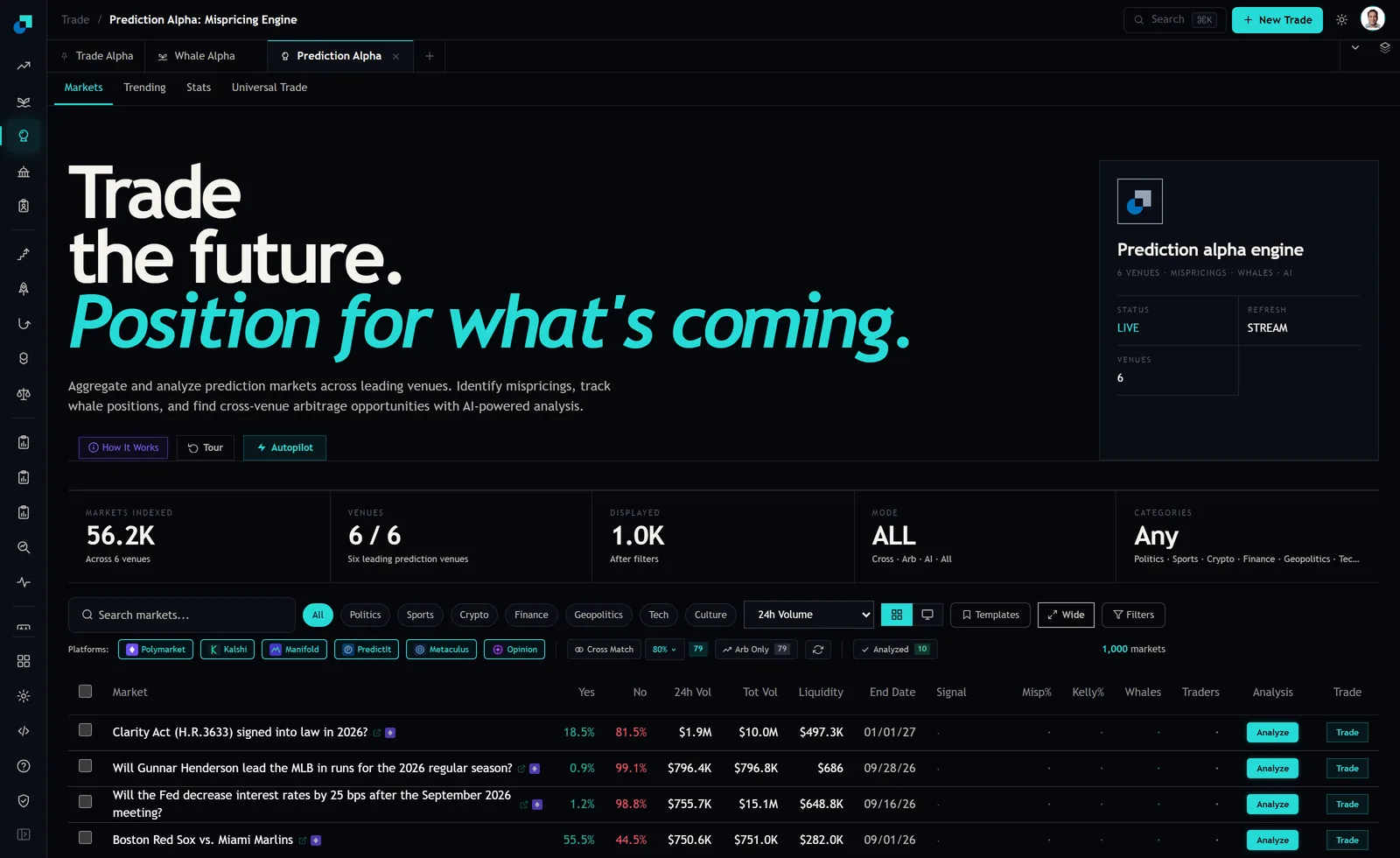
The Clarity Act (H.R.3633) row, 18.5 against 81.5 with an End Date of 01/01/27, is a public record fact rather than an estimate, so it is not revision exposed in the statistical sense. It is exposed to something adjacent that belongs in the same note, which is definitional ambiguity about what precisely counts as the described event occurring. That risk is settled by the criteria text and the venue's arbitration clause, not by a later data vintage.
The Gunnar Henderson row, ending 09/28/26, is the interesting one, because it is a season-long league statistic and nobody thinks of league statistics as revisable. Whether the figure a venue reads on the settlement date can subsequently be corrected by the league's own scoring process, and whether the venue would care if it were, are two separate questions. I do not know the answer for that contract. Neither does the screen. That is precisely the point of the exercise, because a contract you assumed was in the final bucket and is actually in the provisional one is where this risk lives.
Finality is a rulebook question and the aggregator does not answer it
Be clear about what the platform can and cannot settle for you here. The markets table carries Market, Yes, No, 24h Vol, Tot Vol, Liquidity, End Date, Signal, Misp%, Kelly%, Whales, Traders, Analysis and Trade. There is no field for the resolution source, no criteria text, and nothing describing what a venue does after a settled contract's underlying number changes. The module's cross-matching is described as a confidence score for mapping two listings to the same underlying outcome, which is a similarity judgement rather than a criteria comparison.
So the finality question is answered off platform, one venue at a time, by reading rulebooks. I want to be honest that I could not verify a general answer across the six venues in this feed from the product surfaces available to me, and I am not going to assert one. What I would write in a file, as an assumption rather than a finding, is that settlement is final and a subsequent revision is the position holder's problem. That is the direction the incentives point and it is the conservative assumption. Record it as an assumption with a date, name the document you checked for each venue, and where you could not find the clause, write down that you could not find it. An unfound clause recorded as unfound is a defensible file. An unfound clause assumed in your favour is not.
Pricing the revision option you are short
Treat the exposure structurally. Holding a contract that settles off a provisional figure is holding a short option that pays no premium, has no hedge and cannot be closed after settlement. Since you cannot price it into P&L, it has to show up as a selection filter and a size haircut instead.
Four rules do most of the work. Prefer the first bucket when both are available on the same underlying view, because there are usually several ways to express one macro opinion and they do not all read an estimate. Where you trade the second bucket, require a wider edge than your standard hurdle and write the increment down so it is a policy rather than a mood. Avoid thresholds that sit inside the range a series is routinely restated by, because a contract pinned near the middle of that band is closer to a coin flip than the quote suggests. And check which vintage the criteria actually name, because reading the first print, the print as of a stated date, and the latest available figure are three genuinely different contracts that can be written in nearly identical language.
That last check is the highest-value minute in the process. It is answered by the criteria text on the venue and by nothing else, and it converts an unmeasurable exposure into a known one.
The attribution problem a revision creates
Here is where the asymmetry stops being philosophical. If you score your forecasting model against final data and settle your trades against first prints, your measured skill and your realised P&L are answering two different questions, and the gap between them will be read as bad luck or bad execution when it is neither.
The fix is to keep two vintages on every settled contract. The settlement vintage, which is the number the venue read on the day, and the current vintage, which is the number as it stands now. Explain P&L against the settlement vintage, because that is what actually happened to the money. Validate the model against whichever vintage it was trained to forecast, and be strict about it, because a model trained on final data and deployed on first prints is mis-specified in a way no amount of parameter tuning will fix.
Then carry the difference as a named line in attribution. Call it settlement basis. Over a decent number of resolved contracts it should sit near zero, and if it does not, you have learned something specific rather than something vague. A persistently negative line means you are systematically on the wrong side of a series with a directional revision pattern, which is a selection problem you can act on. A large line in either direction means too much of the book is in the second bucket for a desk that has not priced it. Both of those are actionable. Neither is visible at all if you only ever store one vintage, which is what almost every system does by default.