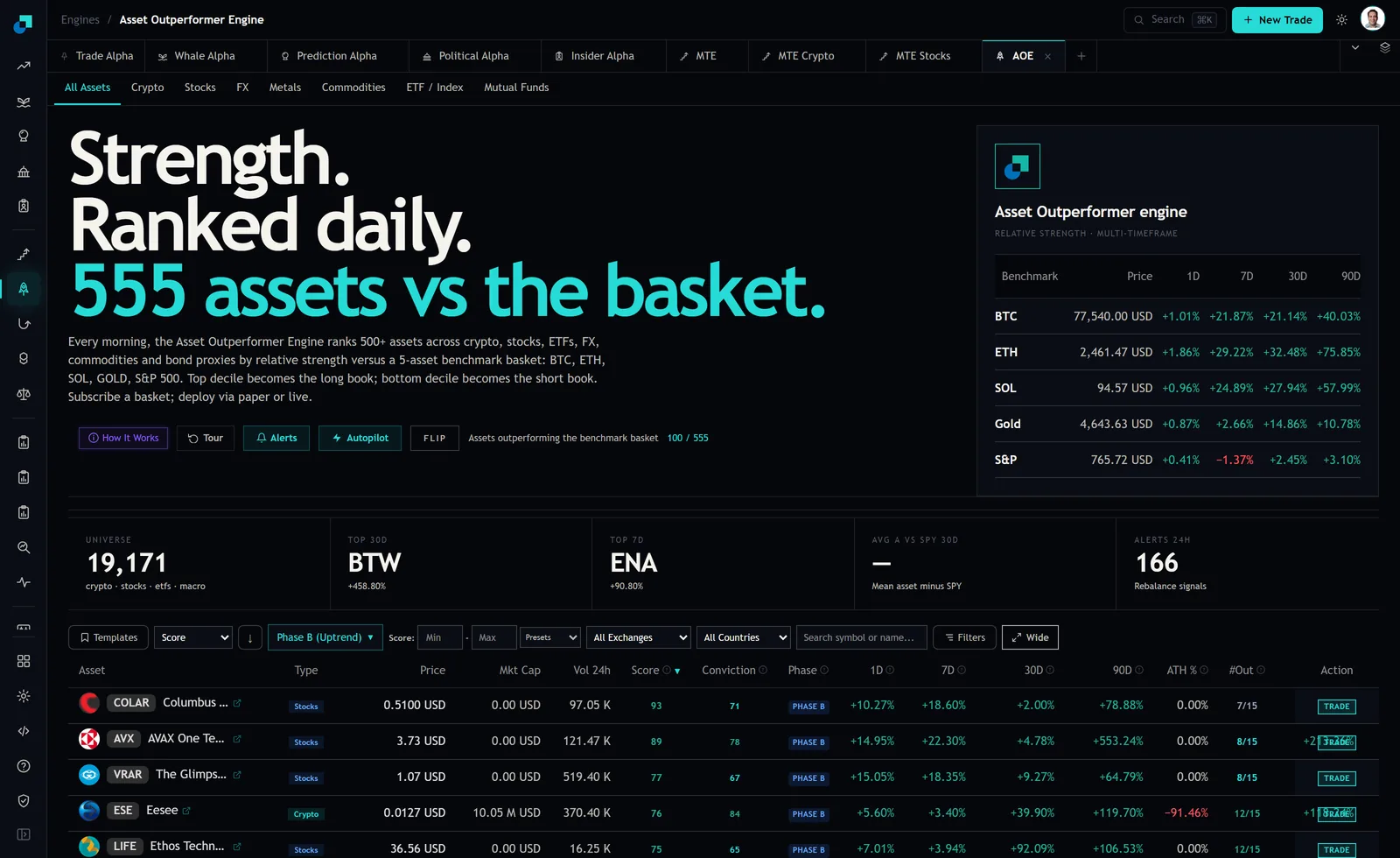
A relative strength sleeve built on the Asset Outperformer Engine holds assets selected for outperforming a five-asset basket: Bitcoin, Ethereum, Solana, Gold and the S&P 500. Three of those five are crypto. That structure has an attribution consequence which surfaces at the worst possible moment, usually in a quarterly review, and it is this: in any period where the basket itself runs hard, the sleeve will very likely post a strong absolute number regardless of whether the ranking selected well. Reporting that number as selection skill is the error, and it is an error that only becomes visible when the benchmarks stop cooperating.
The quarter that flatters everybody
Look at what the benchmark strip showed at capture. ETH at +32.48% over 30 days and +75.85% over 90. BTC at +21.14% and +40.03%. SOL at +27.94% and +57.99%. Gold at +14.86% and +10.78%. The S&P line at +2.45% and +3.10%, with 7-day at -1.37%.
A sleeve selecting names that outperform that basket, in a period where three fifths of the basket delivered between forty and seventy six percent over ninety days, is a sleeve whose holdings are heavily exposed to whatever drove those moves. The selection criterion does not neutralise the beta. It conditions on it. Assets that outperform a rapidly rising crypto complex are, in the main, assets that are correlated with the rapidly rising crypto complex, and their absolute returns in that window will be large whether or not the ranking added anything on top.
The reverse case is the one to worry about in advance. When the basket falls, the same selection criterion produces holdings that fall with it, and a sleeve that was reported as skilled on the way up will be reported as broken on the way down. Both reports will be wrong in the same way and for the same reason.
Defining the basket return you have to beat
Attribution needs a single benchmark return series and the engine does not hand you one, because the fifteen benchmark and timeframe checks are pass or fail per benchmark rather than a blended index. Constructing the composite is your decision and it must be made explicitly and in advance.
Equal weight across the five is the natural default and it is a strong claim, since it puts sixty percent of the reference in crypto. A weighting that matches your mandate's strategic allocation is more defensible for reporting purposes and has the drawback that it no longer matches the hurdle the ranking actually used. Both are legitimate. Running one for the internal decay work and the other for client reporting is also legitimate, provided the difference is documented and nobody quietly switches between them when one flatters.
Whichever you pick, fix the rebalance convention for the composite too. A basket rebalanced daily and a basket left to drift will diverge materially over a quarter when its components differ in return by seventy percentage points, and that divergence will land entirely in your selection term if you have not specified it.
The decomposition itself
Four terms, and the discipline is in insisting that they sum to the reported number rather than approximately explaining it.
Basket exposure is the sleeve's beta to the composite basket multiplied by the basket's return over the period. This is the term that gets mistaken for skill and it is usually the largest one. Estimate the beta from the sleeve's own history rather than assuming it is one, because a portfolio of assets selected for outperforming the basket typically has a beta above one to it.
Selection is the residual return attributable to holding these names rather than the basket, at the weights held. This is the term the ranking is supposed to generate and it is what should be discussed when anyone asks whether the engine is working.
Timing is the contribution from when positions were opened and closed relative to a hold-throughout alternative. In a rotation with a rebalance rule this term is not incidental, and separating it out is what lets you evaluate the rebalance interval independently of the selection.
Costs are the fourth and they belong inside the attribution rather than as a footnote, because a rotation's turnover is the mechanism by which selection alpha is converted into net return or into nothing.
Run the same decomposition per type tab where the sleeve spans several. A blended figure across crypto, equities and ETFs will show a selection term that is really an asset allocation term, since the type mix itself was a decision.
Why the module's alpha tile does not answer this
The engine surfaces a summary tile reporting average alpha against SPY over 30 days, described on the panel as the mean asset minus SPY. It is a reasonable headline and it will not do the job here, for three separate reasons that are each sufficient on their own.
It measures against SPY alone rather than the five-asset basket, so in the captured period it was comparing sleeve assets to a benchmark showing +2.45% over 30 days while the crypto components of the actual hurdle showed between twenty one and thirty two percent. It is a mean across assets rather than a portfolio return at your weights, so it does not reflect anything you held. And it is a fixed 30-day window, which will not align with your reporting period.
None of that makes the tile wrong. It makes it a different measurement, and the failure mode is a review deck that quotes it as though it were the sleeve's alpha. If it appears in reporting, label it as what it is and put the computed attribution next to it.
Reporting it so the next drawdown is explainable
The point of doing this in a good quarter is that it is the only time you can do it credibly. An attribution framework introduced after a bad quarter reads as an excuse regardless of how sound it is.
So the reporting pack should carry, every period and in the same format: the composite basket return with its weighting convention stated, the sleeve's estimated beta to that basket and how it was estimated, the four decomposition terms summing to the reported return, and the benchmark strip readings at each rebalance date so the difficulty of the hurdle at decision time is on the record.
Add one sentence that most packs omit, naming which term drove the period. In a quarter where basket exposure contributed the majority, say so plainly while the number is good. The desk that writes that sentence in a strong quarter has a much easier conversation in the weak one that follows, because the framework was already agreed and the drawdown becomes a movement in a term everyone had been reading for months rather than a surprise requiring an explanation invented on the spot.