Open the Macroeconomic Risk Scorecard today and the combined score reads 29 out of 100, tagged LOW. Most people read that, feel fine, and close the tab. That is the wrong thing to take from the number, and it is wrong in a way that costs money at exactly the moment you can least afford it, because the single most useful thing about a macro composite is not where it sits. It is where it sat three months ago.
A 29 that was 12 in the spring is a score that has more than doubled. A 29 that has drifted between 25 and 33 all year is nothing. The dashboard prints the same number in both cases and gives you the same LOW label, so the distinction has to come from you.
Why the level on its own is a bad trigger
The composite runs zero to one hundred and rolls up seven separate recession probability models across more than fifty macroeconomic indicators pulled from FRED, the BLS, the BEA and the ECB. That is a lot of machinery producing one number, and the thing to understand about that number is that it has no natural danger line. There is no reading at which something is scheduled to happen.
So if your plan is "I will de-risk when it hits 60", you have picked 60 out of the air, and you will find out whether 60 was the right choice exactly once, after it is too late to change it. Worse, a level rule keeps you fully calm through the entire journey from 12 to 55, which is the part of the cycle where you still had the option to act cheaply and in an orderly way.
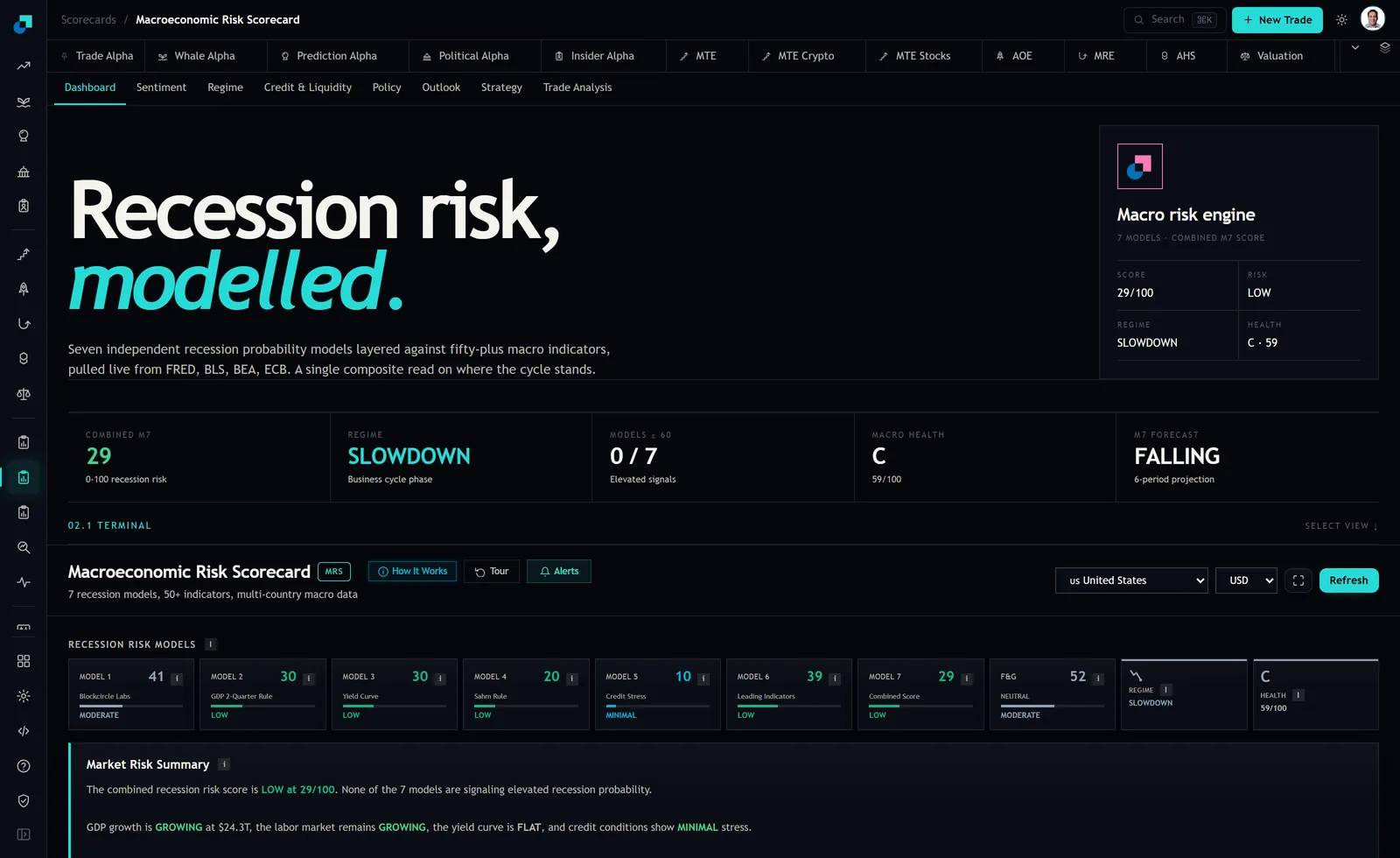
Look at the row in the screenshot. The score says LOW. The regime tile next to it says SLOWDOWN, described underneath as the business cycle phase, and the health grade is a C at 59. Those tiles are not in violent disagreement, but they are not telling one clean story either, and if you only ever read the first one you would never know the other two existed.
The number worth keeping is the three-month change
Here is the whole method. Once a month, on a day you pick and stick to, open the dashboard and write down four things in a note or a spreadsheet row: the date, the combined score, the regime label, and the count of models at or above 60. That is a ten minute job, eleven times a year, and after four months you own something the dashboard cannot give you, which is your own dated history of what you actually saw.
Then compute one thing: today's score minus the score three months ago. That is your rate of change, and it is the number that should be driving your behaviour.
- A change of a few points either way is noise. Macro composites wobble because their inputs wobble. Ignore it.
- A rise of roughly ten to fifteen points over three months is a real move. Something in the underlying indicator set has shifted in one direction and stayed there.
- A rise of twenty points or more over three months is the case this whole article exists for, and it deserves a decision even if the absolute level still looks unthreatening.
I want to be honest about those bands. They are judgement, not a backtested result, and I am not going to dress them up as one. What justifies them is the structure of the thing being measured: a composite of seven models over fifty plus indicators does not move fifteen points in a quarter because one series printed oddly. It moves that far when several inputs agree, and agreement across independent inputs is the closest thing to signal this kind of number produces.
What a big three-month rise should actually change
Not everything. That is the first point. A rising macro score is not an instruction to go to cash, and anyone who tells you to sell everything on a macro reading is selling you a story about their own conviction.
What it should change is the shape of the risk you are carrying. On a twenty thousand dollar account, a twenty point three month rise is the trigger for four specific things.
- Stop adding leverage. If you are running margin or perps, this is the month you do not increase the notional. Costless, reversible, and the one that most often matters.
- Rebalance back to your written weights rather than letting winners run. If crypto has drifted from twenty percent to thirty two percent of the account, that is roughly twenty four hundred dollars of unintended exposure you did not decide to take.
- Rebuild the cash buffer to whatever number lets you not sell at a bad price. For most people that is three to six months of spending, held outside the trading account, and it is the difference between riding out a drawdown and being forced to realise it.
- Name the single position that would hurt most in a broad twenty five percent drawdown, and size it so that outcome is survivable rather than account ending.
All four are things you can finish this week, none of them require you to be right about the macro call, and none of them lose much if the score falls back to 15 next quarter. That asymmetry is the point. Rate of change is a good trigger precisely because the actions it justifies are cheap.
The two ways this rule will embarrass you
The first is false alarms. The score will sometimes climb fifteen points over a quarter and then walk straight back down. You will have rebalanced, trimmed leverage, and rebuilt cash into a market that then ran without you. This is not a bug you can engineer out. It is the price of the rule, and the reason the actions above are deliberately mild rather than dramatic. If your response to a rising score is going to cost you a lot when you are wrong, you have made the response too big.
The second is the slow grind. A score that climbs three points a month for a year never triggers a three month rule, and ends the year at a genuinely high level having never once set off your alarm. The fix is boring: alongside the three month change, keep a twelve month change in the same spreadsheet. Two columns, same log, no extra work. If either one moves far, you look.
What I would not do is check daily. The composite draws on indicators that release monthly, and a large part of what you see on a daily basis is market data such as the dollar index and credit spreads moving around underneath a mostly unchanged official data set. Checking a monthly-paced number every morning produces a lot of reactions and very little information, and the reactions all cost spread and commission while the information does not.