Construct a book, purely as an illustration. Nine open event contracts. Three sit in a politics bucket, two in finance, two in crypto, one in tech, one in geopolitics. Five categories, nine names, nothing above a modest share of equity, and every concentration report you run comes back clean. Then a single scheduled statistical release lands at 08:30 on a Thursday and eight of the nine move together, because eight of them read their answer off that print.
That exposure has a name worth using, and it is not correlation. Call it resolution-source concentration, because the thing being shared is not the outcome. It is the mechanism that determines the outcome.
Correlated outcomes and shared resolution are different exposures
Outcome correlation is about the world. Two contracts are correlated when the truths they refer to tend to move together, and the standard toolkit handles it. You estimate a relationship, you net where the relationship is stable, and you carry a residual you can size.
Shared resolution is about the determination step, and it survives every treatment you would apply to correlation. Two contracts can refer to genuinely independent facts about the world and still both be answered by the same publisher reading the same series at the same timestamp under the same methodology. When that publication is late, or restated, or ambiguous at the margin, both positions are affected simultaneously and no correlation estimate anticipated it, because in the historical data the outcomes really were independent.
The clearest version is a ladder. Several contracts pinned to different thresholds on one published series look like different bets and are, in outcome terms, quite different. In determination terms they are one bet on one number produced by one agency. Your risk report sees five positions. The world sees one print.
The four rows on this screen resolve four different ways
Take the visible rows on the Prediction Alpha markets tab and read them as determination mechanisms rather than as questions. The Clarity Act (H.R.3633) contract, quoted at 18.5 Yes against 81.5 No with an End Date of 01/01/27, is answered by a legislative record. The Fed contract on a 25 basis point decrease after the September 2026 meeting, quoted at 1.2 Yes and ending 09/16/26, is answered by a central bank announcement at a scheduled minute. The Gunnar Henderson contract, ending 09/28/26, is answered by a league statistic compiled over a season. The Red Sox against the Marlins row, quoted 55.5 against 44.5 with an End Date of 09/01/26, is answered by a scoreboard.
Four publishers, four processes, four timestamps. On this axis those four rows are properly diversified, and they would look diversified on a category report too. The point is that the second fact is a coincidence. Category chips on this screen are Politics, Sports, Crypto, Finance, Geopolitics, Tech and Culture, with 20 categories counted on the stats tab, and none of them is a statement about who determines the answer. Nine contracts can spread across five of those chips and share one determinant.
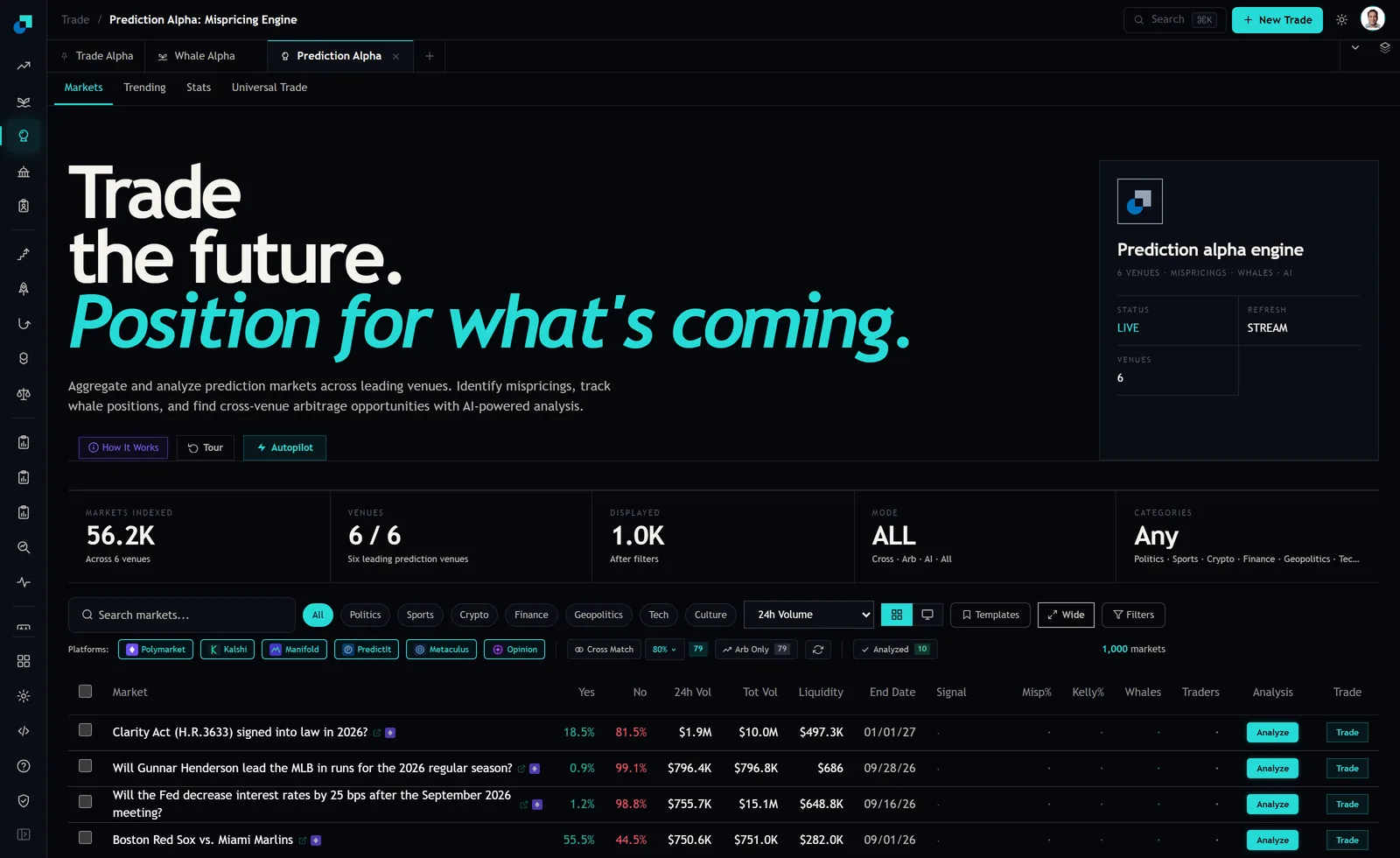
One further detail from that capture is worth recording before you design a control around this screen. On all four visible rows the Signal, Misp%, Kelly%, Whales and Traders columns were showing placeholder marks rather than values. The columns exist. They were not populated for these rows at that moment. Any risk process that assumes a screen field will always be filled is a process that will silently stop working, so build yours on data you write yourself.
The tag the screen does not have, written at ticket time
There is no resolution-source column here and no criteria text, which means the tag has to be created at the point of order approval, by the person who read the criteria, before the position exists. Retrofitting it across an open book is a week of work nobody schedules.
Six fields are enough. The publishing authority, named as an entity rather than a category. The specific series or document, at the level of detail that distinguishes one release from its neighbours. The scheduled release timestamp in UTC, including whether it is fixed or approximate. Whether the figure carries scheduled revisions. The tie-break or ambiguity clause the venue applies and who arbitrates it. And the venue itself, because two venues can read the same publication under different rules.
Make the tag mandatory on the ticket and make an unresolvable tag a reason to decline the trade. If the person proposing the position cannot say who determines the answer, they have not read the contract, and that is a useful thing to discover before capital is committed rather than on the settlement date.
What the exposure report has to show, and the limit it enforces
The report is not a list of positions. Its rows are resolution events, and positions roll up into them. For each event, show the gross notional attached, the net directional notional, the worst-case loss if that event resolves against every position tied to it, the number of positions, the venues involved and the scheduled timestamp. Sort by worst-case loss descending and read the top five. That is the whole report and it should fit on one page.
Two limits sit on top of it. A per-event cap expressed as worst-case loss over book equity, which is the one people expect. And a per-timestamp cap, which is the one they do not. Several genuinely distinct events can be published within the same few minutes, and if your operational response to a surprise is to reduce exposure, you will discover that you cannot reduce nine positions across four venues inside a window that narrow. The per-timestamp limit is really a liquidity limit wearing a risk limit's clothing, and it should be set by how much you can actually transact in that window, not by how much you are comfortable losing.
Report the same view forward as well as at present. A calendar of the next thirty days by resolution event, with committed capital against each date, tells the desk where its capital is going to be trapped and where it is about to be freed. On this asset class capital velocity is set by other people's publication schedules, and a book whose contracts all end in the same fortnight has a funding profile as lumpy as its risk profile.
The three ways one source becomes one loss
The first is non-publication. The print is delayed or does not appear, and every contract tied to it extends. Capital stays committed, the venue's rulebook rather than your judgement decides what happens next, and the rulebooks are not identical across your venues. Know, before you size, what each venue does when the source it depends on goes missing.
The second is ambiguity. The publication arrives and does not cleanly answer the question, which happens more often than the clean cases suggest because contracts are written months ahead of the data. Each venue resolves that under its own arbitration process, so two positions on the same real-world question at two venues can settle in opposite directions and both be correct under their own rules. If your tag recorded the arbitration clause, you can at least name that risk in advance instead of discovering it in a settlement notice.
The third is operational. The source publishes, the world learns the answer, and one venue is degraded at exactly that moment because everybody holding a contract on that print is trying to act at once. That is a concentration in venue capacity rather than in data, and it is the reason the per-timestamp limit should count venues as well as dollars. None of these three is exotic. What makes them dangerous is that a category-diversified book reports as diversified right up until the moment all three arrive together, and the only thing that would have shown it beforehand is a field the screen does not have and you have to write.