A long-short momentum sleeve is usually approved on a backtest where both legs are symmetric. Buy the strength, sell the weakness, net the two, report the spread. The long leg then deploys more or less as designed and the short leg does not, and the tracking error that results is not noise. It is structural, it has a known cause, and it is worst in precisely the names the signal ranks most strongly.
The uncomfortable part is that the constraint is correlated with the signal. That is what makes it a design problem rather than a cost line.
Read what the equity signals are actually telling you to do
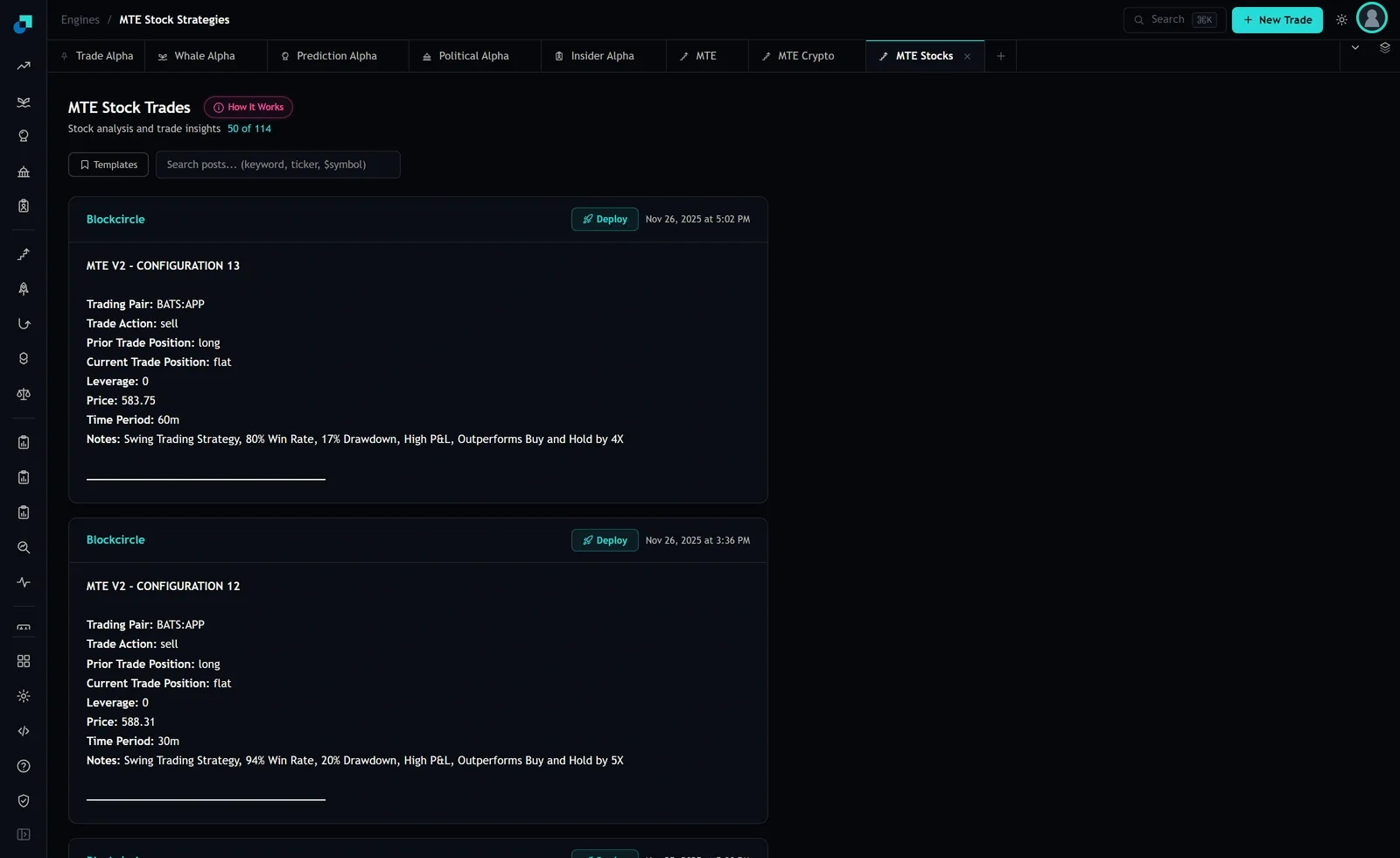
Start with the signal grammar, because there is an assumption here that is worth checking before anything else. The stock strategy feed presents each signal as a card with a fixed payload, and at capture the header read 50 of 114 with a template control and a search over keyword, ticker or symbol.
Two adjacent cards on the same instrument show the pattern. Configuration 13 reads a trading pair of BATS:APP, trade action sell, prior trade position long, current trade position flat, leverage 0, price 583.75, time period 60m. Configuration 12 reads the same instrument, sell, prior long, current flat, leverage 0, price 588.31, time period 30m.
Both sells are exits. Prior position long, current position flat. Neither card establishes a short. That is a meaningful observation for anyone planning a short leg, and I want to state it precisely rather than generalise from two cards: in the captured feed the sell actions I can see are position-flattening rather than short-establishing, and the payload carries an explicit current position field that would read short if a short were being opened. So if your sleeve requires a short book, check whether the configurations you are subscribing to actually produce one, or whether you are constructing the short leg yourself from the ranking. Those are different products with different diligence requirements.
The names the signal wants are the names the desk cannot get
Securities lending supply is not evenly distributed. It is deep in large, widely held, index-heavy names and thin in small floats, recent listings, heavily retail-owned names and anything where a large fraction of the register is held by people who do not lend. Demand runs the other way: borrow demand concentrates in names that a lot of people want to be short at the same time.
A momentum short signal selects on sustained relative weakness and high attention. That description overlaps almost exactly with the population where borrow is expensive, where the fee is being repriced daily, and where existing lenders are most likely to recall. So the constraint is not an independent friction you can average over the book. It is a function of the same variable the signal is built on, which means the subset of your short signals that you can actually implement is systematically the least extreme subset.
The consequence for attribution is specific. Your realized short leg is a truncated version of the signalled one, truncated at the end where the signal was strongest. If the strategy's edge is concentrated in the tail, and in momentum it usually is, the realizable short book captures a materially smaller share of the expected spread than the backtest implies, and no amount of trading skill recovers it.
The three costs a long-only backtest never contains
Borrow fee is the visible one and the least dangerous, because it is a rate you can look up before you trade and it accrues predictably on market value. Model it as a daily accrual on the short notional rather than as a spread at entry, since a momentum position held for weeks pays it for weeks. Work an example with your own numbers: a short position held for 30 days at an annualised borrow rate of 8 percent costs roughly 66 basis points of the notional, which against an expected move of a few percent is a real fraction of the trade. On a hard-to-borrow name where the rate is a multiple of that, the position can be uneconomic before the thesis is tested.
Recall risk is the expensive one because it is path dependent. A lender recalls, your prime broker buys you in, and the buy-in happens at the moment the borrow got tight, which is usually the moment the name is squeezing, which is the worst possible print. A backtest exits on a signal. The real book sometimes exits on someone else's decision, at a price nobody modelled, in the same direction as everyone else being bought in at the same time.
Locate failure is the invisible one. The trade simply does not happen, and it leaves no trace in any P&L record. It appears only as a difference between the book you intended and the book you have, which is why it has to be recorded deliberately or it disappears from your own history.
Measuring it so a review can answer the question
The review question, when the sleeve underperforms, will be why the short leg did not do what the memo said it would. You want that answered with a table rather than a recollection.
Capture two books at every rebalance. The signalled short book, as the engine ranked it, and the realized short book, as the desk actually got it. Store both. The difference between them is the implementation shortfall of the short leg and it is the single most useful number in the whole sleeve.
Then track four fields per name: the locate outcome, the borrow rate at entry, the borrow rate at exit, and whether the exit was signal-driven or forced. Aggregate the last one separately, because forced exits are a different distribution and averaging them into the strategy's statistics hides the tail you are exposed to.
Report the short leg's return gross and net of borrow. A short book that looks flat gross and negative net is a book that is working and being taxed, which calls for a different response than a book that is simply wrong.
Design choices that survive contact with a stock loan desk
Set a borrow rate ceiling in the mandate above which a name is dropped from the short book regardless of signal strength, and set it before you see which names it excludes. This converts an unbounded cost into a known opportunity cost and gives the trader a rule rather than a judgement call at eight in the morning.
Size the short leg on realizable notional rather than signalled notional. If half the tail is unavailable, a sleeve sized on the full signalled book runs a smaller short and a larger net long exposure than the mandate describes, and it will look like a directional bet in the attribution because it is one.
For the un-borrowable tail, decide in advance whether you substitute. An index or sector short, or a listed put where one exists with adequate liquidity, will hold some of the exposure at the cost of a basis you have to own explicitly. Write the substitution rule into the process document, along with the basis assumption, so it is a decision with a number attached rather than an improvisation.
And check the timeframe against the mechanics. The configurations in the feed run at 30 and 60 minute periods. Locates are arranged around the start of the session and availability changes intraday, so a signal that wants to open a short at eleven in the morning on a tight name is asking for something the borrow desk may not be able to provide on that timescale. Either pre-arrange the locate for the full candidate list at the open, which costs you a fee on names you never short, or accept that the fastest short signals will have the lowest fill rate and record that as a known property of the sleeve rather than as a surprise.