A fund distributes its remaining position to limited partners. The filing shows a disposition of several hundred thousand shares by a ten percent owner. Nothing was sold on that date, and yet most of those shares will be sold, by other people, on a schedule that is invisible to every filing system. The gap between the filing and the actual supply is the entire analytical problem, and pooling the row with discretionary officer selling destroys both halves of it.
The cost of getting this wrong is asymmetric in an unhelpful direction. A missed distribution shows up as an unexplained two week period of heavy volume and price weakness in a name you own, and the post mortem concludes that something was wrong with the business.
The mechanics that make a distribution look like a sale
A sponsor holding, whether venture, growth or buyout, usually sits inside a fund vehicle that is itself the Section 16 filer as a ten percent owner. When the fund distributes in kind, shares move pro rata to the partners. The transaction code is the catch-all other category with an explanatory footnote rather than an open-market sale code, because no open-market transaction occurred. There is no execution price, so the value field is either empty, zero, or a vendor-supplied closing mark, and which of the three you get is a property of your data pipeline rather than of the event.
What changes is the holder set. Before the distribution the block sat with one entity subject to a blackout calendar, a Section 16 reporting obligation and Rule 144 volume limits. After it, the same shares sit with dozens of holders subject to none of those things. The reporting perimeter shrinks and the sellable float grows on the same day, which is close to the opposite of what a naive sell signal implies.
Where the Transfers view helps and where it stops
Insider Alpha does segregate non-sale dispositions into their own view, which is more than most feeds do. The taxonomy is the thing to look at before you rely on it. The type filter offers Gift To Family, Trust Funding, Divorce Settlement, Estate Plan and Internal. There is no distribution bucket, so an in-kind distribution lands in whichever category the footnote language pushes it toward.
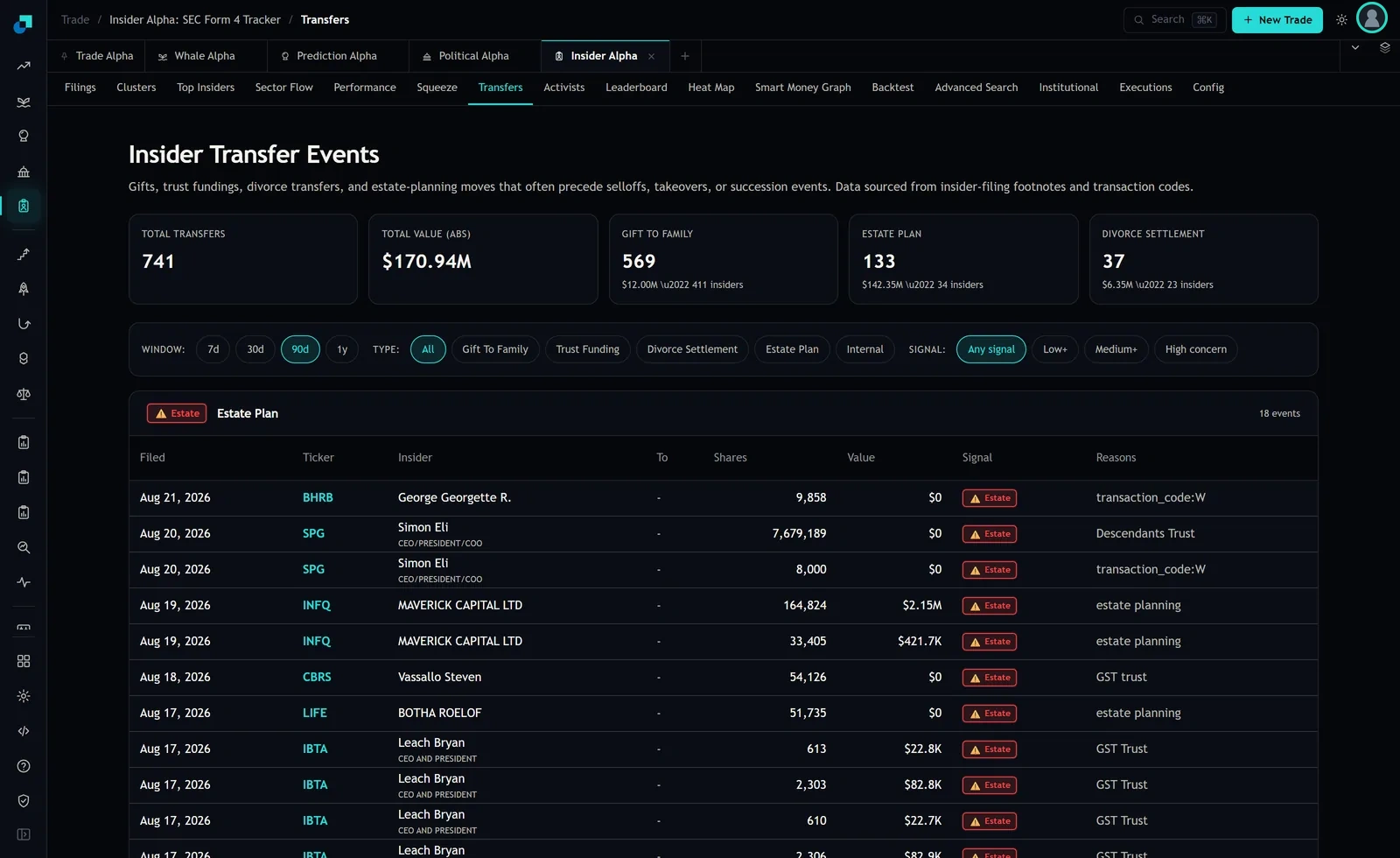
Two observations from that screen matter for this workflow. First, entity filers appear alongside individual officers, and at least one fund entity on the capture is grouped under an estate-planning reason string. That is not a criticism of the filer, it is a statement about text classification: a category assigned from footnote language will inherit the vocabulary of whoever drafted the footnote. Treat the category as a hint and read the underlying text before it enters a model.
Second, the board is captured on the ninety day window with total transfers of 741 and total absolute value of $170.94M, of which the three named categories account for 739 events and $160.70M. About ten million dollars of value sits outside the categories the cards enumerate. That residual is where entity mechanics tend to live, and it is small enough to read by hand.
Modelling the overhang the distribution actually creates
Shares distributed is a gross number and it is the wrong input to a risk model on its own. What you want is expected net supply and its timing, which decomposes into three estimates you have to make explicitly.
- Sell-through rate by holder type. Passive vehicles and funds of funds that cannot hold a single-name position generally liquidate promptly. Endowments and family offices with discretion may hold. Individual general partners are the least predictable and the smallest slice.
- Timing distribution. In my experience the sell-through is front-loaded rather than spread evenly, because most limited partner accounting references a price near the distribution date and holding away from that reference creates tracking error against the reported mark.
- Absorption. Express the result in days of average daily volume at your own participation limit, not as a dollar figure. A four million share distribution into a name that trades nine hundred thousand shares a day is a two week volume event if sixty percent sells through in ten sessions, and those illustrative numbers are worth running properly for any name where the sponsor stake exceeds a few days of volume.
The uncomfortable part of this model is that the filing arrives after the decision. Limited partners are notified before the Form 4 is filed, and the shares are in their accounts before you read the row. The filing is confirmation. The tradable input was the lockup calendar and the fund vintage, both of which you can have in advance.
Keeping lifecycle events out of the insider factor
If your insider sleeve pools entity dispositions with officer sales, its loading is partly a proxy for time since listing. Sponsor distributions concentrate in a predictable band after a lockup expires and again as a fund approaches the end of its life. A factor that is short names with heavy insider selling will therefore be systematically short recently listed companies with venture registers, which is a real exposure and possibly one you want, but it is not the exposure the factor claims to be.
The fix is a two-dimensional tag on every disposition rather than a single bucket. Actor type comes first, splitting officer and director from individual ten percent owner from entity ten percent owner. Mechanism comes second, splitting open market from plan from in-kind from gift from estate transfer from withholding. Then run the sleeve's attribution twice, with entity in-kind rows included and excluded. If the answer moves materially, the factor was measuring fund lifecycle and the sleeve document should say so.
The same tagging pays for itself in the other direction. Once entity mechanics are separated out, the residual discretionary selling by officers and directors is a much cleaner series, and its base rates are worth measuring on their own. A pooled series is dominated by mechanical volume and its statistics are close to meaningless.
What the risk memo needs before the print, not after
For any position where a sponsor holds a stake large enough to matter, the file should already contain the remaining sponsor holding as a share of float, the fund vintage and its stated term, the lockup and any staged release schedule, the desk's participation limit in that name expressed as a share of average volume, and the trigger that moves the name from watch to reduce. Name the person who signs off on that trigger.
Write down the falsifier too. If a distribution prints and the expected volume does not materialise within your modelled window, your sell-through assumption was wrong for that holder base and you should record the miss rather than quietly reusing the same assumption on the next name. Overhang models degrade in exactly this way, by never being scored, and the version that has been silently correct for three years is usually the one that has never been checked against a print.