Most failures announce themselves. An order rejects, a connection drops, a red banner appears somewhere. The one that does not announce itself is a price feed that stops updating while everything downstream carries on believing it, because a stuck price is not an error condition. It is a number, and it is a perfectly valid number, and every calculation you have built on top of it will run to completion and produce a confident answer.
What that looks like from the outside is a calm market. Nothing is moving. Your indicators sit still. The engine reports itself live and healthy, which it is, and continues acting on the last thing it was told. This is the failure mode I would most want a retail operator to understand before switching anything to live, because it is the one where the tooling is genuinely not going to help you.
A stale feed looks exactly like a quiet market
Work through what a frozen quote does to the rules you are running. Suppose the last price your engine received for an instrument was 100, and it stopped updating there while the real market walked down to 94.
A momentum rule computes its indicators across a series where the recent bars are flat or absent. It sees no momentum, so it does not fire. A reversal rule sees no move away from any average, so it does not fire either. Neither produces an error, and both are behaving exactly as designed on the data they were given. The absence of signals over an afternoon is indistinguishable from a genuinely dull session, and you will assume the second explanation because it is true almost every time.
Now the part that costs money. If you hold an open position with a stop, ask where that stop is evaluated. If it is a rule inside the engine, watching the price and acting when a level is breached, then it is reading the same frozen 100. The market can go to 94, then 90, and the stop will never trigger, because from the stop's point of view the price has not moved. Your protection and your data are the same dependency, which means a data failure disarms your protection silently and at exactly the moment it was needed.
A stop that exists as a real resting order at your broker or exchange does not have this problem, because the venue is matching against its own book and does not care what your engine believes. That distinction is worth establishing for your own configuration, once, by opening the venue directly and looking at whether anything is actually sitting in the working orders list.
The tells you can actually see
None of these is conclusive on its own. Together they are usually enough to make you go and check properly, which is all you need them to do.
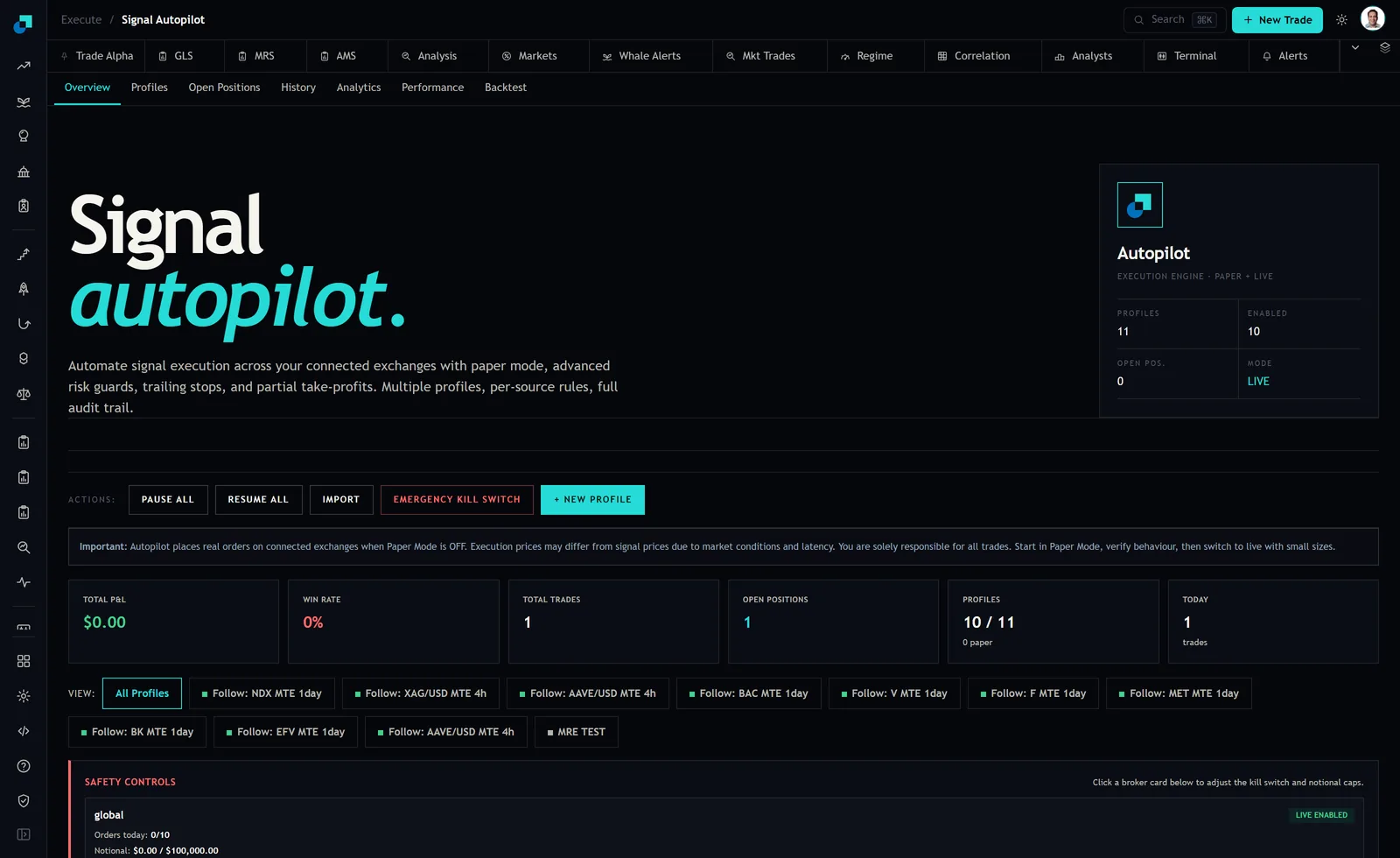
An activity count that is wrong for the conditions. You need a baseline for this to work, which is one of the quieter arguments for running a month in paper first. If a profile normally produces two or three entries a week and has produced none in ten days across a market that has clearly been moving, that is worth a look. My own overview read TOTAL TRADES 1 and TODAY 1 at capture, and on an engine that quiet a stale feed could persist for a fortnight without anything looking unusual.
Timestamps that stop advancing. Open the History tab and read the most recent entries by time rather than by content. The useful habit is checking the gap between now and the last thing the profile did, against what that gap normally is.
Two counters that disagree. At capture, the header strip on my overview read OPEN POS. 0 while the tile below read OPEN POSITIONS 1. There are innocent explanations, and they are the ones you will reach for: different scope, one filtered to a view, or a refresh landing between the two reads. The habit worth building is not assuming the worst, it is resolving the difference rather than shrugging at it, because an unexplained mismatch between two views of the same quantity is the same shape as a data problem and takes about a minute to settle.
The price on the screen against the price at the venue. This is the only tell that is close to definitive and it is also the fastest. Open your exchange or broker in a separate tab and compare the quote for one instrument the profile trades. If they differ by more than a normal spread, you have your answer immediately.
The staleness rule to impose, and what it should do
The condition you want is simple to state. For each instrument a profile trades, if the age of the most recent price exceeds a threshold, the profile stops taking new entries. Define the threshold as a multiple of the bar interval the profile runs on, because that is the only scale that makes sense across timeframes. Around three times the expected interval is a reasonable starting point: a four hour profile tolerating twelve hours of silence, a daily profile tolerating three days.
Be careful about what it does when it trips, because the intuitive response is wrong. Stopping new entries is right. Automatically closing open positions is not, and this catches people out. If your data is stale you cannot price the exit either, so a forced flatten means sending market orders into a market you currently cannot see, which converts a data problem into a realised loss at an unknown price. Stop entering, hold what you have, and escalate to yourself.
The threshold also has to know about sessions, and this is where naive staleness alarms die. My own profile list has entries following instruments with very different calendars, along the lines of Follow: NDX MTE 1day and Follow: XAG/USD MTE 4h. Index and metals feeds have scheduled gaps, weekends, and holidays where no ticks arriving is entirely correct. An alarm that does not know the session calendar will fire every Saturday, you will mute it within three weeks, and a muted alarm is strictly worse than no alarm, because it occupies the space where a real control would have gone.
The manual version, ten minutes a week
If your setup does not enforce a staleness condition for you, build the habit version, which is cruder and still catches the majority of this.
Pick one instrument per profile and cross check its price against the venue directly, once a day at a fixed time. Fixed time matters more than frequency, because the discipline survives and an ad hoc check does not. Ten seconds each.
Once a week, open the History tab and read the time gaps between entries rather than the outcomes. You are looking for a gap that is out of character, not a bad trade.
And set one crude alarm that has nothing to do with your engine, using price alerts at your venue or in a separate tool. A pair of alerts a few percent either side of the current price on each instrument you hold means that when the market moves and your engine does not react, something else tells you. That is the whole trick: your staleness detector cannot share a data source with the thing it is meant to be detecting staleness in.
The last piece is a partial failure, which is harder than a total one. One instrument frozen out of ten looks like nine healthy profiles and one selective strategy, and the aggregate counters on the overview will look completely normal because the other nine are filling them in. If you run several profiles, the per instrument check is the one that catches this, and the aggregate view never will.