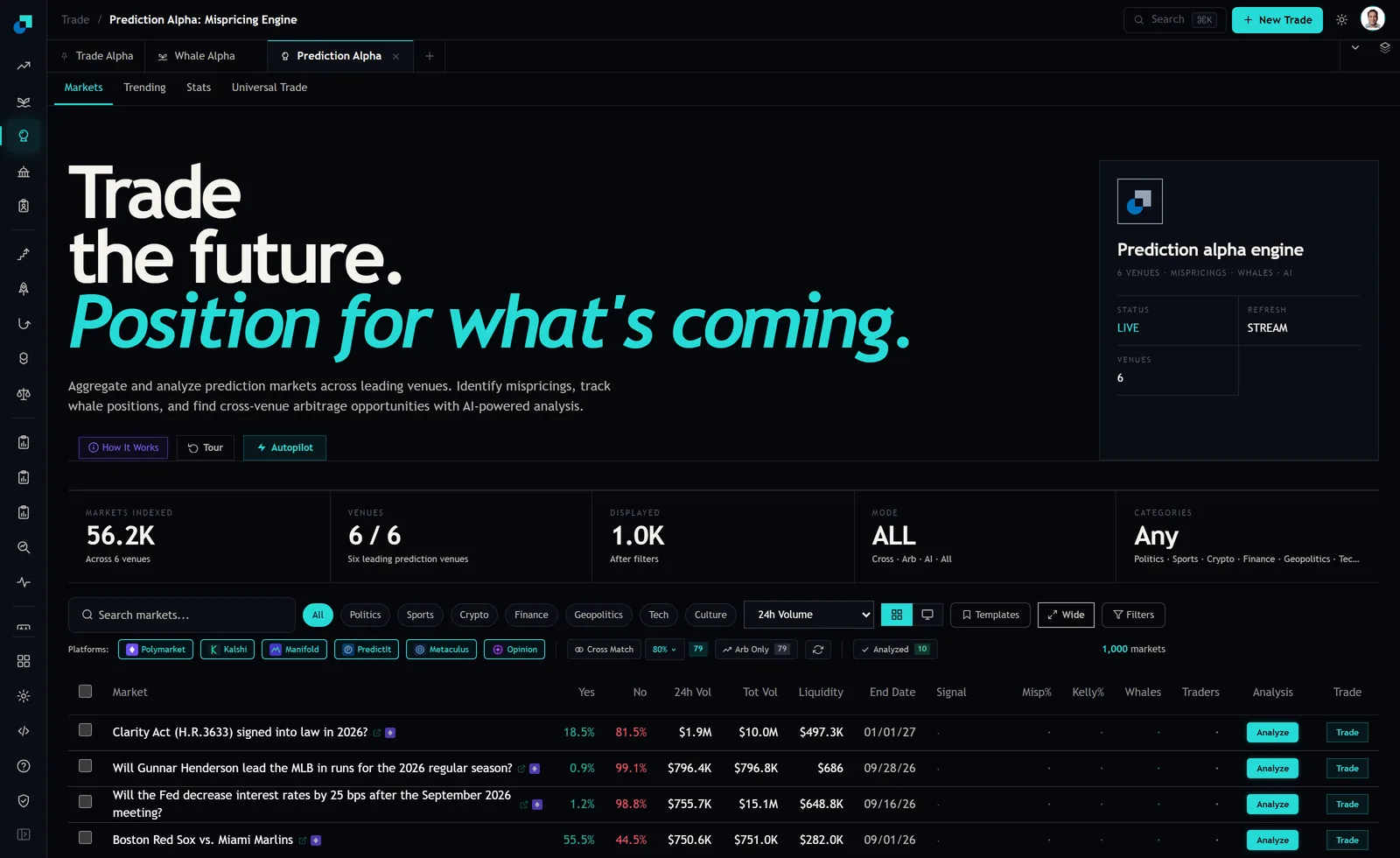
Sort the Prediction Alpha markets table by 24-hour volume and you will find contracts priced at almost nothing near the top. In the view I am looking at, the question of whether Gunnar Henderson leads the MLB in runs for the 2026 regular season shows Yes at 0.9 percent and No at 99.1. Two rows down, whether the Fed decreases rates by 25 bps after the September 2026 meeting shows Yes at 1.2 percent.
The arithmetic is seductive. A contract that pays a dollar, bought for nine tenths of a cent, returns about a hundred and eleven times your money. Risk fifty dollars, collect five and a half thousand. That is the shape of the trade before costs, and costs at this price level do not behave the way they do anywhere else on the board.
At nine tenths of a cent, one increment is an enormous move
Start with the minimum price increment on your venue, because that single parameter dominates everything else down here. If your venue quotes in tenths of a cent, then moving from 0.9 to 1.0 costs you eleven percent of your entire cost basis. If it quotes in whole cents, the next price up from 0.9 is 1.9, and paying it more than doubles what you paid for the same claim. Look up which one applies to the venue you are about to use, because the answer changes the trade by a factor of ten.
Now compare that to a normal contract. On a question trading at 50, one cent of adverse pricing takes your breakeven from 50 percent to 51 percent. You need to be two percent more accurate than you thought. Down at 0.9, that same single cent takes your breakeven from 0.9 percent to 1.9 percent. You need to be a hundred and eleven percent more accurate. The absolute cost is identical. The relative cost is not remotely identical, and relative cost is the only kind that matters when you are pricing your own forecasting ability.
The breakeven table nobody puts in the pitch
Here is the same one cent of round-trip friction applied across the price range, expressed as the increase in the hit rate you need before the position stops being a donation.
| Quoted Yes | Breakeven after one cent of friction | Extra accuracy required |
|---|---|---|
| 0.9 cents | 1.9 cents | 111 percent more |
| 5 cents | 6 cents | 20 percent more |
| 25 cents | 26 cents | 4 percent more |
| 50 cents | 51 cents | 2 percent more |
| 90 cents | 91 cents | about 1 percent more |
Read that top row again in plain language. To make money on a contract the market prices at roughly one in a hundred, you need to be right closer to one time in fifty. Your view has to disagree with the market by a factor of two before you have covered a single cent of friction, and you have not yet paid a fee.
The fee base matters more than the fee rate
I am not going to quote a fee schedule here, because they differ by venue and they change. What I will tell you is the question to ask, which is not what the rate is but what base it is charged on.
If your venue charges per contract, do this arithmetic before anything else. A hundred dollars at 0.9 cents buys you eleven thousand one hundred and eleven contracts. A per-contract charge of even a tenth of a cent is eleven dollars, which is eleven percent of your stake, taken on entry. The same fee on a hundred dollars of a 50 cent contract touches two hundred contracts and costs twenty cents. Identical fee schedule, identical stake, and the cost differs by a factor of fifty five, purely because cheap contracts mean you own an enormous number of them.
If instead the fee scales with the price or the expected value of the position, the sub-penny end of the board is treated more gently, and the spread rather than the fee becomes your dominant cost. Either way, find out which regime you are in, in writing, before you size anything at these prices. This is a five minute job on the venue's fee page and almost nobody does it.
Getting out costs more than getting in
Everything above assumes you hold to resolution. Now suppose you change your mind, or the position moves your way and you want to take something off. You have to cross back to the bid.
On a contract bought at 0.9 and bid at 0.8, you have lost eleven percent on a round trip in which nothing whatsoever happened. On a whole-cent venue where you paid 1.9 and the bid is 0.9, you have lost more than half your stake to a market that did not move. That is not slippage in the usual sense, it is the structural consequence of a spread that is enormous relative to the price even though it is trivial in absolute terms.
The practical consequence is that a sub-penny contract is a hold-to-resolution instrument whether or not you intended that. Check the End Date column and treat the money as committed until then. The Henderson row ends 09/28/26. If the answer becomes obvious in June, you will spend the summer holding something worth nothing that nobody will bid a tenth of a cent for.
What would have to be true for the trade to work
There is one more thing worth knowing before you go longshot hunting, and it points the wrong way for this trade. The long-running result in betting and event market research is that longshots tend to be priced above their realised frequency rather than below it. In other words the systematic error at the far end of the board favours the seller, not the buyer. That does not make every penny contract a bad trade, but it means the base rate is against you before your specific view is even considered.
So stack the requirements honestly. You need the market's implied one percent to be wrong. You need it wrong by a factor of two or three, not by a few tenths, because that is what covers the increment and the fee. You need enough depth on the row to get filled, and on the Henderson row the Liquidity column reads $686, so that is doubtful at any size worth the effort. And you need to be comfortable with the position being unsellable for months.
The table gives you two columns built for exactly this question, Misp percent and Kelly percent, sitting to the right of End Date. Use them as prompts rather than answers. The one that matters is the second, because a Kelly figure is a statement about how much of your capital your edge justifies, and a genuine edge on a one percent contract is rare enough that if you cannot say in one sentence what you know that the market does not, the honest size is zero.