The Score column on the Asset Outperformer board is the one everybody reads. The column three places to its left is the one that decides whether the score is any use to you, and it takes about four seconds to check.
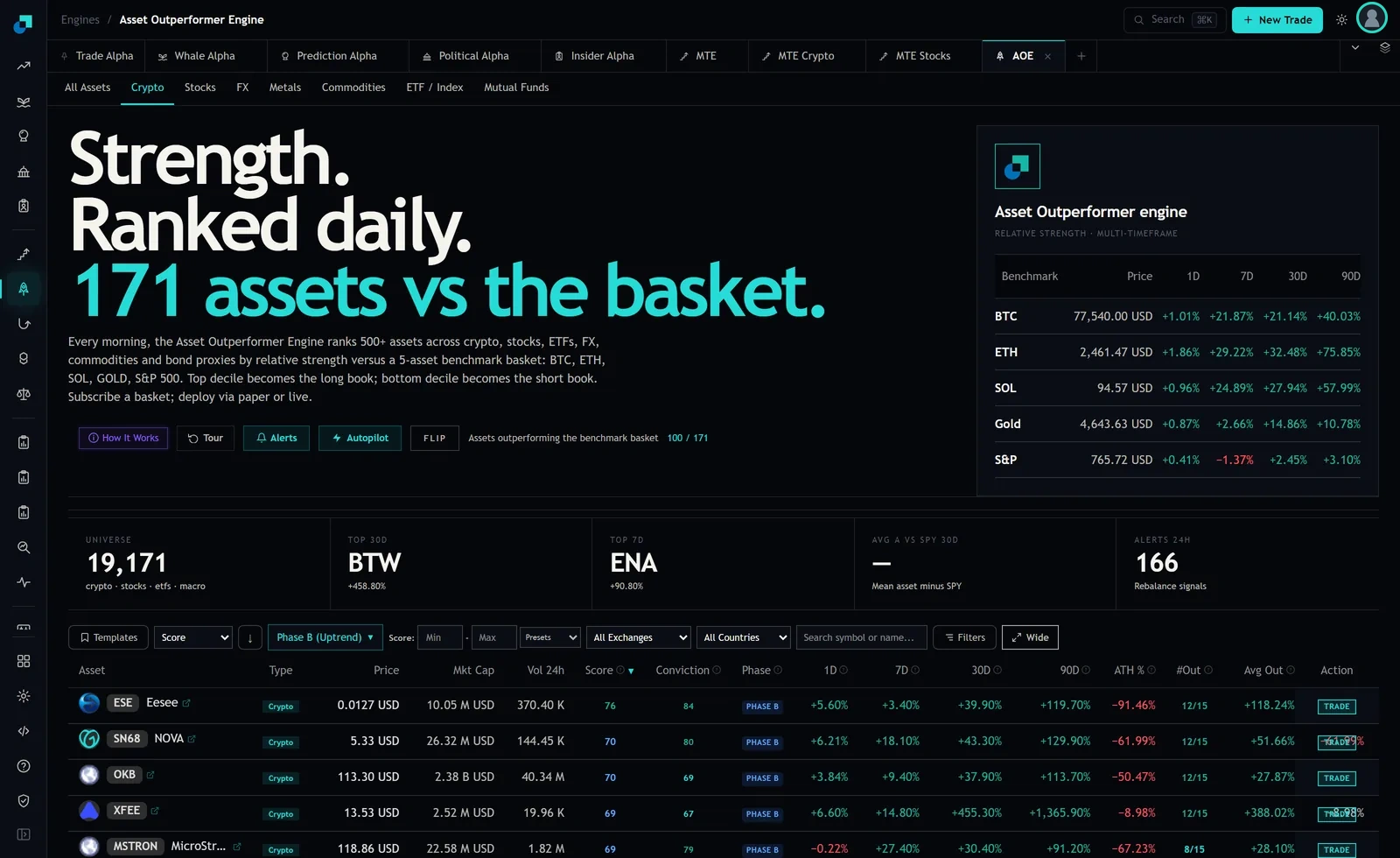
Here is the crypto tab as it stood at capture, reading the top five rows across. Eesee scored 76 on 370.40 thousand dollars of twenty four hour volume. NOVA scored 70 on 144.45 thousand. OKB scored 70 on 40.34 million. XFee scored 69 on 19.96 thousand. MicroStrategy's tokenized wrapper scored 69 on 1.82 million. Those five scores sit inside a seven point band. The volume figures behind them span a factor of roughly two thousand.
The ranking is telling you these assets have similar relative strength against the benchmark basket. It is not telling you they are similarly tradeable, because tradeability is a separate column and it is not part of the score.
Seven points of score, two thousand times the liquidity
Take the two extremes on that board. OKB carried a 2.38 billion dollar market cap and 40.34 million dollars of daily turnover. XFee carried a 2.52 million dollar market cap and 19.96 thousand dollars of daily turnover. On score they are one point apart. As positions they are not remotely the same instrument.
A twenty thousand dollar daily tape is the total value of everything that traded in the asset over a full day, on both sides, across every venue the data covers. It is not depth. It is not what is resting on the book right now waiting for your order. The amount actually sitting there at the moment you press buy is some small fraction of the daily figure, and on a token like that the fraction is small enough that a single retail order can be the largest trade of the session.
What a twenty thousand dollar tape does to a small order
Put a real number on it. Say your normal position in a speculative token is a thousand dollars. Against 19.96 thousand dollars of daily volume, that single order is five percent of everything that trades in the asset that day. You are not participating in the market, you are briefly the market.
Now walk the round trip. You buy, and your own order moves the price up because there is nothing much to absorb it. The fill you get is worse than the quote you saw. Some weeks later you decide to sell, into a book that has no reason to be deeper and every reason to be thinner, because the reason you found this token in the first place was a spike that has since passed. Selling five percent of a day's turnover on the way down is a materially worse experience than buying it on the way up, and that asymmetry is the whole problem. Entry flatters you. The exit is where the number is collected.
None of that requires a bad token or a scam. It is just arithmetic on a small pot of money.
The volume floor I set before I look at the score
The fix is a floor you decide once, away from any particular chart, and then apply mechanically. Pick the largest share of daily volume you are willing to be, then work backwards from your usual position size.
One percent of daily volume is a reasonable ceiling for a retail order in a thin asset, and half a percent is better. That gives you a required volume figure for any position you might take.
| Your position size | Minimum Vol 24h at 1 percent | Minimum Vol 24h at 0.5 percent |
|---|---|---|
| 250 dollars | 25,000 dollars | 50,000 dollars |
| 500 dollars | 50,000 dollars | 100,000 dollars |
| 1,000 dollars | 100,000 dollars | 200,000 dollars |
| 2,500 dollars | 250,000 dollars | 500,000 dollars |
Run that against the board and the picture resolves fast. At a thousand dollar position and a one percent cap, XFee at 19.96 thousand is out by a factor of five, NOVA at 144.45 thousand passes, Eesee at 370.40 thousand passes comfortably, and OKB at 40.34 million is not a liquidity question at all. The score did not change. What changed is that you now know which of those rows is a candidate for your account rather than for somebody else's.
The practical version this week is simpler than the table. Open the crypto board, sort by Score as usual, and before you look at a single chart, delete every row whose Vol 24h is below your floor. What is left is your actual shortlist. It will be shorter than the one you started with, and that is the point.
Thin volume also weakens the score behind it
There is a second effect that matters more than the slippage, and it is the reason I put the volume check first rather than last.
XFee at capture showed a thirty day move of plus 455.30 percent and a ninety day move of plus 1,365.90 percent, with an average outperformance figure of plus 388.02 percent. Those are enormous numbers, and they were produced on a token turning over twenty thousand dollars a day. A price that rises fifteen fold on almost no money has not been tested by anybody trying to sell size into it. The move is real in the sense that trades happened at those prices. It is not real in the sense that you could have participated at any meaningful size, in either direction.
Relative strength scores are computed from prices, and prices from a thin tape carry less information than prices from a deep one. The same percentage move means something quite different when it takes forty million dollars of turnover to produce it than when it takes twenty thousand. So volume is not only an execution filter, it is a quality filter on the input to the ranking, which is why a high score on a tiny tape should make you more cautious rather than more excited.
The one case where a thin row is still worth keeping
Screening a name out is not the same as ignoring it. Keep the thin high scorers on a watchlist, because volume changes and scores do not usually change as fast. A token that clears your volume floor three weeks from now, with the score still intact, is a genuinely better setup than the same token today: you get the relative strength reading plus evidence that real money has arrived.
What you should not do is take the position at a smaller size to make the liquidity work. Halving your order to fit a thin book fixes the slippage arithmetic and breaks the portfolio arithmetic, because a position too small to matter still costs you the same attention, the same tracking and the same emotional weight as a full one. A hundred dollar stake in something you check daily is the worst trade on the board, whatever the score says.