Alert volume is treated as a nuisance and it is a capacity constraint. A desk that generates more alerts per hour than its coverage can handle is not a noisy desk, it is an over capacity queue, and queues that run over capacity do not degrade gracefully. They fail by dropping work invisibly, and the dropped items are selected by whatever is easiest to dismiss rather than by what mattered least.
The useful framing is arithmetic. Count the alerts arriving per hour, count the analyst hours you can actually staff in that hour, divide, and compare against a handling time you have measured rather than assumed. Everything else in an alert fatigue discussion follows from whether that ratio is under one.
Getting a real firing count, not a rule count
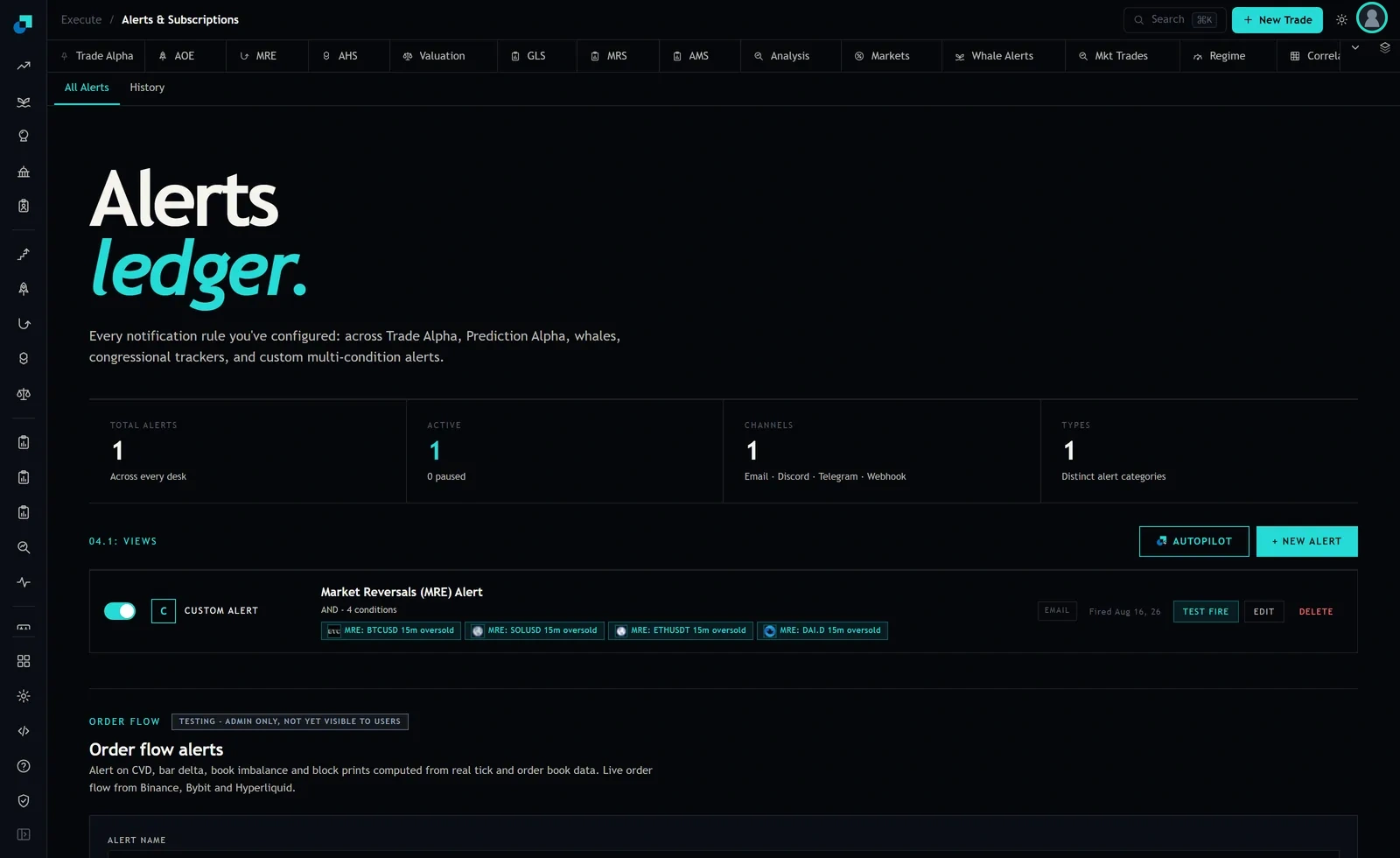
The first obstacle is that the obvious number is the wrong one. The Alerts and Subscriptions ledger counts rules: the header tiles show total alerts, active against paused, channels in use and distinct alert categories, and the row for each rule carries a name, its logic and conditions, a channel badge, an enable toggle, a last fired date, and controls to test fire, edit or delete. Those tiles describe the size of your estate, not its output.
Twelve rules can produce two firings a week or six hundred. So the number you need is firings, and the History tab beside the main list is where that record lives. Export or transcribe it for a representative period, and treat that period with some care: a fortnight containing a policy meeting and an earnings week is not representative of a quiet August, and capacity planning done on either one alone will be wrong in a predictable direction.
Bucket the firings three ways once you have them. By hour of day in the time zone your staff actually sit in, which is the only bucketing that maps onto a roster. By rule, so you can see the small number of rules generating most of the volume, which there always is. And by whether the firing required an action, since a firing that never requires anything is a different kind of load from one that might.
Handling time is longer than the touch
The denominator is where estimates go wrong. People price an alert at the time it takes to read it, which is seconds, and conclude they have enormous headroom. The real cost of an alert to a person doing focused work is the interruption plus the recovery, and the recovery is the larger half.
Measure it rather than guess. For a fortnight, have the covering analysts record the clock time from opening an alert to being back on what they were doing, for a sample rather than for everything. You will get three distinct populations: dismissals, which are genuinely quick; triage, where the analyst checks a position or a chart and concludes nothing is needed; and actions. Weight them by their observed frequency and you have a mean handling time that is defensible.
Then be honest about the hour. An analyst hour is not sixty minutes of alert capacity, because that person has a job that is not answering alerts. If alert handling is expected to occupy a quarter of their time, then an analyst hour supplies fifteen minutes, and the ceiling falls accordingly. Write the assumed share down explicitly, because it is the number that gets quietly inflated when someone wants to justify adding a rule.
The ceiling, and what to do at each breach
Set the ceiling per hour of day rather than as a daily average, since the average is comfortable in exactly the hours nothing arrives. The interesting number is the busiest hour of a busy day, and the useful discipline is that the ceiling applies there.
When an hour breaches, there are four responses and they are not interchangeable.
- Merge. Where several rules describe one situation, combine them into a single rule with ANDed conditions, which produces one alert to handle rather than four. The custom alert visible on the ledger does exactly this, requiring four separate oversold conditions before it speaks at all. Merging cuts volume and it also cuts sensitivity, so it is right when the constituent rules were rarely actionable alone.
- Suppress. Where one situation produces repeated firings, a cooldown or a longer evaluation window collapses the cluster into one event. This is the cheapest fix available and the one most estates have never applied, because the clusters are invisible until you bucket the history.
- Demote. Move the rule to a channel with no urgency, which for most desks means email or a scheduled digest. This does not reduce the work, it moves it to a time you chose, which is the entire point for anything that is not time critical.
- Automate the response. Where the decision following an alert is deterministic, encode it and stop notifying a human at all. This is the only one of the four that genuinely removes work, and it is also the one that transfers risk rather than eliminating it.
Reach for these in order. The first three are reversible in an afternoon; the fourth is a change to your control framework.
Staffing the hours the volume actually arrives in
Once the volume is bucketed by hour, the roster question becomes concrete rather than political. You are looking for the hours where arrivals exceed capacity and for the hours where capacity sits idle, and the two are rarely adjacent.
Three patterns show up repeatedly. Overlaps, where a session open produces a spike an order of magnitude above the day's mean, which argues for scheduled cover at that hour rather than more headcount overall. Overnight, where the volume is low but the capacity is nearly zero, so the ratio is worse than the raw count suggests. And the correlated hour, which is the one that matters, where a market event fires many rules at once because the rules are watching related conditions. Your worst hour is not your busiest average hour, it is that one, and it should set the ceiling.
Use expected firing frequency as an operational field in your own routing table, one row per rule, and reconcile it against the ledger's last fired dates monthly. That reconciliation catches both directions of drift: the rule that has started firing far more often than it was designed to, and the rule that has gone silent and told nobody, which is the failure no amount of capacity planning detects on its own.
Automating because the decision is deterministic, not because you are short staffed
The fourth response above is the one that needs a guardrail around it, because the reasoning is easy to invert. Automating a response is correct when the decision is genuinely mechanical and you have demonstrated that on history. It is not correct as a way to absorb volume you cannot staff, and the tell is that the justification talks about analyst hours rather than about the decision rule.
An automated response also does not reduce your supervision load, it changes its shape. The alerts you no longer receive are replaced by an obligation to check that the automation is doing what it was specified to do, and that check has to be staffed too. Desks that automate to relieve pressure and do not add the supervision line back are the ones that discover a misconfigured profile weeks later.
Be precise about what the platform does and does not do here. Notification is not control. Nothing on the alerting surface halts a strategy, and the fleet level actions on the Autopilot page, pause all, resume all, and the emergency kill switch, are manual buttons rather than thresholds that trigger on their own. So the terminal safeguard for an unattended strategy is a human with authority and credentials, awake and reachable. That person is a staffing line, in every hour the strategy can trade, and if your capacity model does not have a row for them, then the volume calculation above has understated what you need by the one number that matters most.