The announcement is the part everybody reads and the least useful part of the document. What determines whether this costs you nothing or costs you the position is the timetable underneath it, and the timetable is four dates that vary by venue and by notice.
I am not going to tell you how long any particular venue gives you, because that number is set in each notice and inventing one would be worse than useless. What does generalise is the structure of the clock, the decision at each stage, and the balances people forget they hold until the window has closed.
The four dates the notice actually contains
Read the notice looking for these specifically, in this order.
The announcement date, which is when the clock starts and is usually the only date anyone quotes.
The trading halt, which is when the book closes. After this you cannot sell at that venue. Note that a notice covering several pairs sometimes halts them at different times, so check the line for your pair rather than the headline.
The withdrawal deadline, which is when you can no longer move the token off the venue. This is frequently later than the halt, and the gap between the two is the single most valuable piece of information in the document. It is the window in which you can no longer sell but can still leave with the asset.
The disposal terms, which is what the venue says it will do with balances still sitting there after the withdrawal deadline. Notices vary widely on this, from continued custody to conversion into another asset at a price and date the venue picks. Find the sentence, read it literally, and do not assume the friendly version applies.
Those four dates convert a vague sense of urgency into a schedule. Everything below is about what to do inside it.
The row is a pointer, not the notice
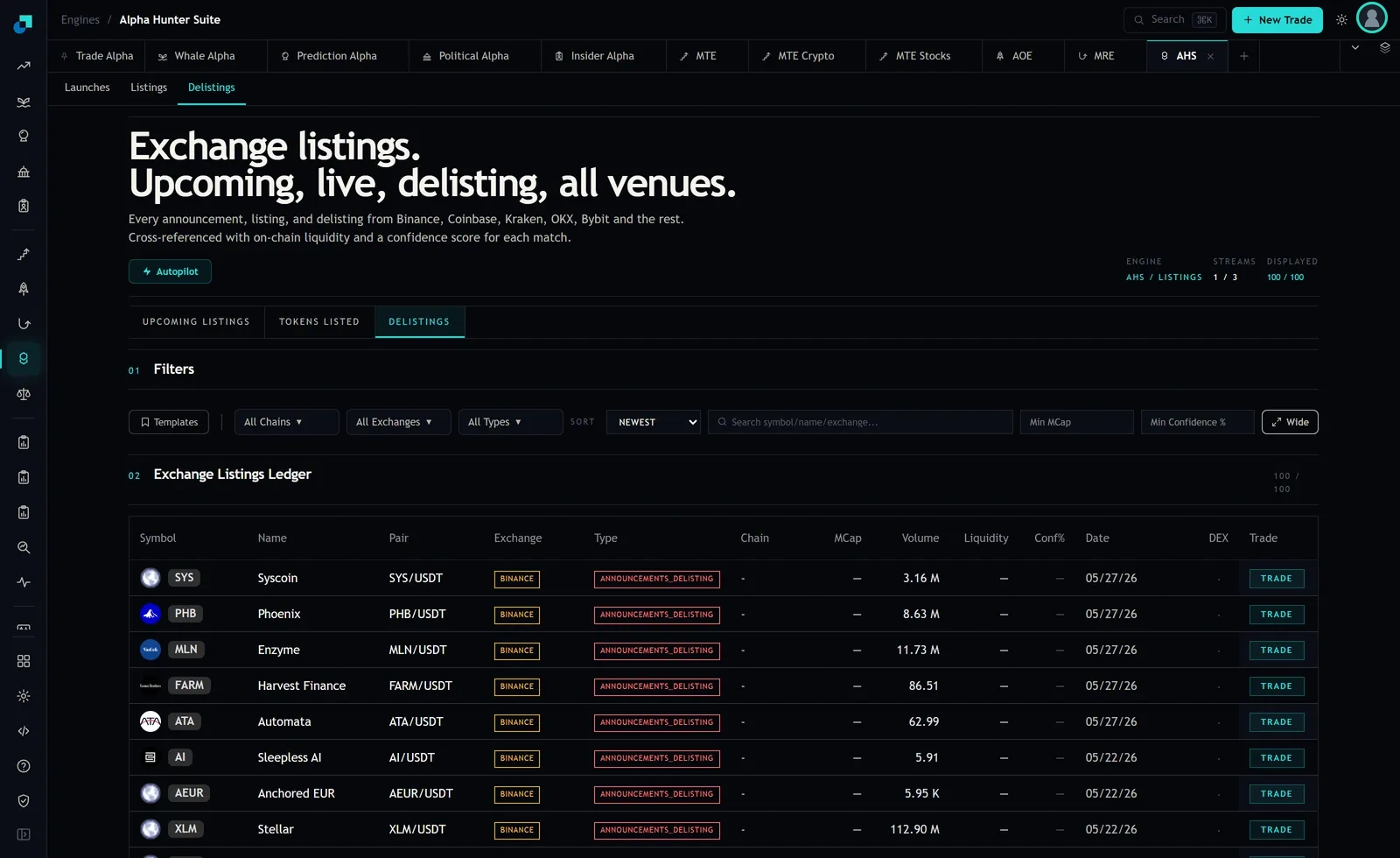
Use the stream for what it is good at, which is catching the event early and telling you which venue and which pair to go and read about. Set the exchange filter to the venues you actually hold balances on and check it on a schedule rather than relying on the venue's email reaching you, since those emails are routinely filtered, delayed or sent to an address you stopped reading.
Then go to the venue's own announcement. The row cannot tell you the timetable because the timetable is not in the data, and the difference between a notice giving you a long window and one giving you a short one changes the decision completely.
Selling on-venue against withdrawing, priced
Both routes cost money and the comparison is arithmetic rather than philosophy.
Selling at the venue costs the spread, the taker fee, and the price impact of your size in a book that is losing its market makers. Add the cost of whatever you receive, since if the pair settles in a stablecoin you did not want, you have another conversion afterwards. The important feature of this route is that its cost is not constant. It grows as the halt approaches, because the people quoting that book have progressively less reason to be there.
Withdrawing costs the venue's withdrawal fee, the network fee, and then whatever you eventually pay to trade the token somewhere else, plus the spread at that destination. The important feature of this route is that its cost is mostly fixed and known in advance, and it preserves optionality, since you still hold the asset afterwards.
So the comparison has a time shape. Early in the window, selling on-venue is often the cheaper route because the book still works. Late in the window it frequently is not. If you are going to sell, the argument for doing it early is about book quality, and it is a much better argument than the panic that usually drives it.
Three things push the decision toward withdrawal regardless of price. If the token has a functioning market elsewhere that you can reach, if you would want to hold it anyway, or if the on-venue book has already gone so thin that your size would move it several percent. Two things push against withdrawal. If the token has no other reachable market, or if withdrawals for that token are suspended or restricted, in which case the closing book is your only exit and delay is the expensive choice.
Doing it in slices instead of one order
Whichever way you go, a single market order for the whole position is almost never the right execution, and delisting books are the clearest case of this.
Split the position into slices and work them across the available window, using limit orders where the spread is wide enough to matter. The point is not to time the price. It is that a thin book refills between your slices, so five orders spread over hours frequently realise a better average than one order that walks the book down in a single pass.
Set a floor before you start. Decide the price below which you would rather withdraw the token than keep selling, and write it down, because that decision made in advance is worth more than any view you will form while watching the fills come in. If the slices start printing below your floor, you switch routes rather than continuing.
And leave margin at the end. Do not plan to finish on the last hour before the halt. Venues move halt times forward, systems get busy, and the notice you are working from may be amended. Finish early and the amendments do not matter.
The balances people forget until the window closes
This is the part that actually catches people, and it is worth ten minutes with your account open the day a notice lands.
Tokens in staking or earn products are not in your spot balance and are frequently subject to an unbonding period that runs past the withdrawal deadline. Start the unstake first, before you do anything else, because that clock is the one you cannot compress.
Collateral posted against a margin or futures position is not free to withdraw either. Work out what closing the position releases and when.
Open orders on the pair being retired hold balance hostage. Cancel them so the tokens return to the wallet you can act on.
Small balances below the venue's minimum withdrawal amount cannot be moved at all, only sold or abandoned. If you have dust in the token, sell it while there is still a book, since after the halt it is stranded by definition.
Deposits in flight are the nastiest case. A transfer you sent before reading the notice can arrive after the deposit channel closes, and recovering it depends entirely on the venue's goodwill. If you have anything in transit, check its status first and stop any further sends immediately.
Wrapped or bridged versions of the token are a separate asset with a separate deposit and withdrawal setup, and a notice covering one does not necessarily cover the other. Check which one you actually hold rather than which one the notice mentions.