A ranked rotation is easy to approve and hard to fund honestly, because the thing that gets presented is a gross edge and the thing that gets delivered is that edge minus implementation. The Asset Outperformer Engine's design is a decile rule over a universe that spans crypto, US and international equities, ETFs, FX, precious metals, commodities and mutual funds. Every one of those has a different cost structure, and a rotation that looks comfortably profitable priced at equity costs can be underwater priced at micro-cap token costs. The order of operations matters: build the cost stack first, then ask what turnover the edge can support.
The cost stack, line by line and by asset class
Five components, and their relative sizes invert completely across the universe the ranking covers.
Commissions and venue fees are the smallest and the most visible, which is why they get the most attention and deserve the least. Half-spread is the first real cost and it is the one that scales worst with asset size. Market impact is the term that dominates at institutional size and it is the one nobody can quote you in advance. Financing and borrow apply to the short side, which matters here because the engine's own construction puts the bottom decile in a short book, and borrow on small caps and thin tokens is neither cheap nor reliably available. Delay and opportunity cost is last and it is not optional in a signal that rescans every six hours.
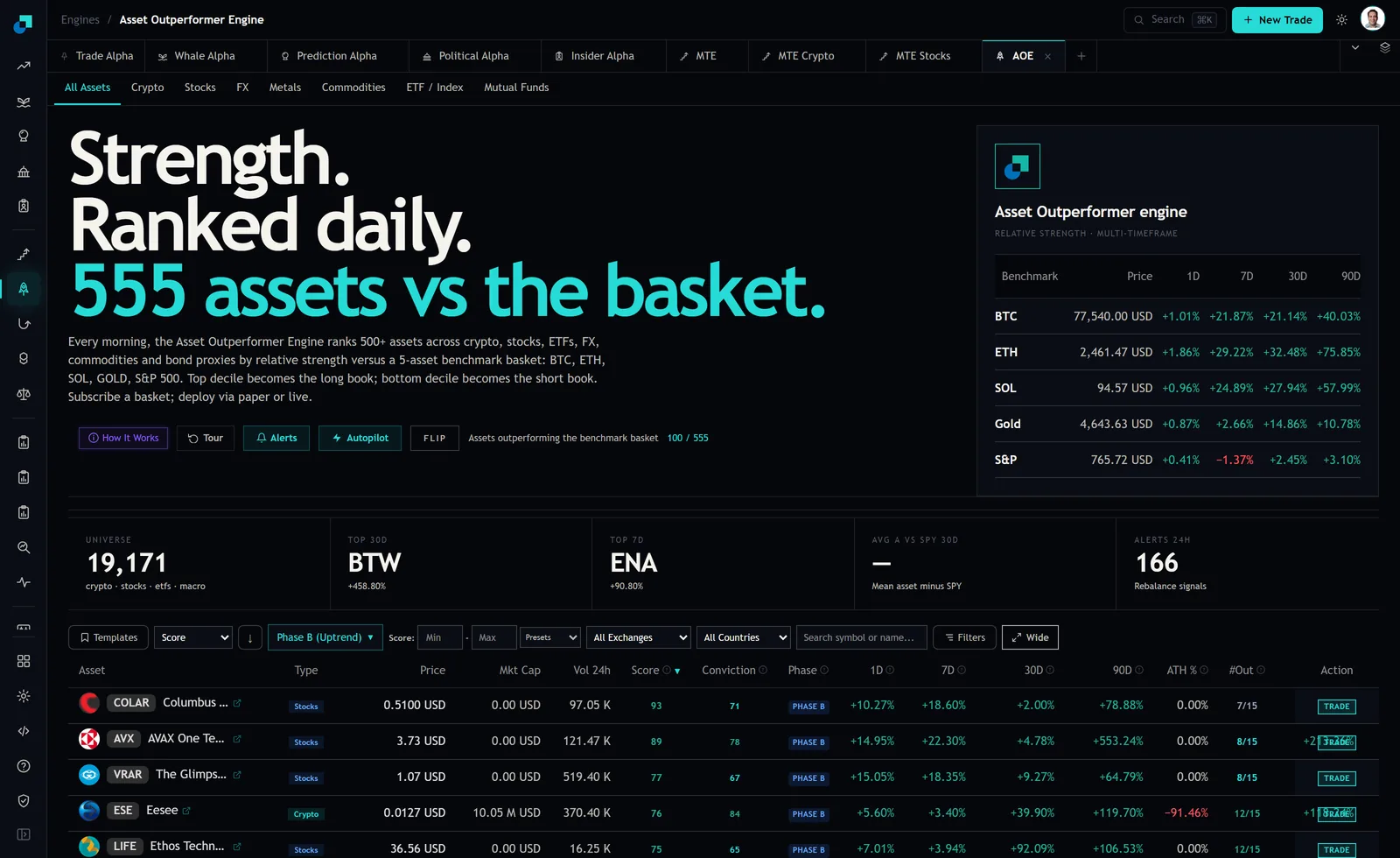
The dispersion across the ranked universe is the point. The board carries exchange filters covering NASDAQ, NYSE, LSE, XETRA, TSE and HKEX among others, and it also carries crypto rows whose market caps at capture ran down to 1.79 M USD and 2.52 M USD. Those two populations do not belong in the same cost assumption. An institution modelling the whole board with one number has assumed away the entire problem.
Turnover is a rate, and the ranking sets it
Turnover is not a policy choice you make after the fact. It is an output of the signal's construction and your rebalance interval, and both are knowable before you fund anything.
The engine rescans fully every six hours. If you rebalance on that cadence you inherit the maximum turnover the signal can generate. Sample it weekly and you get considerably less, monthly less again. The relationship is not linear, because a name that leaves and re-enters the decile between your observations costs you nothing if you never looked, which is one of the few genuinely free improvements available in this design.
The second driver is the score distribution near the cut line, and it is unfavourable. On the captured board, six US stocks shared a score of exactly 70, and the crypto tab had five names at 69 and five more at 68. A decile boundary falling into a block of tied integers produces membership changes on every rescan that carry no information at all. That churn is pure cost, and it is the first thing a damping rule should target.
Measure turnover as the fraction of book notional replaced per rebalance, annualise it, and do it separately per type tab. A blended figure hides exactly the asymmetry that determines whether the strategy works.
The breakeven arithmetic
The identity is simple enough to do on a whiteboard and it is the only part of this that is not an estimate. Net return equals gross edge minus annual turnover multiplied by round-trip cost. Rearranged, the turnover at which the strategy stops paying is gross edge divided by round-trip cost.
Work it with placeholders you own rather than any figure I supply, because the inputs are yours and the output is meaningless otherwise. Suppose a sleeve you have measured at a gross edge of 300 basis points a year, and a round-trip cost of 30 basis points in liquid large-cap equity. Breakeven turnover is ten times a year. Rebalance monthly with full replacement and you are at twelve, which is past it. Now reprice the same sleeve at 150 basis points round trip, which is not aggressive for thin small caps or small-cap tokens once impact is honest, and breakeven turnover falls to twice a year. The same signal, the same gross edge, and a rotation frequency that has to fall by a factor of six.
That sensitivity is the finding. The turnover a ranked rotation can afford is set almost entirely by the cost of the least liquid decile members, not by the average, because the rotation trades the whole decile. Two or three genuinely illiquid names can consume the edge generated by the other twenty.
Where capacity binds first
Capacity is the same arithmetic asked in dollars, and the market cap column answers it faster than any model will.
On the crypto tab at capture, ranked names in the sixties and seventies included HTR at 1.79 M USD, UNX at 1.98 M USD, XFEE at 2.52 M USD and SN59 at 2.88 M USD, alongside OKB at 2.38 B USD. That is a spread of roughly three orders of magnitude inside one decile. A sleeve sized so that a position in OKB is meaningful will be an enormous fraction of daily volume in HTR, and the impact cost on that leg will not resemble the model.
Three responses are available and they should be chosen explicitly rather than discovered. Cap position size as a fraction of median daily volume and accept that some decile members will be underweight or absent. Apply a market cap or volume floor to the eligible universe before ranking, which changes the signal and must be tested as a change to the signal rather than as a filter. Or run the rotation per type tab with separate sizing rules for each, which is the most work and the most defensible.
The pre-trade memo
What survives a review is the version written before the money moved. It needs the cost stack per asset class with the source of each estimate named, including which are quoted, which are modelled and which are guesses, since impact is always the last of those. It needs measured turnover per type tab at the rebalance interval you actually intend to run, not at the scan interval. It needs the breakeven turnover calculation with your gross edge estimate and its confidence interval stated, and a sentence on what happens to the conclusion at the pessimistic end of that interval.
It needs the capacity constraint expressed as a hard notional per name, derived from volume rather than from conviction. And it needs the decision rule for what you do when a decile member is untradeable at size, written down in advance, because that decision will otherwise be made in a hurry by whoever is at the desk and it will be made differently each time.