The structured part of a Form 4 is easy. Codes, share counts, prices, dates, ownership form, all machine readable and all identical in shape across every filer in the market. That is precisely why every automated insider process leans on it, and why the interesting failures live somewhere else. The footnotes are free text, they are not standardised, and they carry the facts that decide what the numeric row actually means.
I have never seen a serious insider process fail because it parsed a share count wrong. I have repeatedly seen one fail because a row that read as a clean open-market sale by a chief executive was a distribution by a fund the executive is a partner in, and the footnote said so in one sentence that nothing upstream read.
Indirect ownership and who is actually exposed
The ownership form column tells you direct or indirect. The footnote tells you what indirect means, and the variants are not equivalent. Shares held by a family trust, by a limited liability company the insider controls, by a spouse, by a foundation, by a partnership in which the insider holds an interest but disclaims beneficial ownership beyond that interest. Each has a different economic exposure and a different set of people who can decide to sell.
The one that costs money is the disclaimer language. When a filing reports a large disposition by an entity and the footnote states that the reporting person disclaims beneficial ownership except to the extent of their pecuniary interest, the headline dollar amount attributed to that insider is wrong, sometimes by an order of magnitude. If your concentration monitoring or your insider ownership factor uses the reported share count without reading that sentence, you are attributing a fund's position to an individual.
The weighted average price footnote and your fill assumptions
A single Form 4 row can represent many executions. When it does, the price field holds a weighted average and a footnote gives the range, with an undertaking to provide the full breakdown to the SEC, the issuer or a security holder on request.
Two consequences for a desk. First, any event study that treats the reported price as a fill is measuring something slightly imaginary, and the error is largest exactly where you care most, on the biggest transactions, because those are the ones that get worked over a range. Second, the width of that range is itself information. An insider whose sale was executed across a two dollar band over a session was working a large order through a market that could not absorb it, which tells you something about liquidity in that name that a single average price hides. If you are sizing a position on the same side, that band is a better capacity estimate than most of what you will find on a screen.
Plan adoption dates, which the checkbox does not give you
The current Form 4 carries a checkbox indicating that a transaction was made under a contract, instruction or written plan intended to satisfy the affirmative defence conditions of Rule 10b5-1(c). The checkbox is binary. The footnote is where the adoption date usually appears, and the adoption date is where the analysis is.
What you want to know is the distance between adoption and execution, and what the company disclosed in between. The amended rule imposes a cooling-off period between adoption and the first trade, with different lengths for officers and directors than for other employees, so a plan whose first sale lands close to the earliest permissible date was adopted with a schedule in mind. More usefully, a plan adopted shortly before a materially good announcement, then selling into the strength it produced, is a governance observation worth recording even where it is entirely lawful. And a discretionary sale with no plan reference at all, from an insider whose previous eight sales were all plan sales, is a change in behaviour by a person whose behaviour was previously mechanical.
None of that is available from the checkbox. It requires the footnote text, retained as text, joined across a filer's history.
Pledges, margin and the footnote that belongs in a risk memo
Pledge disclosures appear in footnotes, typically as language about shares pledged as collateral for a loan or held in a margin account. There is no transaction attached, which is exactly why automated pipelines skip them. They belong in the risk file rather than the signal file.
A pledged position is a forced seller waiting for a price. If a founder has pledged a large fraction of their holding and the stock falls far enough, the sale that follows is not a view about the business and it will not wait for a convenient window. For a concentrated position, or for anything in a small cap where the insider stake is a meaningful share of the float, that is a tail risk you should be able to describe before it happens rather than after. It also has a governance dimension that some allocators care about explicitly, so it is worth a field in whatever internal record you keep on a name.
Distributions, gifts and transfers that are not sells
The largest category of false sell signals I encounter is stock leaving an insider's control without anybody selling anything. A fund distributing shares in kind to its limited partners. A gift. A transfer into a trust. A division of assets in a divorce. Each shows up as a disposition and each has a footnote explaining it.
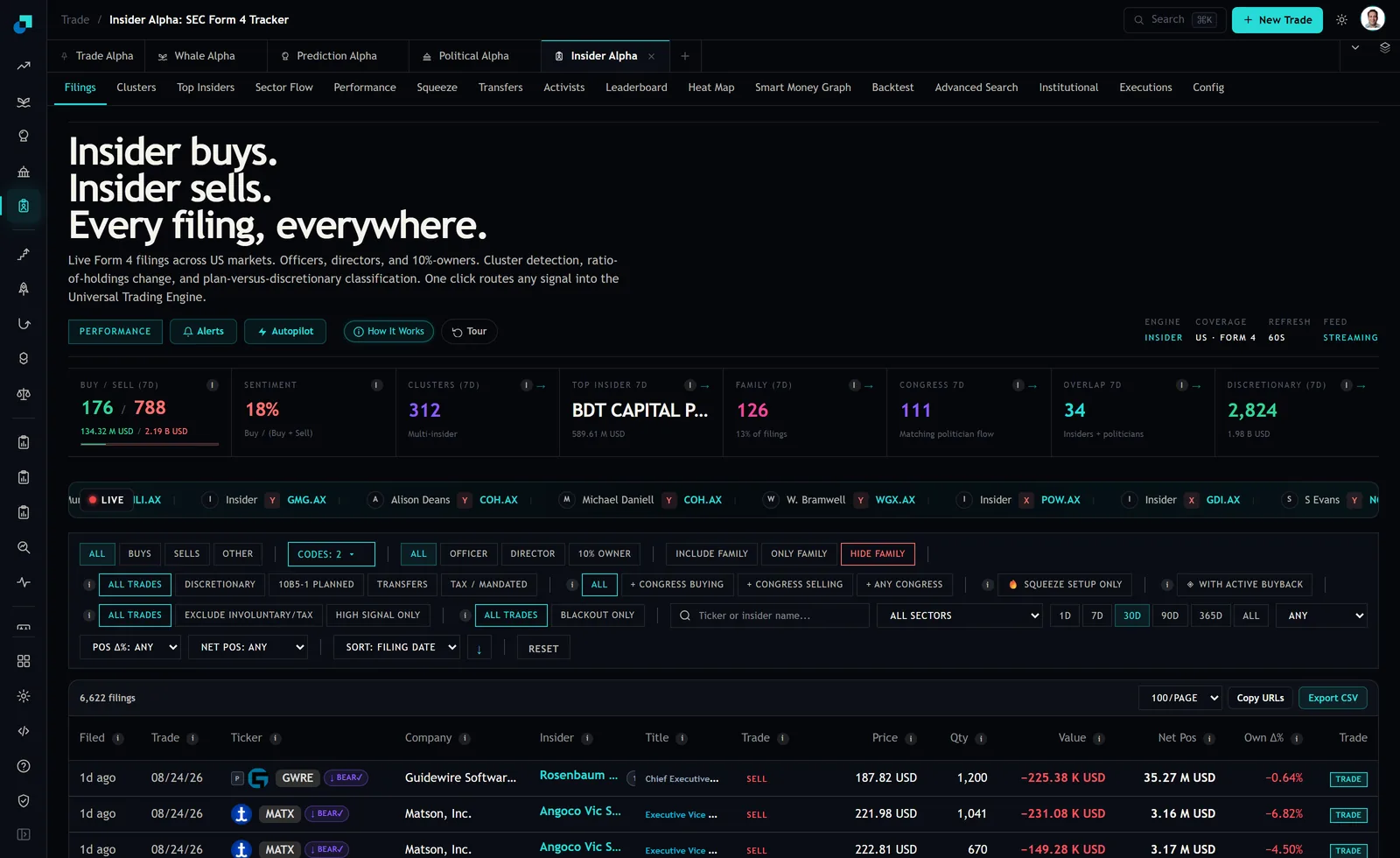
Insider Alpha isolates this material in its Transfers view, and the shape of it at the time of writing is instructive. The view listed 741 transfer events with $170.94M of absolute value, of which 569 were gifts to family totalling $12.00M across 411 insiders, while 133 estate planning events accounted for $142.35M across just 34 insiders and 37 divorce settlements accounted for $6.35M across 23. Gifts are numerous and small. Estate moves are few and very large. A pipeline that treats both as dispositions will produce an insider selling aggregate dominated by a handful of estate transactions that involve no market activity whatsoever.
Making footnotes a first-class field rather than an exception
Three requirements, in order of how much they buy you.
- Retain the raw footnote text, per filing, indexed and searchable, alongside the parsed rows. Everything else depends on this and it is the cheapest to do. If your vendor or your parser discards footnotes, that decision is unrecoverable after the fact.
- Extract flags rather than meaning. Pledge present, plan reference present with adoption date, disclaimer language present, weighted average price with range, in-kind distribution, trust or estate transfer. Keep each flag's matched text so a human can check it. Be honest in your documentation that pattern matching on free text has a recall limit, because it does, and the miss rate is not uniform across filers.
- Require a human read of the full footnote block before any position above a stated size threshold. Set the threshold in the process document. This is the control that catches what the extractor misses, and it is the one you will be asked about in operational due diligence.
The economics of this are lopsided in your favour. Footnote review costs a few analyst minutes per candidate filing. The error it prevents is entering a position on the basis of a sell that was a gift, or sizing to an ownership figure that belonged to somebody else's fund.