The part of a Form 4 that decides whether the filing deserves another minute of your time is two characters wide. It sits in the transaction code column, and it separates an officer spending her own money in the open market from the same officer receiving shares she was always going to receive on a date that was fixed a year ago. The dollar value printed on those two rows can be identical. One of them is information and the other is payroll.
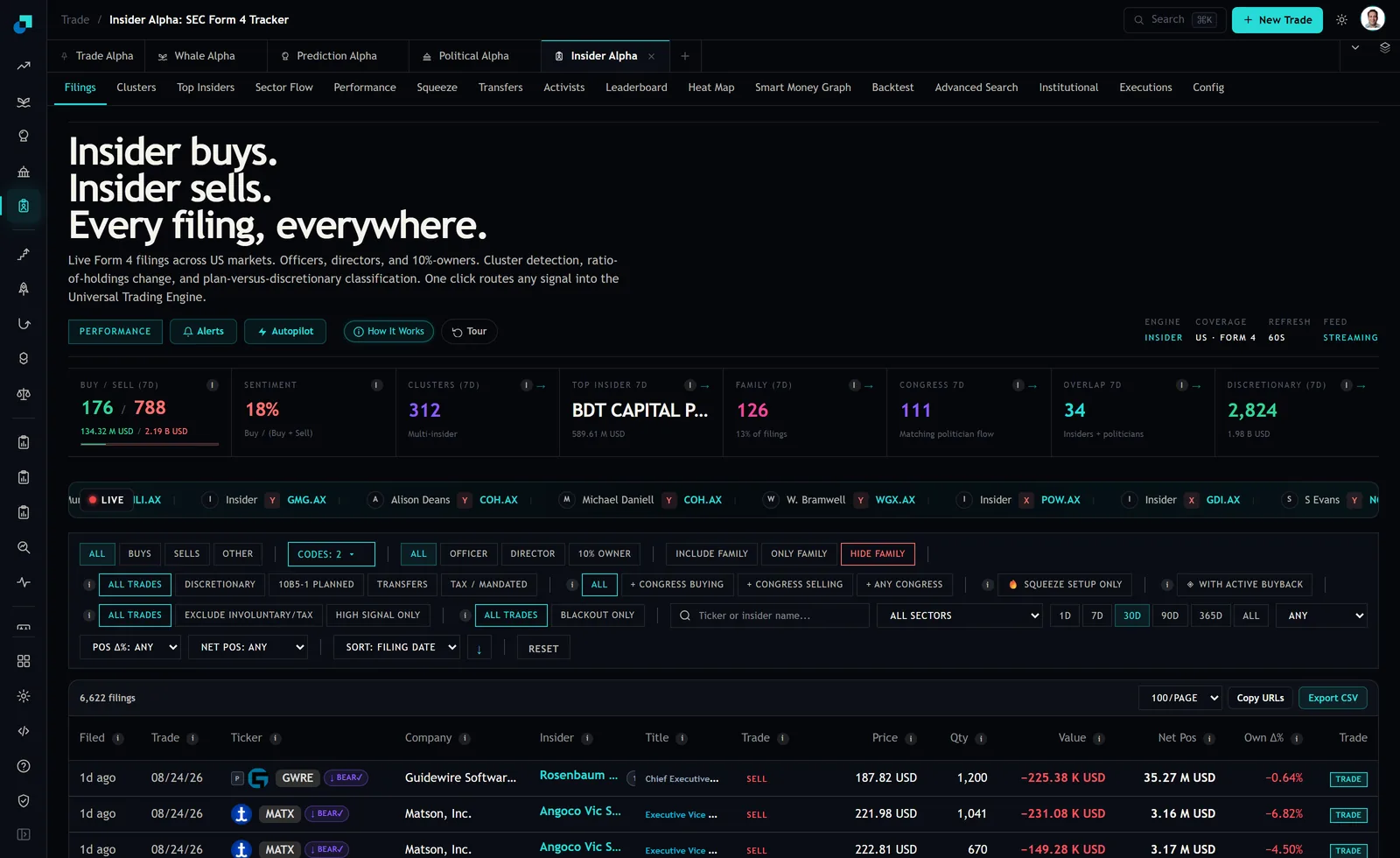
Insider Alpha states its coverage plainly on the page: every SEC Form 4 filing from US-listed companies, and inside that, open-market buys, open-market sells, option exercises and 10b5-1 plan sales all arriving in the same stream. That is the right design for a data feed and the wrong design for a watchlist. Splitting the stream by code is the first thing you do with it, and what follows is the table I use to do the splitting.
The five families of codes on the form
The SEC groups the codes on the form itself, and the grouping tells you more than the alphabet does. General transactions are things the insider chose to do at a market price. Rule 16b-3 transactions are the compensation machinery. Derivative codes cover options and converts. Then there are two small buckets for exempt transfers and for everything that did not fit anywhere else.
| Code | What it means | Does it carry a signal |
|---|---|---|
| P | Open-market or private purchase | Yes. This is the one. |
| S | Open-market or private sale | Weak, and only in context |
| V | Reported voluntarily, earlier than required | A modifier, not a trade |
| A | Grant, award or other acquisition from the issuer | No. Compensation. |
| D | Disposition back to the issuer | No. Usually a buyback or forfeiture. |
| F | Shares delivered or withheld to pay the exercise price or tax | No. Withholding. |
| I | Discretionary transaction inside an employee plan | Rare, and weak |
| M | Exercise or conversion of an exempt derivative security | No, despite looking like a buy |
| C | Conversion of a derivative security | No |
| E | Expiration of a short derivative position | No |
| H | Expiration or cancellation of a long derivative position with value received | No |
| O | Exercise of an out-of-the-money derivative security | Rare, and worth reading |
| X | Exercise of an in-the-money or at-the-money derivative security | No |
| G | Bona fide gift | No. Nobody paid anything. |
| L | Small acquisition under the de minimis rule | No |
| J | Other acquisition or disposition, footnote required | Read the footnote |
| K | Equity swap or similar instrument | Read the footnote |
| U | Shares tendered in a change of control | Event driven, not a view |
| W | Acquisition or disposition by will or inheritance | No |
| Z | Deposit into or withdrawal from a voting trust | No |
Why P is the code worth building a routine around
A code P row means somebody with a job at the company moved money from their bank account into the stock at a price the market set that day. They had a choice about the timing, a choice about the size, and no tax or plan mechanics forcing their hand. The long-running result in the insider literature is that purchases carry more information than sales, and the reason is structural rather than mysterious. There is one common reason to buy and a dozen ordinary reasons to sell.
Two things sharpen a P further. The first is who filed it. An officer or a director is a person with a view about the business. A ten percent owner is often a fund following its own portfolio logic, which may have nothing to do with next quarter. The second is size relative to the person rather than relative to the market. A director putting one hundred thousand dollars into a company where their annual retainer is sixty thousand is a different act from a chief executive doing the same on an eight figure package. The form gives you shares owned following the transaction, so you can see what fraction of the stake was added.
The compensation codes and the pattern they hide
Codes A, M, F, D and X are the machinery of getting paid in stock. In my experience they make up the bulk of what arrives in an unfiltered feed, and none of them tell you anything about what an insider thinks. A grant is a compensation committee decision from months earlier. An exercise is a deadline arriving. Withholding is arithmetic.
The pattern that costs people real money is the M and S pair filed on the same day. The insider exercises options, code M, at a strike far below the market, and immediately sells the shares, code S. If your feed shows the M leg as an acquisition, you have just recorded a large purchase on the exact day that insider reduced their economic exposure to the company. I have seen this misread as a seven figure vote of confidence more than once. It is the opposite. Look at the shares owned following transaction figure across the whole filing, not at one row of it. If the net change in what they hold is zero or negative, the insider did not buy anything.
The codes that are transfers wearing a trade's clothing
G, W, Z and much of J are movements of stock where no money changed hands at a market price. A gift to a family member, a transfer under a will, a deposit into a voting trust. In a naive feed these show up as large dispositions and read like an insider heading for the door.
They are still worth a glance for a different reason. Insider Alpha keeps a separate Transfers view built out of exactly this material, and at the time of writing it listed 741 transfer events worth $170.94M in absolute terms, of which 569 were gifts to family totalling $12.00M across 411 insiders and 133 were estate planning moves totalling $142.35M across only 34 insiders. Note the shape of that. Gifts are numerous and small, estate moves are few and enormous. Neither is a sell, but a founder restructuring a large holding is a fact about the ownership base you would rather know than not know.
The filter to set this week
You can do this in fifteen minutes. Set your insider feed to alert on code P only, with a minimum transaction value that matches the size of company you actually trade. The module exposes size buckets at $25K, $100K, $500K and $1M in its filter panels, and for most retail accounts $100K on a mid cap or $25K on a micro cap is a sensible floor. Everything else in the code table goes to a weekly review pass that you read on a Saturday, or does not get read at all.
Then add one manual check before any position. Open the actual filing, find the shares owned following transaction column, and confirm the insider holds more stock after the transaction than before. That single check catches the M and S pair, catches the withholding rows, and catches the case where a headline buy is a grant that was always coming. It takes about thirty seconds and it is the cheapest thing in this entire workflow.
The tradeoff is real and you should know what you are giving up. Filtering to P alone means you will miss the occasional code J or code K filing that genuinely matters, and you will miss discretionary plan transactions under code I. If you want those, do not loosen the alert. Keep the alert clean and read the rest in a weekly batch, where a code you do not recognise costs you a footnote rather than a position.