The most common failure I see when a desk picks up disclosure data is that nobody ever defines the universe. The feed arrives, someone writes a scoring rule on top of it, the backtest looks encouraging, and six months later the attribution meeting discovers that a third of the historical fills were in names the book could never have held at size. The universe was implicit, it drifted, and no version of it exists anywhere you can point to.
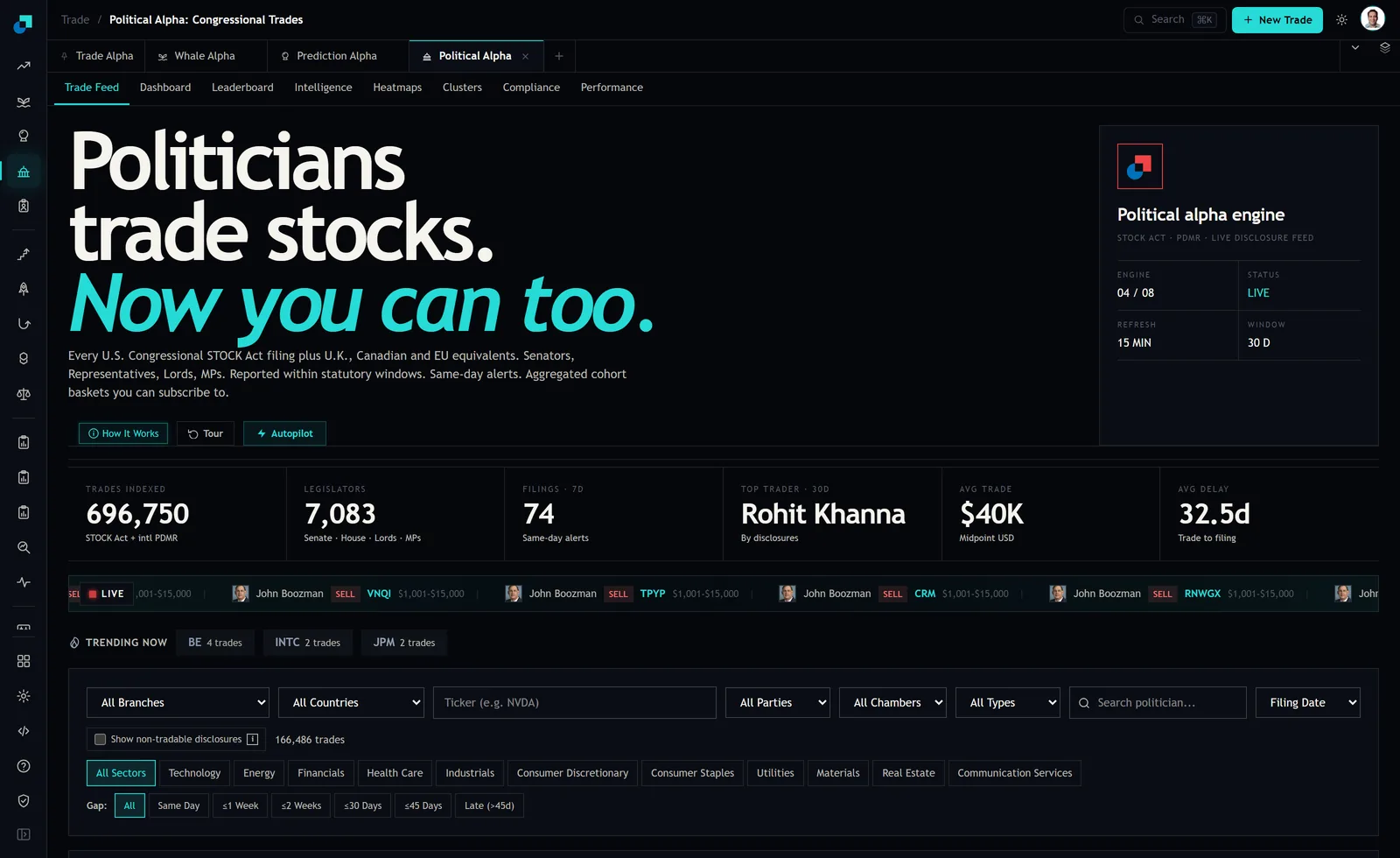
Political Alpha makes this easy to get wrong precisely because the feed is so complete. At the time of writing the header strip read 696,750 trades indexed across 7,083 legislators, covering Senate, House, Lords and MPs, with the module documenting coverage across eighteen countries. That is a research asset. It is not an investable list, and the distance between the two is where most of the work lives.
A feed is an event stream and a universe is a versioned object
The distinction is not pedantic. An event stream answers "what was disclosed". A universe answers "what am I permitted to hold, at what size, as of a given date". The second is a dated, immutable artifact that you can reproduce two years later when someone asks why a name was in the book.
Practically that means your universe file needs an effective date, a construction hash, the screen parameters that produced it, and a row count. If your process cannot regenerate the 2026-03-31 universe exactly as it stood on 2026-03-31, you do not have a systematic process, you have a discretionary one with a script attached. Everything below is the input to that file, not to a signal.
Exclusions before scores, always in that order
The first control on the trade feed is a checkbox labelled "Show non-tradable disclosures", and it sits directly above the row counter. With it unchecked at capture the counter read 166,486 trades against the 696,750 total indexed. Those two numbers are not a clean subtraction, since the counter reflects whatever the current filter set is and the indexed total spans the full history including international PDMR filings. The point is the order of magnitude. A large share of what arrives in a disclosure feed is not an instrument you can express a view in.
Build the exclusion list explicitly rather than relying on the default. Mine has four tiers. Instrument type comes first, since Treasury issues, municipal debt, education savings vehicles, deferred compensation and pooled funds are all legitimate disclosure line items and none of them are positions you can mirror. Jurisdiction comes second, because a UK or EU equivalent filing has a different statutory clock and a different disclosure format, and mixing regimes inside one universe silently mixes two different data-generating processes. Instrument listing venue comes third. Corporate action status comes fourth, and it is the one people forget, because a name that was acquired eighteen months ago will still sit in your historical universe and will still look tradable to a naive backtest.
Liquidity floors sized to your book, not to the filing
The average trade on the module reads $40K at the midpoint of the disclosed band. That is the number that should end the debate about whether disclosure data can be followed literally. A member disclosing a position in the $1,001 to $15,000 band, which is what the live ticker was showing for four consecutive lines at capture, is describing an allocation decision with no size information you can scale. You are not copying their trade. You are using their filing as a candidate generator, and the size decision is entirely yours.
So the liquidity screen is set against your own capacity, and it belongs in the universe, not in the sizing model. The construction I use is a floor on twenty-day median dollar volume calibrated so that a full position at target weight is under a fixed share of that median, plus a hard floor on absolute dollar volume to kill the microcaps outright, plus a price floor. Set the target share first and derive the volume floor from it, rather than picking a round number and discovering your participation rate afterwards. Then record the floor in the universe file, because when the strategy is reviewed the first structural question will be whether the screen was set before or after you saw the results.
Disclosure bands are ordinal, and your minimum band is a real decision
Every filing carries a range rather than a number. That has two consequences for universe construction. The first is that band is the only size signal available, so treating it as ordinal and setting a minimum admissible band is a legitimate screen. Excluding the lowest band removes a large volume of low-conviction and administrative activity, and it removes it uniformly rather than case by case.
The second consequence is that the band cannot be converted into a dollar amount without an assumption, and the midpoint assumption the module uses for its $40K average is one choice among several. If your process aggregates disclosed value anywhere, document which convention you use and never mix conventions between the research and production paths. I have seen a desk reconcile two internal numbers for a week before discovering one pipeline used midpoints and the other used the lower bound.
Cadence, point-in-time integrity, and the questions the review will ask
The header also shows an average delay of 32.5 days between trade and filing. That figure is the reason your universe cadence and your signal cadence are different problems. The universe can rebuild weekly or monthly, because liquidity and listing status move slowly. The signal has to be evaluated against a disclosure clock that is a month long on average and much longer in the tail, which the module's Gap chips let you slice directly, running from Same Day through to Late over 45 days.
Point-in-time integrity is the part that is tedious and non-negotiable. The feed is refreshed every fifteen minutes and rows get amended. If your universe build reads the current state of the database rather than the state as of the effective date, you have leaked amended data backwards and your historical universe contains information that did not exist. Store the feed with an ingestion timestamp separate from the filing timestamp, and build from the ingestion view.
When this goes to committee, three questions come up every time. Who set the liquidity floor and when. What fraction of the raw feed survives to the universe, and can you show the funnel by stage. What happens to a name that fails the screen while you hold it, which is a rebalance policy question and not a universe question, and needs a written answer before the first fill rather than after the first breach.