The uncomfortable version of a liquidity framework is not when it is wrong. It is when it is right and you still lose money. The composite climbs, the policy field says easing, the driver tags say the Fed is adding liquidity, and the thing you bought on the back of all that is down eleven percent. At that point you have to decide which of the two things in front of you is the better guide, and the honest answer depends on which of three specific conditions you are in.
The screen already separates the two, which is the first clue
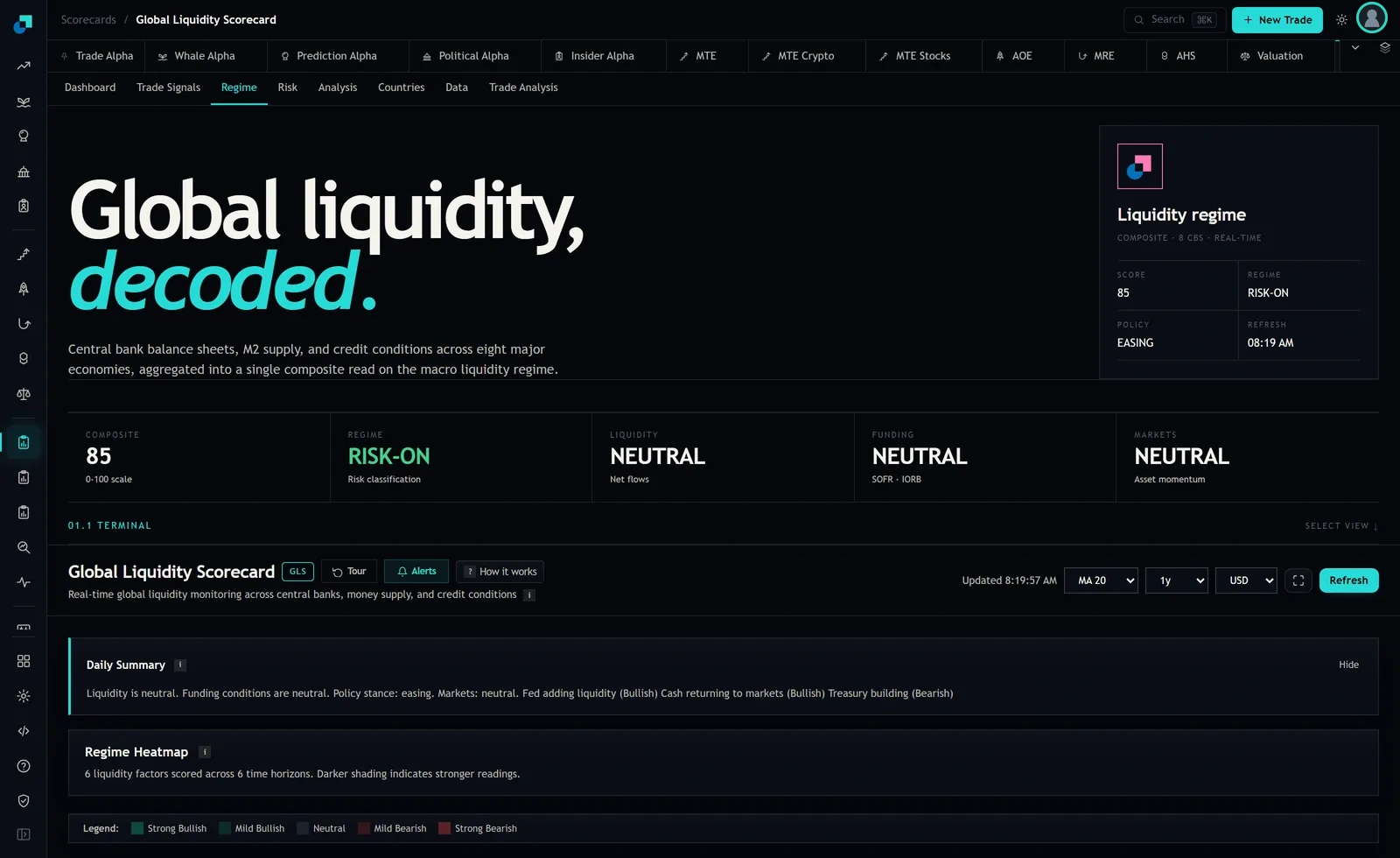
Look at the strip on the Regime tab. LIQUIDITY reads NEUTRAL with a sub-label of "Net flows". Four fields to its right, MARKETS reads NEUTRAL with a sub-label of "Asset momentum". Those are two different fields with two different sub-labels, sitting on the same row.
That layout is telling you something before you read a single value. The module does not treat liquidity conditions and asset momentum as the same measurement. It measures them separately because they can and do disagree, and a design that expected them to move together would have collapsed them into one number. On the capture I am looking at they happen to agree, both printing NEUTRAL underneath a composite of 85 and a RISK-ON classification. The point is the structure, not today's values. When they diverge, you will see it as one field moving while the other does not, and you will see it there before you see it anywhere else.
Why liquidity can genuinely rise while price falls
The mechanism is not mysterious and it is worth having in your head before you need it.
Liquidity is a condition, not a bid. More money existing in the system does not create a buyer for the specific thing you own at the specific price you paid. It changes the environment in which buyers and sellers meet, which is a real effect and a slow one.
Then there is what the price already contains. If everyone can see the same easing you can see, some or all of it is in the price before you act on it. A composite reading conditions as favourable says nothing about whether those conditions have already been paid for. The module lists its input families plainly, being aggregate central bank balance sheets, global M2, USD liquidity indicators and credit spreads. Not one of those is a valuation.
And there is timing. The composite blends inputs that publish on very different schedules. Credit spreads move daily. Money supply does not. A number built partly on slow series cannot turn as fast as a market can, and it is not designed to.
Condition one, the price is reacting to something the composite does not measure
This is the most common case and the easiest to check.
Global liquidity has no view on an earnings miss, a hack, a regulatory action, a delisting, an unlock schedule or a governance blowup. If the fall in your position started on a specific day and traces to a specific event, the composite is not wrong and it is not relevant. It was measuring the tide while somebody drilled a hole in your boat.
The check takes two minutes. Find the day the decline started. Ask what happened that day to your asset specifically. If you find a cause that is local to the asset, price wins outright, and no amount of favourable macro should be used to argue you into holding. Liquidity does not repair broken things, it just means the water is deeper when they sink.
Condition two, the divergence is in your position and not in the market
Second check. Pull up two or three other things in the same broad category and see whether they are also down.
If the whole category is falling while the composite rises, you are looking at a genuine macro divergence and the question is which one leads. If your position is falling while its peers are flat or up, you do not have a macro divergence at all. You have a stock-specific or token-specific problem wearing a macro costume, and dressing it in liquidity language is how people talk themselves into averaging down on the worst holding in the sector.
Price wins in the second case, and it wins immediately. The uncomfortable part is that this is the case where the liquidity story is most tempting, because it offers an explanation that is not about your selection.
Condition three, price is moving faster than the composite can update
Third check, and this one is about the clock rather than the cause.
The header on the module carries a refresh stamp, 08:19 AM on my capture, and the module describes itself as real-time monitoring across central banks, money supply and credit conditions. Real-time recompute is not the same as real-time inputs. If the fastest thing in the blend updates daily and the slowest updates monthly, then in a week where price moves fifteen percent, the composite is working from a picture that is partly weeks old.
In a fast move, price is the only genuinely current input either of you has. That does not mean price is right about the future. It means price is the only thing that has seen today. When a market is moving that quickly, the correct use of the liquidity read is not to argue with the move, it is to decide what you do after it stops.
The mirror case is a slow grind lower over months with no event and no peer divergence. That is the one situation where the composite has a real claim to being the better guide, because it is operating on its natural timescale and price is not telling you anything a slow measure could not also see.
The rule that keeps you from having this argument twice
My resolution is to give each input the job it is actually capable of doing, and to write it down so I am not renegotiating it while a position is red.
Liquidity sets the size. A favourable composite means the overlay sleeve can be at its larger setting. An unfavourable one means it is smaller. That is a slow dial and it should move slowly, because its inputs move slowly.
Price sets the entry and the exit. Whether I am in a specific position, and whether I stay in it, is decided on the price of that position against a level I set before I bought it. The composite has no vote here, in either direction.
The consequence, which is the point of the whole arrangement, is that a favourable liquidity read never becomes a reason to hold something through a stop. If a 3,000 dollar position is sized on a favourable macro read and then breaks the level I chose, it gets cut at that level and the macro read stays exactly where it was. The sleeve is still the larger size. The money simply goes into a different expression of the same view.
That separation is the entire benefit of having two measurements instead of one. The failure mode it prevents is the one that costs the most, which is using a slow, broad, non-price signal to override a fast, specific, price signal about a position you already own.