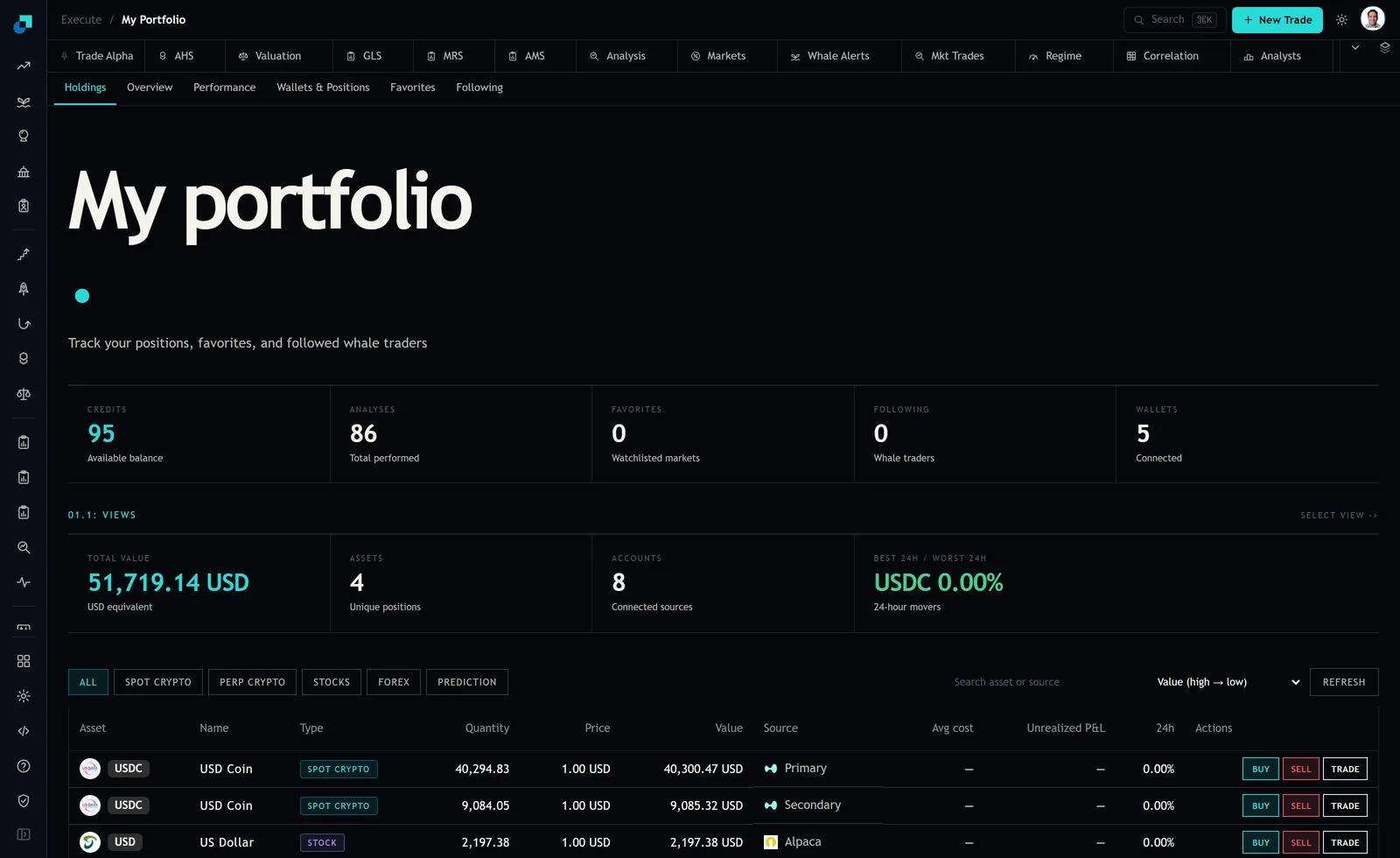
The ACCOUNTS tile on the portfolio in the capture reads 8 connected sources, with a separate WALLETS tile reading 5 connected, carrying 4 unique positions and a total of 51,715.70 USD. Scale the source count rather than the notional and you have the shape of most digital asset desks: a handful of venues, a brokerage, a set of self custodied addresses, and a consolidated screen that is asked to behave like an accounting record.
It is not one, and the distinction is the whole discipline. A consolidated view is a derived artefact assembled from sources that were never designed to agree with each other. A book of record is a position set you are prepared to defend, with a stated precedence rule, a tolerance policy, and evidence for every difference you decided not to chase. The work is turning the first into the second on a schedule.
Three clocks behind one screen
The most common reconciliation break is not an error at all. It is a timing difference, and it exists because the sources on that screen are stamped by three separate clocks.
Exchange APIs are close to continuous. A balance you pull is accurate as of a moment that is usually within seconds, and it moves again immediately. Chain sourced wallet balances are accurate as of a block, which means the effective timestamp is discrete, varies by network, and can lag a transaction you consider done by anything from seconds to a reorg window. A brokerage reports on a settlement cycle with an overnight file, so a trade you executed at 14:00 may not appear in the reported position until the next business morning, and a corporate action can restate a quantity you already reconciled.
Consolidate those three and a difference is the expected outcome, not the exception. This is why the first line of any reconciliation policy is a stated as of time. Pick one, apply it to every source, and accept the sources that cannot honour it precisely by documenting how far off they are. A desk that reconciles to whatever the screen showed when someone happened to open it will generate breaks forever and learn nothing from any of them.
A break taxonomy that survives a month end
Breaks get resolved faster when they are classified before they are investigated, because the class determines who looks at it and what evidence closes it. Five categories cover almost everything on a digital asset book.
- Timing. The quantity is right at both ends but the two ends are stamped at different moments. Evidence is the transaction that sits between the two timestamps. Resolution is a note, not a correction.
- Quantity. The venue and your record disagree on units held. This is the only class that is always urgent, because it means either a transfer you did not capture, a fee taken in kind, a rebase or airdrop, or a genuine control failure.
- Valuation. Quantities agree, values do not. Two sources priced the same instrument from different feeds, at different times, or against a different quote currency. Nothing is missing, but the number you would report is ambiguous until you fix the pricing source.
- Classification. The same underlying is sitting in two categories. Spot against perp is the obvious case, and a wrapped or bridged representation against its native asset is the one people miss. The exposure is right and the breakdown is wrong.
- Completeness. A source is absent entirely. This is the most dangerous class because it produces no break at all. Nothing on the screen tells you about the venue you never connected.
Completeness is checked against an independent list of accounts, not against the tool. Someone maintains a register of every venue, wallet and brokerage relationship the desk has, that register is owned outside the person who runs the reconciliation, and the count on it is compared to the ACCOUNTS tile every cycle. Eight sources on screen against nine on the register is the finding, and it will never surface any other way.
Which source wins, decided in advance
Precedence written down during a break is precedence written by whoever wants the more convenient answer. Write it before, and write it per attribute rather than per source, because different sources are authoritative about different things.
Quantity is owned by the custodian of the asset. The venue statement or the chain is the truth about how many units exist and where they sit, and the consolidated view is a copy of that truth. When they disagree, the copy is wrong until proven otherwise.
Price is owned by your pricing policy, not by whichever venue reported the position. Two exchanges will hand you two marks for the same instrument and both are real prints. Nominate a source per instrument class, nominate a snapshot time, document the fallback for when the primary is unavailable, and apply it consistently across the whole book. Otherwise your total is a mixture of marks taken at different moments from different order books, and no allocator question about it has a clean answer.
Instrument identity is owned by your own security master. Ticker collisions across chains and venues are routine, and letting each source name its own instruments is how two different assets end up summed into one row. Map every source symbol to an internal identifier at ingestion, and treat an unmapped symbol as a blocking exception rather than a new position.
Cost basis and lot history are owned by the source that executed the fills, kept in the venue native convention, with the consolidation layer holding whatever house convention you have adopted on top. That separation is what lets you answer a tax or audit question without unwinding your management reporting.
Tolerances, evidence and sign-off
A reconciliation with no materiality threshold is a reconciliation nobody completes. Set thresholds in two dimensions and state them in the policy: an absolute floor below which a difference is not worth an analyst hour, and a relative threshold in basis points of the position or of the book. Something in the region of a few basis points of position value is a defensible starting point, and the number matters less than the fact that it is fixed in advance and reviewed rather than negotiated per break.
Every break above threshold gets a record with five fields: as of time, source pair, class from the taxonomy above, the evidence that closed it, and who closed it. That log is the artefact you produce when someone asks whether the position that went wrong was actually the position you thought you held. Answering that from memory is where operational credibility is lost.
Two things escalate immediately regardless of size. Any quantity break on a self custodied wallet, because the population of explanations for units moving without instruction is short and all of it is serious. And any completeness break, because a missing source means the exposure number the desk has been trading against is understated by an unknown amount. Everything else can wait for the cycle.
The cycle itself should run daily on quantity and completeness, and at least monthly on valuation and classification with a full sign-off. The daily run is short if the taxonomy is doing its job, most items resolve as timing, and the residue is the part of the book that actually needs attention. That residue, tracked over a quarter, tells you which of your eight sources is the one degrading the record, which is a procurement question rather than an operations one.