You have the Blockcircle Terminal open on one screen and your exchange order ticket on the other, and the two prices are not the same. The chart says one thing, the ticket says another, and you are about to type a limit price into the ticket. This happens to everyone, it is almost never a bug, and the resolution is unglamorous: the two numbers are answering different questions, and only one of them is the number your order will actually be measured against.
The check takes about twenty seconds and it is worth doing every time the gap looks larger than usual, because the cases where the gap means something are the cases where sending the order costs you real money.
A print is not a quote
The number on a chart is a trade that already happened. Someone bought, someone sold, the exchange published the price, and the chart drew it. It is history, even if the history is two seconds old.
The number on your broker ticket is a two sided market. There is a bid you can sell into and an ask you can buy from, and the mid that most interfaces show you is the average of the two, a price at which nobody is obliged to do anything. When you compare a chart last against a ticket mid you are comparing a completed trade on one venue against a hypothetical midpoint on another. Half the spread of disagreement is built in before anything has gone wrong at all.
This matters because the order you are about to place is a claim on the ask, not on the last. If the ask is 78,995 and the chart last is 78,984, a limit at 78,984 is not a slightly conservative buy. It is an order that sits and waits, and on a fast move it waits forever while the thing you wanted to own leaves without you.
Reading the OHLC strip before you argue with it
The Terminal puts everything you need to settle the argument in one row above the chart. At the time of the capture below the strip read BTC/USD, 25 Aug 07:45, with O 78,956.01, H 79,017.76, L 78,823.03, C 78,984.08 and V 236.98, and the dotted line on the right of the chart was labelled Last 78,984.08.
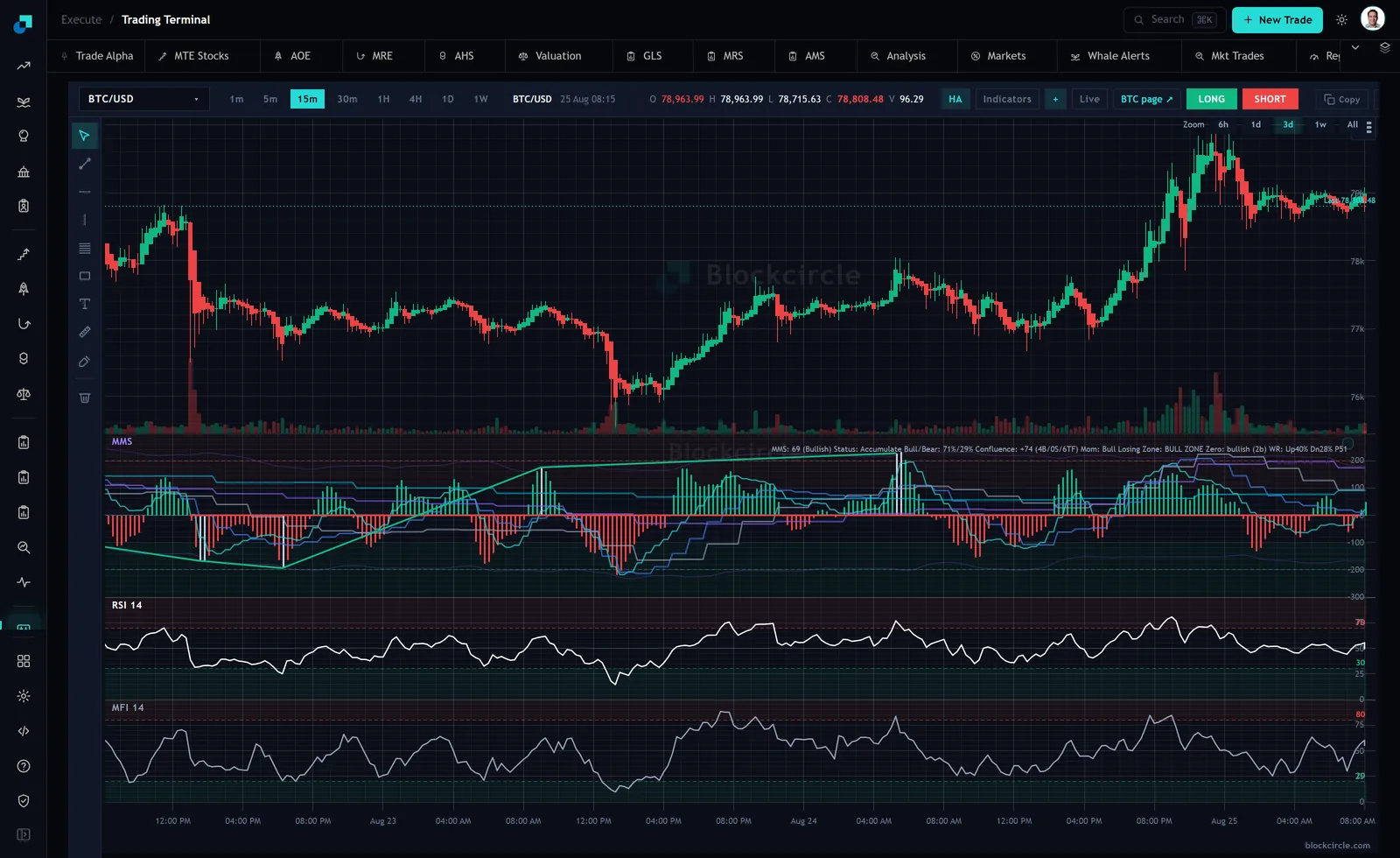
Three controls on that same row change what the number means, and all three sit within a couple of centimetres of each other. The timeframe buttons run 1m, 5m, 15m, 30m, 1H, 4H, 1D and 1W, and the capture is on 15m. There is a Live control. There is an HA control.
The timeframe one is the trap people fall into most. A candle is a bucket, and on a 15 minute chart the close of a completed bucket can be almost fifteen minutes old. If the close you are reading belongs to a bar that has already settled, then of course it disagrees with a live ticket, and the size of the disagreement is simply how far the market has travelled since that bar shut. In the capture the close and the Last line are the same value, which is what you see when the current bar is still open and still moving.
The HA control is the one that produces the confused support tickets. Heikin Ashi candles are built by averaging, so their open, high, low and close are constructed values rather than raw traded prices. A Heikin Ashi close is not a number anybody paid. If HA is lit and you are comparing its close against your broker's book, you are not comparing two prices at all. Check that button before you conclude your broker is quoting badly.
Why the venues are not the same market
The deeper reason for a persistent gap is that the chart's market and your fill market are frequently different markets. Blockcircle's Brokers page exists precisely because execution happens on an account you connect yourself, and at capture that catalog showed 195 venues, 115 crypto exchanges and 80 stock and forex brokers, spread across seven regions. Your order goes to one of them. The chart does not have to be drawn from that one.
Two specific mismatches account for most of the residual difference once you have ruled out staleness.
- The quote asset. BTC/USD, BTC/USDT and BTC/EUR are three different instruments with three different books. A stablecoin trading a few basis points off its peg drags the whole pair with it, permanently, and no amount of staring at the chart will make that gap close.
- Venue basis. Two exchanges quoting the same pair are still two separate books with separate flow. They track each other because arbitrage makes them, not because they are wired together, and in fast markets they come apart by more than the spread for tens of seconds at a time.
Neither of these is a fault. Both are permanent features of trading an instrument that has no single official price.
The rule for where the limit price comes from
The rule I use is short enough to keep in your head under pressure. The chart decides whether you trade. The book you are filling on decides at what price.
Concretely, that means you read structure, levels and momentum off the Terminal, and then you pull the actual limit price off the ticket of the account that is going to execute. Never type a number you read off a chart into an order box on a different venue without adjusting it to that venue's book. If the venues sit at a persistent offset, note the offset once and carry it, rather than rediscovering it on every order.
On a 2,000 dollar position a five basis point difference is one dollar and is not worth a second of your attention. A forty basis point difference is eight dollars, which is still small, but forty basis points on a limit price is also the difference between filling and not filling, and the cost of not filling a trade that then works is the entire trade. The price you set the limit at matters far more through fill probability than through the fill price itself.
Stops are where the mismatch does actual damage. A stop level lifted off a chart drawn from a different venue can land inside the noise band of the venue you are stopped out on. You get taken out on a wick that never printed on the chart you were watching, which is a genuinely infuriating way to lose money and is entirely avoidable by placing stops against the book that will trigger them.
When the gap is a reason to not send the order
Most disagreements are the ordinary ones above. A few are telling you something, and the way to separate them is to ask whether the gap is larger than the market could plausibly have moved during the staleness you can account for.
Work it in that order. Note the timeframe and whether the current bar is open. Note whether HA is on. Note the pair and the venue. Add half the spread. If the residual gap is still bigger than a normal move over that interval, one of the two feeds is stale or you are looking at the wrong instrument, and the correct response is to place nothing until you know which.
The specific failure this prevents is sending a market order into an unexplained disagreement. A market order does not care what your chart said. It takes whatever the book offers, and a book that is disagreeing with the wider market by an unusual margin is often thin, wide, or halfway through an event you have not seen yet. A limit order in that situation costs you nothing if you are wrong about the level, and a market order in that situation is a blank cheque written against a book you have not looked at.