Two supply events cluster around the same date and each one is survivable alone. A vesting cliff releases tokens to holders who have been waiting a year to sell them. Separately, whatever arrangement was supporting depth at the listing reaches the end of its term. Individually these are known risks with known responses. Arriving together they are a different thing, because the supply increase and the depth decrease are the numerator and denominator of the same problem.
Nothing in a listings feed will tell you this is coming. That is the first thing to be honest about, because the whole procedure depends on knowing which half you have and which half you have to build.
What the ledger anchors and what it cannot
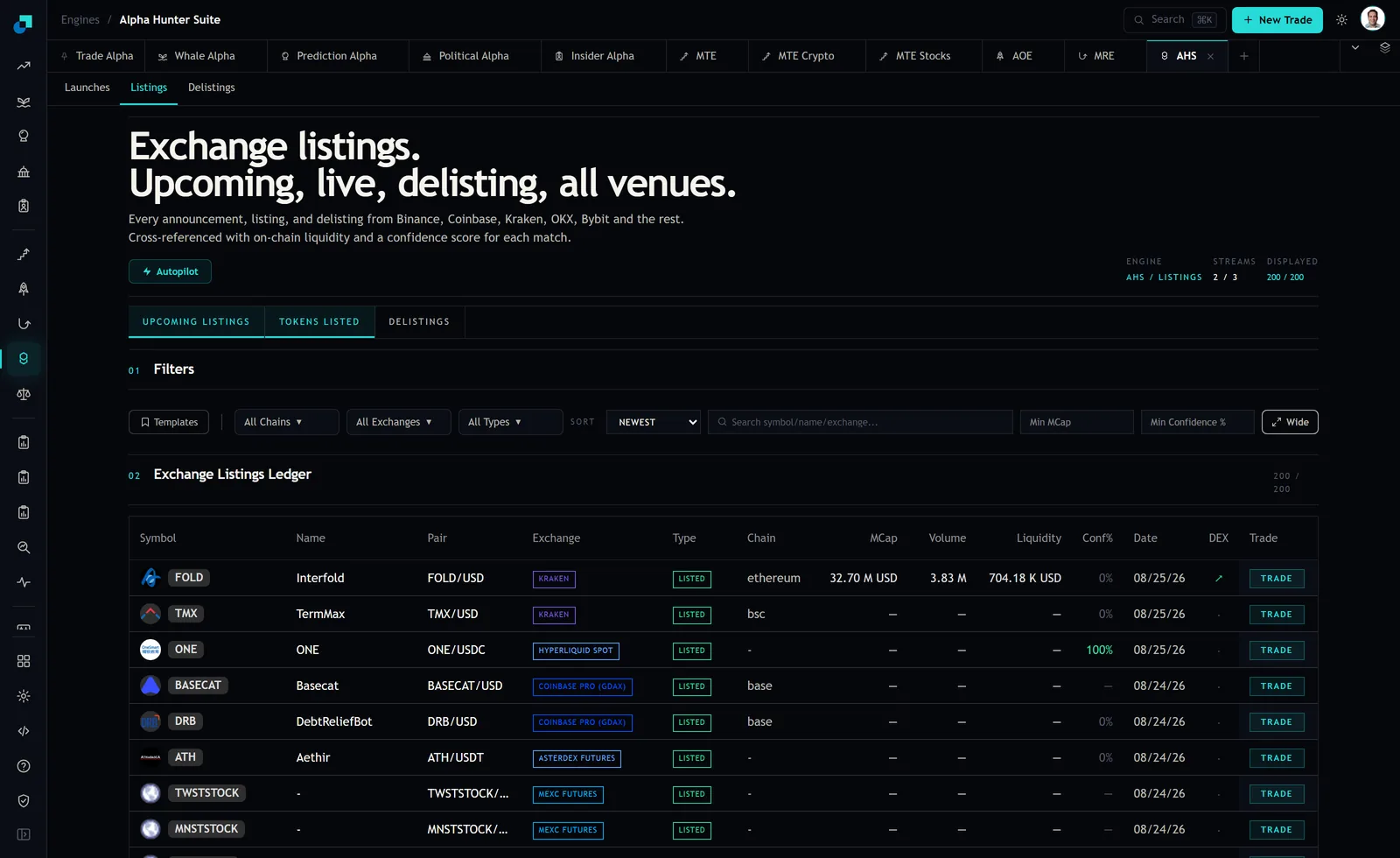
The exchange listings ledger carries Symbol, Name, Pair, Exchange, Type, Chain, MCap, Volume, Liquidity, Conf% and Date, with streams for upcoming listings, tokens listed and delistings. What it gives you for this job is the anchor: a listing date, per pair, per venue, recorded at the time it happened.
That anchor is more valuable than it sounds, because listing dates are surprisingly hard to reconstruct after the fact. A token that listed on three venues across four months has three anchors, and which one you use changes every date downstream.
What the ledger does not carry is any vesting or unlock field. There is no cliff column, no schedule, no allocation breakdown. So the second half of the overlay comes from the token's own documentation, from the vesting contracts if they are on chain, and from whatever the issuer published at the time of the raise. That material lives in your own calendar or risk system, and the listing ledger's contribution is the date you align it against.
Why the anniversary is where the two events meet
The one-year point is not arbitrary. Vesting schedules for team and early investor allocations commonly place a cliff at twelve months from the token generation event, with linear release afterwards, and where listing and generation are close together the cliff lands near the listing anniversary. That is a common shape rather than a rule, and the actual schedule has to be read rather than assumed.
Market-making arrangements are term-limited for their own reasons. Whatever is supporting quoted depth on a venue is a contract with a length, and contracts of that kind are typically written in months rather than years. The result is that the population of positions whose depth is contractual and whose cliff is approaching is not a coincidence, it is a structural overlap.
The compound event is what you are trying to date. Supply that can now be sold, arriving into a book that may be about to get thinner, at a moment when the holders receiving that supply have a year of accumulated basis and a strong reason to realise some of it.
Building the overlay as a table you can act from
Keep it to one row per position and make every column a number rather than a note, because notes do not sort.
- Listing date and venue, taken from the ledger, one row per venue where you might actually exit.
- Cliff date, from the vesting documentation, with a field recording where you got it and how confident you are.
- Cliff size, expressed as tokens released and as a percentage of the float you have verified rather than the float the issuer claims.
- Recent average daily volume for the pair you would exit through.
- Days to absorb, which is cliff tokens divided by average daily volume, multiplied by whatever inverse of your participation cap you use.
The fifth column is the one that produces decisions. If a cliff releases tokens equal to thirty days of total market volume, and your policy caps you at ten percent of volume, then the market needs three hundred trading days to absorb the release at your participation rate and you need a fraction of that just to exit your own position. Those two numbers, side by side, settle arguments that otherwise run on sentiment.
Sort the table by days to absorb, not by cliff date. The nearest event is rarely the largest one, and a small cliff into a deep book is not a risk event at all.
The exit governor and who is allowed to override it
A dated risk deserves a dated rule, and the rule should reduce exposure on a schedule rather than on a judgement, because the judgement will be made under exactly the conditions that impair it.
The shape that works is a staged reduction anchored to the cliff date. A fixed fraction of the position comes off at a stated number of trading days before the cliff, another fraction closer in, with the remaining exposure capped rather than eliminated. The specific fractions matter less than the fact that they are written down before the date approaches and that the default is action rather than review.
Name the override holder and make the override cost something procedural. A single named individual who can suspend the governor, in writing, with the reason recorded and a mandatory revisit date. The purpose of the friction is not to prevent overrides, which are sometimes correct, but to ensure that the reasoning exists in a form somebody can read afterwards.
Attach one more field to the governor: the depth condition. If sampled depth for the exit pair has fallen materially since the position was opened, the staged reduction starts earlier. That is the mechanism that captures the second half of the compound event, and it is the half that has no calendar date attached.
What the overlay does not protect against
Two failure modes remain and both should be stated in the same document as the rule, so nobody mistakes the framework for a hedge.
The first is that the market prices it in early. A well-publicised cliff is not a secret, and if the reduction schedule is the obvious one then the selling pressure arrives before your first stage, not after it. This is the most common way the exercise disappoints: the analysis was right, the dates were right, and the position was already down by the time the governor fired. A framework that only reduces near the date will systematically sell into the weakness it predicted.
The second is the cliff that does not sell. Unlocked is not sold. Tokens released to a long-term holder who has no intention of realising are a change in potential supply, not in actual supply, and reducing a good position for a release that never reaches the market is a real cost that does not appear in any risk report. It only appears in performance, unattributed.
Both of those argue for the same thing, which is that the governor should be sized as a partial reduction rather than an exit, and that the table should record what actually happened at each cliff so that the fractions get calibrated on your own history rather than on the first number somebody proposed in a meeting.