Insider Alpha describes cluster detection as multiple insider buys at the same company within a short window. That sentence contains two undefined quantities, and every disagreement about whether cluster buying works is really a disagreement about how those two quantities were set. How many insiders counts as multiple. How long is short.
I run ninety days and three distinct people. Those are my numbers, not anyone's default, and I want to explain what each dial actually does so you can pick your own rather than inherit mine. The two settings interact, they trade alert volume against signal quality in opposite directions, and moving both at once guarantees you will never know which one mattered.
What the window length is really controlling
The window is a claim about why several people bought at the same time. A short window says they were reacting to the same thing. A long window says they independently reached the same conclusion over a period.
Narrow it to thirty days and you get tight, event-driven clusters. Several insiders buying inside a month usually means one thing happened, most often the trading window opening after an earnings release, or a share price falling to a level the board found interesting. These are clean, they are easy to reason about, and there are very few of them. You will go weeks without a single alert.
Widen it to a hundred and eighty days and something different happens. You are no longer looking at a shared reaction, you are looking at accumulation. Three insiders buying over six months at a company might be a pattern of conviction, or it might be three unrelated people each doing routine annual purchases that happened to land in the same half year. The wider the window, the more of your alerts are coincidence, because the chance of unrelated purchases overlapping grows with the length of the window while the chance of them being related does not.
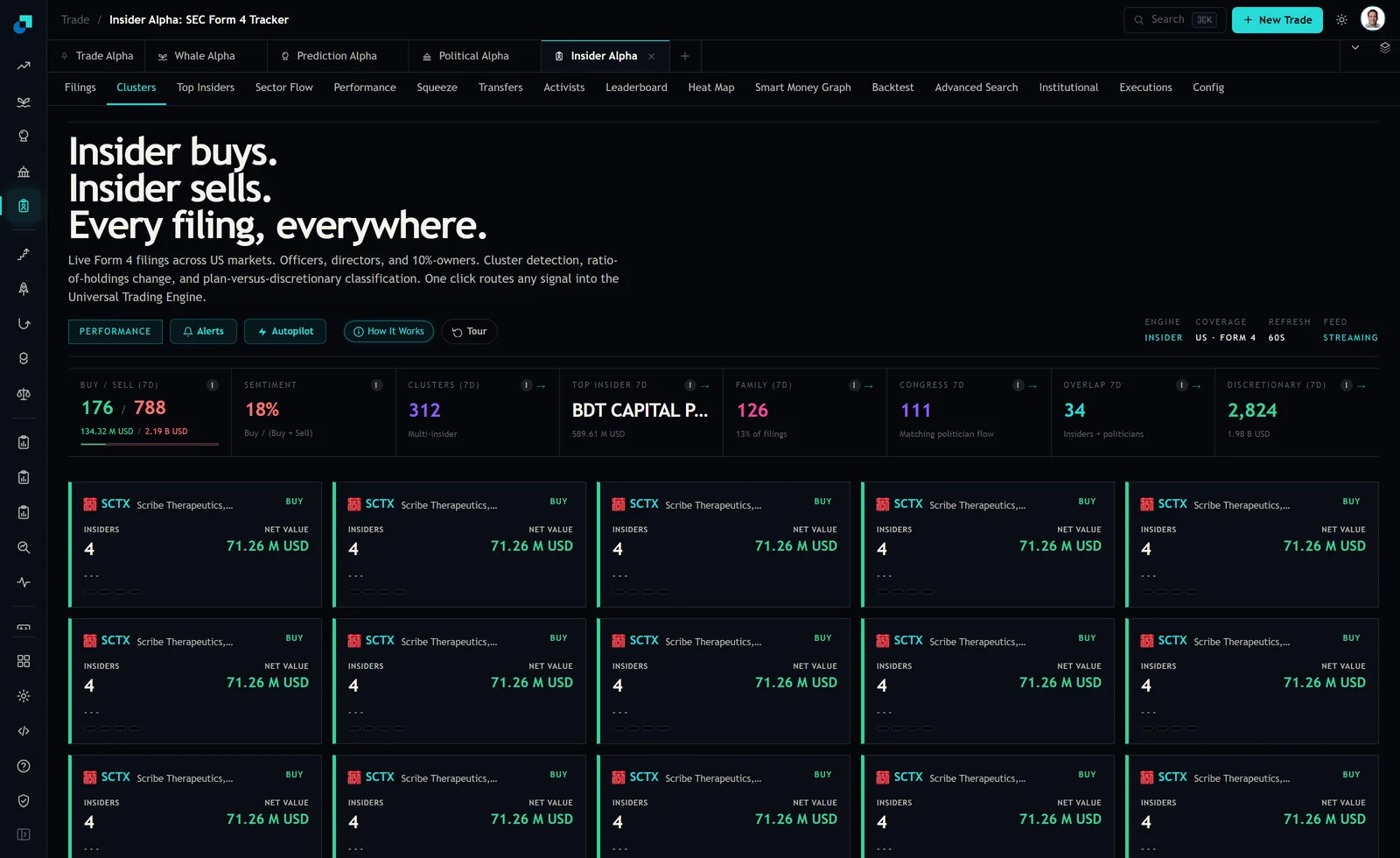
Ninety days is where I sit because it is long enough to catch a board that buys in ones and twos over a quarter and short enough that overlap by accident is still uncommon. It also lines up with the earnings cycle, which means a ninety day window typically spans one open trading window rather than three, and that keeps the interpretation clean.
What the filer minimum is really controlling
The count is a claim about independence. Each additional required insider is another separate person who had to reach the same conclusion with their own money.
Set it to two and the volume of alerts jumps enormously, and the quality falls harder than the volume rises. A large share of two-filer clusters are not two independent people at all. They are one person filing through two entities, an insider and a spouse, an executive and a family trust. Others are two directors joining a board at the same time, both required or strongly encouraged to establish a holding, which is a governance formality rather than a view.
Set it to four or five and you get very few alerts, all of which look impressive, and you arrive late. By the time a fifth insider has filed, the earlier filings have been public for weeks and whatever repricing was going to happen has largely happened. Higher is not automatically better on this dial. It is a tradeoff between confidence and timeliness, and past three the confidence is not improving as fast as the timeliness is degrading.
Three is where I have landed. It is enough to make related-party duplication unlikely to carry the whole cluster on its own, and it still fires often enough to be worth checking.
Count people, not filings
This matters more than either dial. A cluster of three filings can be one person, and a screen that counts rows will tell you it is three insiders.
The duplications to watch for are an insider and their spouse's account, an insider and a trust or limited liability company they control, and a single insider filing multiple times in a period because they bought on several days. Read the reporting owner name and the ownership footnotes, and collapse anything that resolves to the same human being. If a three-filer cluster collapses to two people, it is not a cluster under your own rule, and the fact that your screen showed it does not change that.
The related dial is the code restriction, and it is not optional. If your cluster counter accepts anything other than code P purchases, then vesting dates will manufacture clusters for you, because a whole executive team can acquire shares in the same week for reasons that have nothing to do with anybody's opinion. Restrict to open-market purchases before you touch either of the two dials, or you will spend your time tuning parameters against noise you could have removed outright.
Changing a setting without fooling yourself
Here is the discipline, and it is the only part of this post that is genuinely hard. Change one dial at a time. Keep the other fixed. Run the new setting for at least a quarter before forming a view, and keep a written log of every alert it produced and what you would have done about it, written on the day rather than reconstructed later.
You are watching two things. Alert volume, which you know within a week, and whether the alerts were things you could act on, which takes months. If a setting produces more alerts than you can genuinely review, it is the wrong setting for you regardless of how good it looks in a study, because an alert you skim is an alert you did not use.
Resist the temptation to tune both dials until the historical results look good. With two parameters and a modest amount of history you can always find a combination that would have worked, and it will not survive contact with the next quarter. If you change a dial, change it for a reason you can state in one sentence, and keep the old setting running alongside so you have something to compare against.
Where the dials interact with everything else
Two final interactions worth knowing. A dollar floor and the filer count pull against each other, because raising the floor removes small purchases and small purchases are what most non-executive directors make, so a high floor quietly reduces your effective filer count. If you are running a $100K minimum and a three-insider rule at the same time, you are asking for something considerably rarer than either rule alone suggests.
And the window interacts with staleness. A ninety day window means the first purchase in a qualifying cluster can be almost three months old by the time the cluster completes. That is fine for the interpretation, since the cluster is the signal rather than any individual filing, but it is not fine for your entry price. Check where the stock traded across the whole window before deciding what the cluster is worth to you now.