The reflex when a delisting notice lands is to hit the market button for the whole position, and on some rows that is a perfectly fine decision. On others it is the most expensive thirty seconds of the year. The thing that separates the two is sitting on the row you are already looking at, and it is the only column on a delisting row that scales with your ability to leave.
The one number on the row that is about your exit
On my capture of the delistings stream, the row schema was Symbol, Name, Pair, Exchange, Type, Chain, MCap, Volume, Liquidity, Conf%, Date, DEX and Trade. MCap was a dash on every visible row. Liquidity was a dash on every visible row. Conf% was a dash on every visible row. Volume was the only field carrying a figure.
That is worth sitting with. The announcement row, the one telling you a book is closing, is also the row with almost nothing populated on it. So the Volume column is not one input among many, it is your only quantitative read on the row itself, and the rest has to come from the venue's actual order book.
Two honest caveats before you build anything on it. The column does not label its unit or its window on the row, so treat it as a relative ranking across rows until you have checked what it means at your venue rather than as a precise dollar figure. And volume is turnover, not depth. A book can print a lot of volume in small pieces and still have very little sitting within one percent of the mid price. Volume tells you whether there is activity to work an order into. It does not tell you what a single large order would do.
Four orders of magnitude on one screen
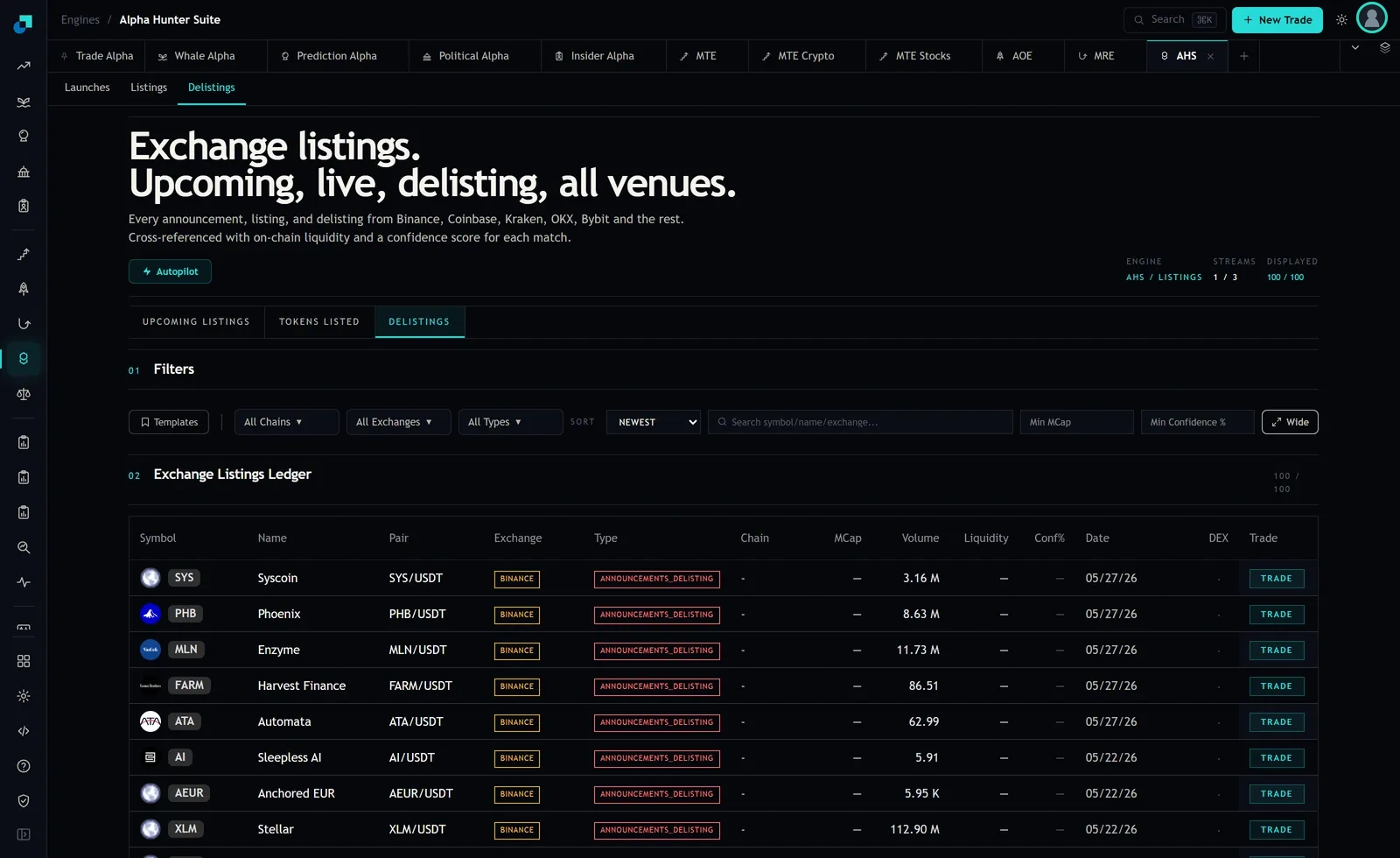
That is the point of the screenshot. Eight rows, one venue, two dates, one type of announcement, and a Volume column spanning from the hundreds of millions down to single digits. If your response to all eight would be the same market order, you have decided that the difference between those numbers does not matter, and it is the only thing on the screen that does.
The reading splits into three groups. Rows with very large volume, where a normal retail position is a trivial fraction of what trades and execution is a minor consideration. Rows in the middle, where your size is a meaningful share of the flow and a schedule is worth the effort. And rows where the figure is in the low double digits or below, where the honest conclusion is that the book has effectively stopped functioning and no execution technique will fix it.
Turning the number into a slice schedule
The discipline is participation rate. Decide what share of the traded volume you are willing to be, and let that decide your slice size rather than picking a number that feels right.
A conservative working rule is to keep each order to a small single-digit percentage of the volume traded in the interval you are working in. If a token trades a hundred units of volume in an hour and your cap is five percent, your hourly slice is five units, and a position of forty units takes eight hours of working rather than one order.
Then check that against the calendar. If your schedule needs eight hours and the notice gives you a week before the halt, you have enormous slack and can afford to use limit orders and wait for the spread to come to you. If your schedule needs three days and the halt is tomorrow, you do not have a schedule, you have a decision, and it is better to know that at the start than to discover it two thirds of the way through.
Work in limit orders where the spread is wide enough to matter and market orders only when the clock is genuinely binding. On a thin book the spread frequently exceeds the price move you are worried about, which means paying it repeatedly across many slices can cost more than the patience would have saved. Fewer, better-placed orders beat many rushed ones.
Why the last day is the worst day
The volume figure on the row is history. It describes what the book was doing, and a delisting notice is precisely the event that changes it.
Two forces run in opposite directions after a notice lands. Volume often spikes as holders exit, which looks like improving liquidity. Meanwhile the market makers quoting that book have progressively less reason to hold inventory in an asset whose venue is about to stop supporting it, so depth thins even as turnover rises. Higher volume with thinner depth is a book that is easier to trade small and harder to trade large, which is the opposite of what a rising volume number suggests to most people.
The practical consequence is that your schedule should front-load rather than back-load. Get the majority of the size done in the early part of the window, when the book still has quotes in it, and leave the tail for the end rather than the other way around. Plan to finish comfortably before the halt, because notices get amended, halt times get moved forward, and venues get busy in exactly the hours everyone else is trying to do the same thing.
It is also worth checking the DEX column on the row and the on-chain route behind it. If a functioning pool exists and you can hold the token in a wallet, withdrawing is a genuine alternative to selling into a deteriorating book, and it converts a deadline into an ordinary position you can work at your own pace. Price it properly, since the withdrawal fee, the network cost and the pool's own depth all count, but do not leave it out of the comparison.
The rows where there is no schedule
Look at the bottom of that Volume column again. A row showing 5.91 or 62.99 while its neighbours show 112.90 M is not a smaller version of the same problem. It is a different problem.
At that level there is no participation rate that produces a sensible slice, because a small percentage of almost nothing is nothing. Any order you place is the market. There is no schedule to build and pretending otherwise wastes the window you have.
What is left is a decision between three options and it should be made deliberately in the first hour rather than reluctantly in the last. Accept the impact and sell now, taking a bad price on purpose while a price still exists. Withdraw the token if the chain route works and there is a market you can reach elsewhere, which converts the deadline problem into a liquidity problem you can take your time over. Or accept that the position may end up subject to whatever the notice says happens to balances left behind, which is a real option only if you have read that clause and are willing to live with it.
All three are defensible on a position that is small enough. What is not defensible is spending the window building an execution schedule for a book that has already stopped existing, and then discovering on the last afternoon that there was never anything to execute into.