The most common way I see a macro signal get wasted is someone treating it as an entry trigger. The Global Liquidity Scorecard flips to RISK-ON, they buy that morning, price drops four percent over the next three sessions, and they conclude the indicator does not work. The indicator was never asked a question it could answer. A composite assembled from eight central bank balance sheets has no opinion about Tuesday. It has an opinion about the next several months, and those are completely different products.
The resolution mismatch, stated plainly
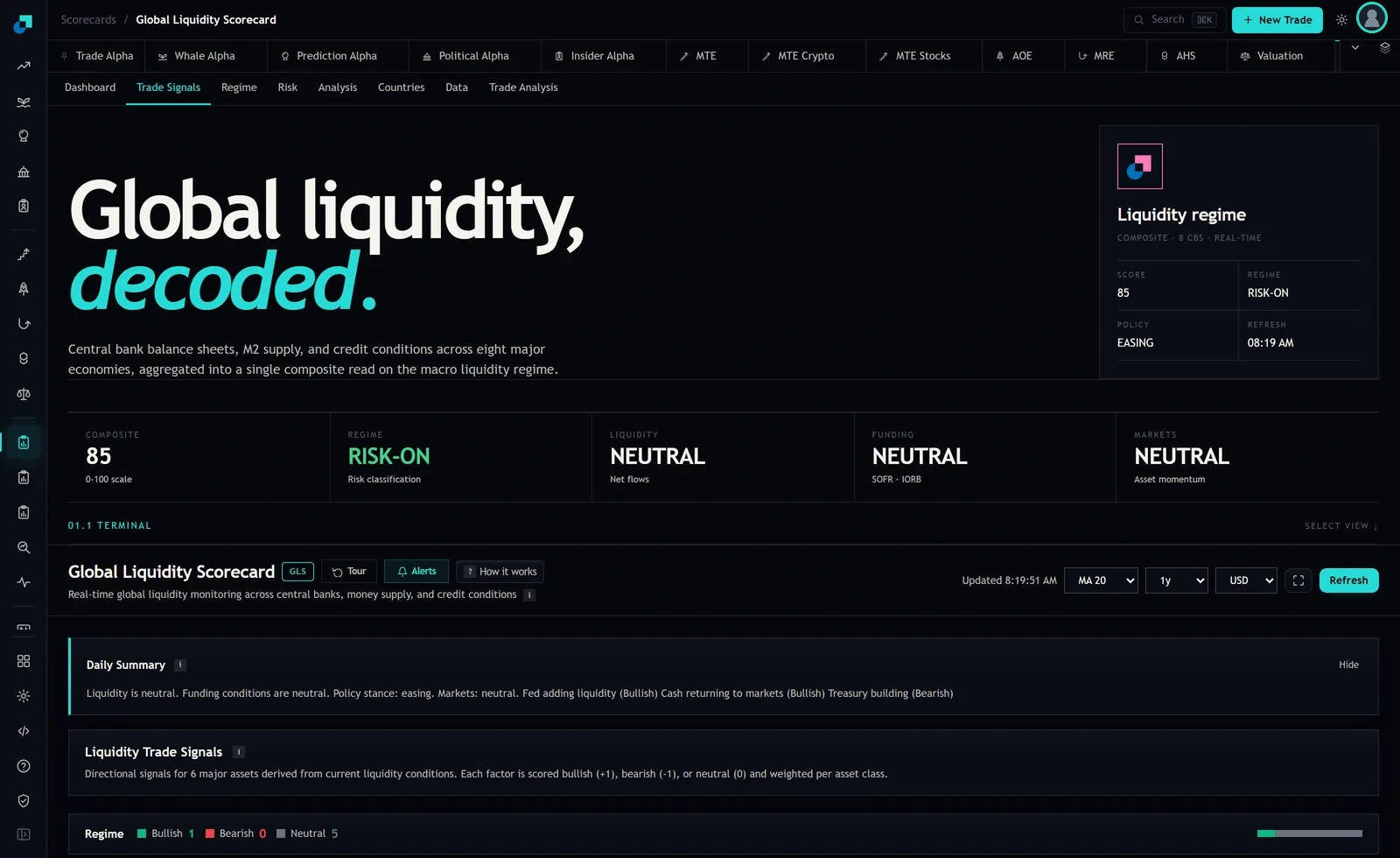
GLS aggregates the Fed, the ECB, the BoJ, the PBoC, the BoE, the SNB, the BoC and the RBA, plus global M2, USD liquidity indicators and credit spreads, into a single score on a 0 to 100 scale. Right now that score reads 85, the regime label says RISK-ON and the policy label says EASING.
Every one of those inputs arrives on a weekly or monthly release calendar. None of them tick. That means the maximum honest resolution of the output is roughly the frequency of its slowest meaningful input, and no refresh stamp on the page changes that. The tile says REFRESH 08:05 AM, which tells you when the page recomputed. It does not tell you that a central bank published anything at 08:05, and on most mornings none of them did.
So when you ask a composite like this "should I buy now", you are asking a monthly instrument an intraday question. It will give you an answer, because the number is always there, and the answer will be uncorrelated with the next three days by construction. This is not a flaw in the module. It is what the underlying data is.
What a reading of 85 actually licenses, in dollars
Here is the translation that makes the signal useful. It does not tell you what to buy or when. It tells you how much of your account should be exposed at all.
Say you run a 40,000 dollar account and your normal fully invested state is 70 percent in risk assets, 30 percent in cash. That 70 percent is your ceiling, chosen because it is the loss you can hold through without selling at the bottom. A liquidity read then scales you inside that ceiling. A top-band composite means you are willing to run at the ceiling, 28,000 dollars at risk. A middle band means you run at half of it, 14,000. A bottom band means 5,600 dollars and no new positions until the read improves.
The difference between the top band and the bottom band on that account is about 22,000 dollars of exposure. That is a decision worth making carefully once a month. Compare it to what an entry trigger would have got you, which is the same 28,000 dollars deployed on a Tuesday instead of a Thursday. The sizing decision is worth an order of magnitude more than the timing decision, and it is the one the composite is actually qualified to inform.
Note the bands are mine, not the module's. I am picking three of them because three is enough to matter and few enough that I will actually follow the rule. You should pick your own from your own capacity to sit through drawdowns.
The dial is in your account, not on the tab
I have been calling this an exposure dial, so let me be exact about what that means, because the phrase implies a control that I cannot confirm exists.
Trade Signals is a view inside GLS, sitting next to Dashboard, Regime, Risk, Countries, Data and Trade Analysis. In the capture above it shows the module header, the composite, and the regime and policy labels. I do not see an exposure setting, a position sizing input, or anything that would push a target weight into a brokerage account, and I am not going to tell you one is there. The dial is a metaphor for a decision you make and then execute yourself, in your own account, with your own orders.
That is less convenient and considerably safer. Anything that automatically translated a macro read into a position size would have to assume your risk tolerance, your tax situation, your other holdings and your time horizon, and it would be wrong about at least two of those. What you get from the module is a clean input. What you supply is the map from that input to dollars, and the discipline to follow it.
Two clocks, two tools
The workable arrangement is to run two clocks and never let one do the other's job.
The slow clock is the liquidity read. You check it on a schedule, weekly or monthly, at a fixed time, and it answers one question: how much total risk am I carrying right now. The answer changes rarely. If you find yourself changing the answer more than a handful of times a year, either you have set your bands too narrowly or you are reacting to noise, and I would bet on the second.
The fast clock is price. It answers where and when, and it is the only tool of the two that can give you a stop. This matters more than it sounds. A macro composite of 85 contains no information about where you would be wrong on a specific position. There is no level in it, no invalidation point, nothing you can put a stop-loss under. If the liquidity read is your only input, you have entered a trade with no exit condition except your own patience.
Worked through, a week looks like this. Sunday, check GLS, write down the composite, the regime and the policy label. Composite is in your top band, so your target exposure is 28,000 dollars against a current 19,000. That is a 9,000 dollar gap to close, and the slow clock has done its entire job for the week. Now the fast clock takes over. You use whatever price-based method you already trust to decide what to add and where, and you split the 9,000 across two or three tranches so a bad entry day costs you a fraction rather than all of it. The macro read set the size of the tank. Price decides which day you fill it.
When the split does not save you
Two failure modes survive this arrangement and you should know both.
The first is being right and early. Liquidity is a slow variable and slow variables turn before prices do, sometimes by months. A composite can sit in a strong band while the market you care about grinds sideways or falls, and it will not feel like patience at the time. It will feel like the indicator is broken. The only defence is that your sizing rule was written before the discomfort started, and that you are not running so much exposure that a two-quarter wait forces you out.
The second is the gap. A liquidity regime can be genuinely favourable and a single event can still take ten percent out of an index overnight, with the composite unchanged because nothing on any balance sheet moved. Macro sizing gives you no protection against event risk. It manages your average exposure, not your worst day. If your worst day matters, that is a separate problem and it needs a separate tool, sized in the same account and paid for out of the same money.