Listing strategies get killed by capacity, not by decay. The research meeting is always about whether the edge is still there. The number that actually determines whether the strategy is worth running at your size is the one nobody computes, which is how many dollars a single listing event can absorb before the execution cost eats whatever the event was worth.
That number is computable in advance from fields already sitting on the row, and for most institutional books the answer is unpleasant enough that it changes the conversation. It is better to have it before you allocate than after.
The two depth numbers, and the one that is missing
The exchange listings ledger carries market cap, volume and liquidity alongside the symbol, exchange, chain and pair. Three of those are relevant to capacity and they measure different things.
Liquidity is on-chain pool depth. It is the deposited capital in the DEX pool behind the asset, and it is the number that governs what you can execute on chain. Volume is turnover, which governs what you can execute without becoming a conspicuous share of the tape. Market cap is neither and should not enter a capacity calculation at all, because on a newly listed asset it is a supply arithmetic artifact.
What is not on the row, and this is the important omission, is the venue's own order book depth. The ledger cross-references announcements with on-chain liquidity, so the liquidity figure describes the DEX side. If your intended execution is on the listing venue itself, the constraint is that venue's book at the moment you trade, and you have to source that separately. Treating the pool figure as a proxy for book depth is the mistake that makes capacity estimates come out optimistic in one direction and pessimistic in the other, depending on the asset, which is worse than being consistently wrong.
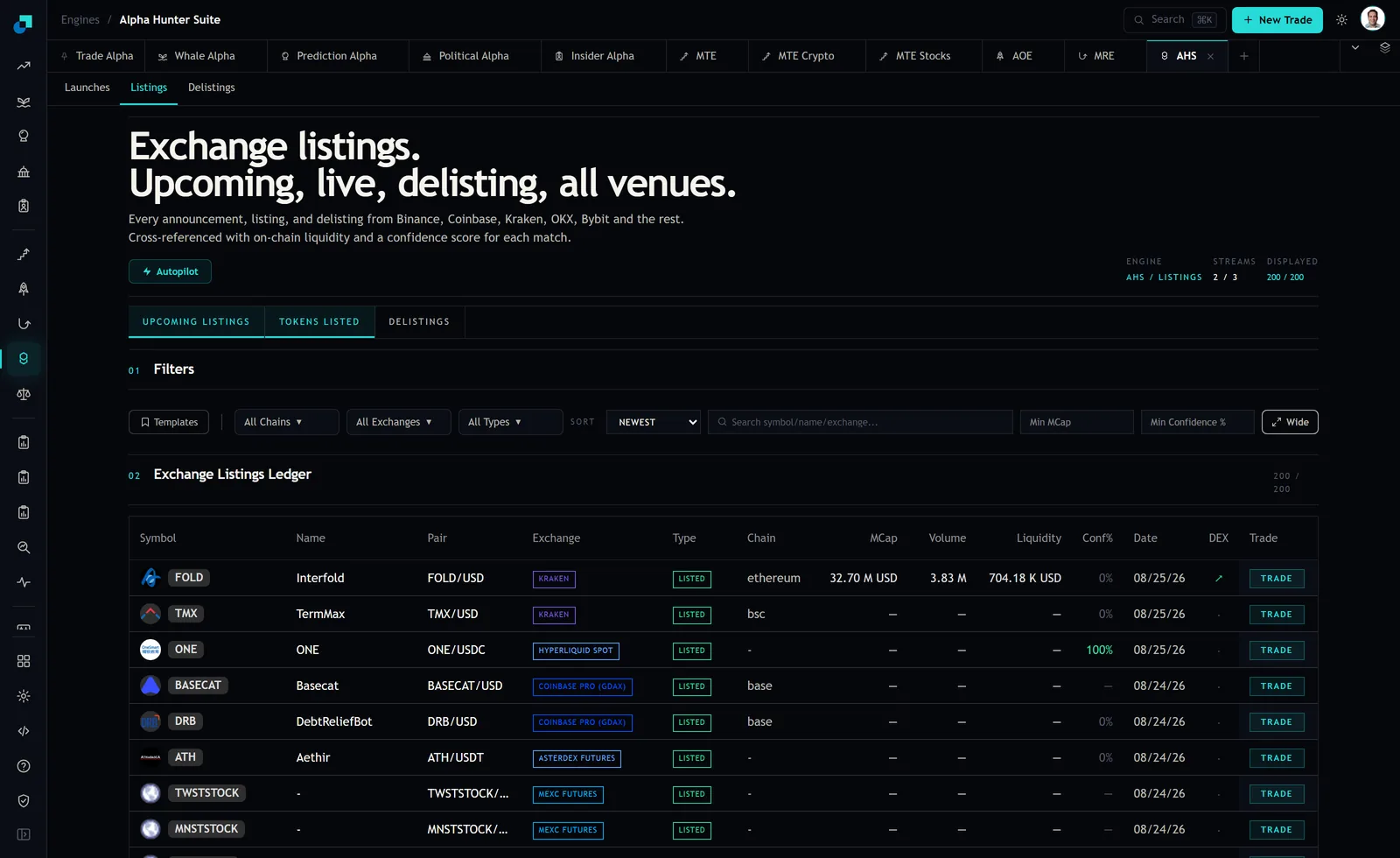
Sort the ledger by volume once and the shape of the problem is visible immediately. Capacity is not evenly distributed across listing events. It is concentrated in a small number of them, and the tail is not a smaller version of the head, it is a different asset class where institutional size cannot participate at all.
Turning depth into a position limit
Start with an explicit impact budget in basis points, because that is the input your investment committee can actually argue about. If the strategy's expected contribution per event is modest, then an impact budget of fifty basis points round trip is already spending a meaningful fraction of it, and anything above a hundred is not a trade, it is a donation.
For the on-chain leg, the arithmetic is deterministic. A standard two-sided pool holds roughly half its headline liquidity in the paired asset, and in a constant product pool the trade size that moves price about one percent is on the order of one percent of that paired side, which is roughly half a percent of the headline figure. Scale that to your budget. A fifty basis point impact budget corresponds to something near a quarter of a percent of headline pool liquidity.
Work an example with round numbers. A listing row showing three million dollars of pool liquidity, a fifty basis point one-way impact budget. Quarter of a percent of three million is seven and a half thousand dollars. That is the clip. Not the position, the clip, and if the position is a multiple of it then you are working an order over time in an asset whose entire thesis is a same-day catalyst.
Now put a number on the other side. A two hundred million dollar book that wants one percent of assets in a position is asking for two million dollars. Against seven and a half thousand, the strategy is short by a factor in the hundreds. Nothing about that gap closes with better execution. It closes only by trading on the venue book instead of the pool, by taking a far smaller position, or by not running the strategy.
The participation constraint is the second binding one. If your policy caps you at some single-digit percentage of daily volume, then a listing row's volume figure directly implies a maximum position, and on day one that figure is both unusually large and unusually unreliable, because a large share of it is other people doing exactly what you are doing.
Why the exit is the binding side
Entry capacity flatters you. Listing events come with a burst of volume and depth that is at its maximum precisely when you want to buy, so an entry-only capacity calculation will tell you the trade is fine.
The exit happens later, into a book that has normalised. Whatever multiple of ordinary depth existed on day one is gone, and the position you built at day-one depth has to leave at day-thirty depth. So the honest capacity calculation uses the depth you expect at exit, not the depth you observe at entry, and if you have no basis for estimating that, then use the pool liquidity figure alone and ignore the venue book entirely, because the pool is the part that persists.
This is also where crowding enters. A capacity number computed as though you are the only participant is a fiction if the event is on a feed that a hundred other desks also read. The relevant quantity is your share of the depth net of everyone else working the same catalyst, and the practical adjustment is to treat the impact budget as materially tighter on high-profile venues than on obscure ones, which inverts the intuition that the big venues are where the capacity is.
From event capacity to strategy capacity
Per-event capacity is not the number you allocate against. The strategy number is events per period multiplied by average capacity per event, adjusted for how many of those events you can actually hold simultaneously.
Three things have to be measured rather than assumed. How many events per quarter clear both your venue eligibility policy and your resolution standard, which is a much smaller number than the raw feed count. What the median rather than mean capacity of those events is, since the mean is dragged upward by a handful of very large listings you may not be able to access. And what your holding period is, because capacity is a flow constraint and a strategy that turns over weekly can recycle the same dollars through many more events than one that holds for a quarter.
Multiply it out honestly and you get a dollar figure for the strategy. If that figure is below one percent of the fund, the correct conclusion is not that the strategy is bad. It is that it is a satellite sleeve at best, and it should be presented that way internally so that nobody builds a capacity assumption into a growth plan that the market cannot honour.
What to write down before the first trade
Capacity work is only useful if it exists before the event, because during the event the pressure runs entirely in one direction. Three numbers belong in the strategy document, and all three are parameters rather than observations.
The impact budget in basis points, one way, stated as a hard cap rather than a target. The maximum share of a listing row's volume the desk may take on day one. And the floor on pool liquidity below which the event is not tradable at any size, which exists because at some point the position that fits within your impact budget is too small to be worth the operational and compliance load of putting it on.
That last one is the most useful and the least common. A desk without a size floor will keep trading events whose capacity has quietly fallen to nothing, generating a long tail of tiny positions that consume review time, occupy risk limits, and contribute nothing measurable to returns. The strategy is capacity-dead well before that point, and the size floor is the thing that tells you so on a schedule rather than in hindsight.