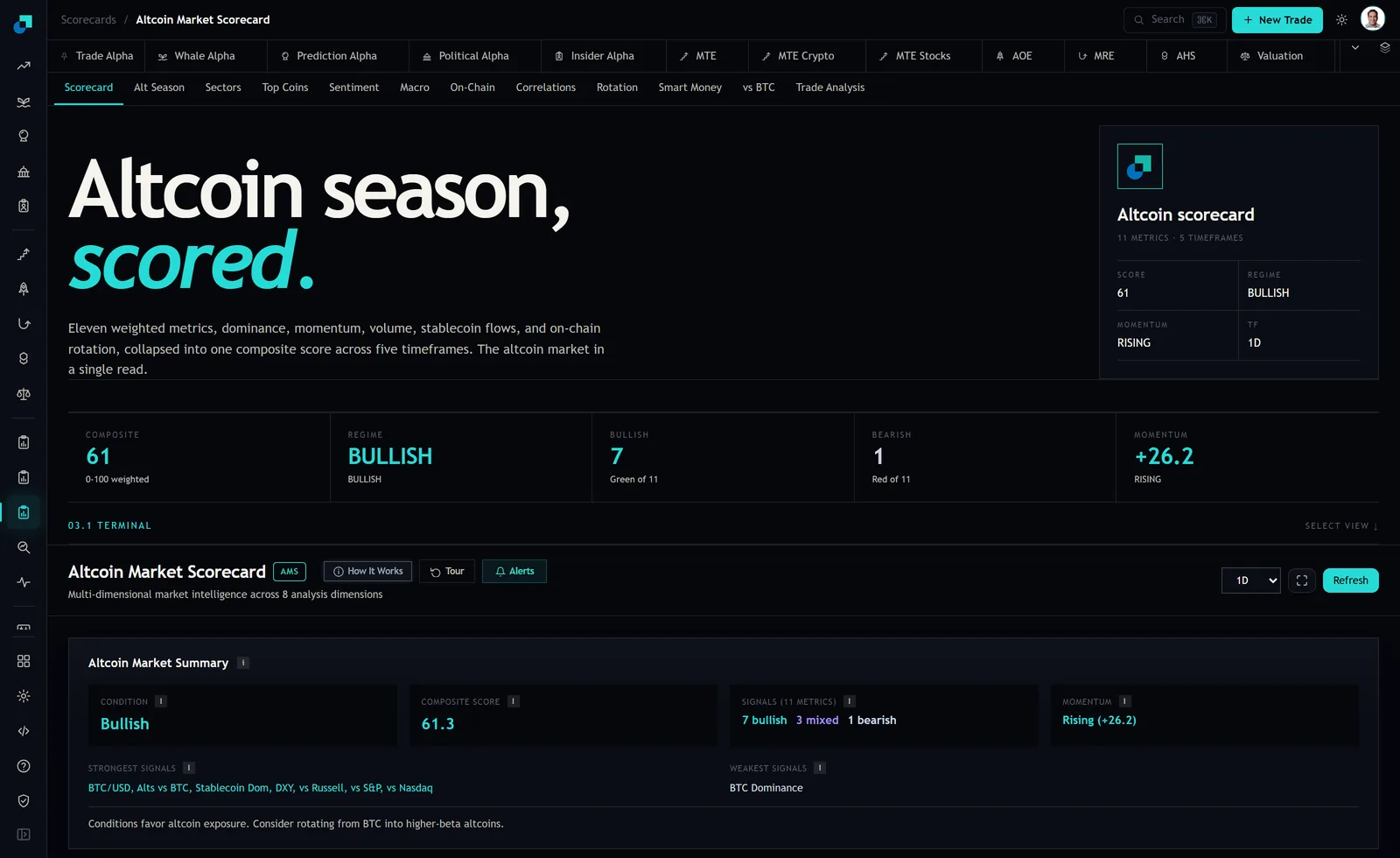
You open the scorecard, it reads 61 with a regime label of BULLISH and momentum RISING, and then you open your own account and you are down eleven percent on the month. The first instinct is to decide the score is broken. It is not broken. It is answering a question about a market, and your profit and loss is answering a question about five specific tokens you happen to own, and those two questions can have opposite answers for weeks at a time without either one being wrong.
What follows is the diagnosis I run when that gap opens up, in the order I run it. The order matters, because each step is cheaper to check than the one after it, and because the first two have fixes while the third mostly has lessons.
The score is measured on a market you may not actually own
The composite is a weighted 0-100 blend of eleven market metrics. The module lists them: BTC Dominance, USDT Dominance, Altcoin Volume Ratio, Funding Rates, Open Interest, Stablecoin Flows, Exchange Reserves, Large Transaction Volume, NVT Ratio, MVRV Z-Score, and Realized Cap Changes. Read that list and ask which of those eleven inputs knows anything about your positions. None of them. Every single one is an aggregate. Stablecoin flows are flows into the whole market. Exchange reserves are reserves across venues. Funding rates are the cost of leverage on the pairs with liquid perpetuals, which is a small and specific set of large tokens.
The Alt Season Index on the neighbouring tab is even more explicit about its universe. It measures the percentage of the top 50 altcoins outperforming Bitcoin. If your holdings are not in the top 50 by market capitalisation, they are not in that measurement at all. Not underweighted in it, not diluted by it, simply not in it. That single sentence explains a large share of the gap for most retail accounts, because most retail accounts are not full of top 50 names.
Check one, and it takes thirty seconds, is your cap tier
Write down each of your holdings and its rough market capitalisation. Then sort them into three tiers. Top 50. Roughly 50 to 300. Everything below that. Now compare that distribution to what the score is measuring.
If four of your five positions sit below the top 300, the honest reading of a bullish composite is that liquidity and positioning look constructive in the part of the market that is one or two rungs above yours. That is not nothing. Capital usually does arrive in tiers, with the largest names moving first and the smaller ones later or not at all, and a bullish composite that never reaches your tier is a completed observation about this cycle, not a delay you can wait out indefinitely.
The practical decision this produces is a sizing decision, not a timing one. If you want your account to track the readings you check, you have to hold some of what the readings measure. If you deliberately want to hold the tier below, which is a legitimate choice with a wider distribution of outcomes, then accept that the composite is context for you rather than a mirror, and stop expecting your account to confirm it.
Check two is sector, and this is where the gap usually lives
Open the Sectors tab. It breaks performance down by crypto sector, DeFi, layer one, layer two, gaming, AI and the rest. The single most common reason a bullish market reading sits next to a red account is that the reader owns one sector and the strength is in another.
Sector dispersion in crypto is routinely larger than the market move itself. It is entirely normal for a month in which the aggregate market is up a few percent to contain one sector up thirty and another down twenty. If your five tokens are effectively five bets on the same sector, and many portfolios that look diversified are exactly that once you look at what the tokens actually do, then your account is not tracking the market at all. It is tracking one line of the sector heatmap.
The check is quick. Label each holding with its sector. If three or more share a label, you do not have a five-position portfolio, you have a one-position portfolio in three wrappers, and your outcome is going to be decided by whether that sector gets a turn rather than by whether the composite is bullish.
Check three is entry, and this one is about you
The first two checks are about what you own. This one is about the price you paid, which is a fact about your history and not about the market at all. The scorecard is a statement about current conditions. It has no memory of your entry, and no reading of it can make an expensive entry cheap.
Do the arithmetic, because it is unforgiving and people avoid it. If you bought a token after it had already run 40 percent, and it has since given back 30 percent from your entry, you need it to rise about 43 percent from here just to get you back to flat. If it is down 50 percent from your entry, you need 100 percent. A bullish market regime that carries the token back to the level you bought at is a fully successful market call that leaves you with nothing. That is not a defect in the score. It is what buying into strength costs when the strength does not continue immediately.
There is a version of this that is worth being blunt about. If your entries cluster in the week after a big move, and they usually do for most people, the composite will spend a lot of its time confirming a market that is above your average cost and below your worst entry. The fix is not a better indicator. It is a smaller position on the first entry and a rule about how much of a move you are willing to buy into.
What to do when all three checks come back clean
Sometimes you run the sequence and everything holds up. You own top 50 names, they are spread across sectors, and your entries are not stupid. The composite says 61 and you are still red. At that point you have eliminated the diagnosable causes and you are left with two honest possibilities, and you should say which one you believe out loud.
The first is that you are early, in the specific sense that the conditions the composite measures, flows, positioning, exchange reserves and valuation ratios, have improved while price has not yet followed. That happens, and it is roughly what a conditions-based blend is for. If that is your view, the correct behaviour is to do nothing and let the position work, and to write down in advance how long you are giving it, because a thesis with no expiry is how a trade becomes an investment becomes a bag.
The second is that the specific tokens you chose are underperforming their own market for a reason that has nothing to do with regime. A team that has stopped shipping. A token unlock schedule that puts steady supply into every rally. A venue delisting. Check the relative strength of each holding against Bitcoin over the last quarter on the vs BTC view. If a name has lagged Bitcoin in a market where the composite has been constructive throughout, you are not waiting for a market that has already arrived. You are holding something the market has looked at and declined, and the size of that position is the only thing left in the decision that is still under your control.